

A filing linking a Canadian media outlet to a Chinese state broadcaster has vanished from Canada’s new foreign influence registry, with officials blaming an unresolved technical failure.
The filing showed The Canada Files received roughly $823 from Chinese state broadcaster CGTN Français, the French-language service of China Global Television Network.
According to an archived copy of the federal filing obtained by The Bureau, the arrangement ran from August 5 to August 13 and involved two sponsored productions intended “to have more Canadians be supportive of China’s management of its domestic political affairs.”
The filing was one of the first three disclosures published under Canada’s new Foreign Influence Transparency Registry.
But it disappeared from public view after the registry suffered a technical problem on September 15.
The Office of the Foreign Influence Commissioner blamed a data transfer problem for the missing information.
“Two of the three submissions that were initially published have been restored,” the office said. “Technical issues with [the] registry will need to be resolved before the third submission can be published.”
As of The Bureau’s report, only two of the original three entries had been restored, while The Canada Files disclosure remained unavailable.


The sponsored productions included a video titled “Shared Prosperity, Guaranteed Dignity: China’s Vision of Human Rights” and a documentary titled “Dad, Is This Train Going to Lhasa?”
According to The Bureau, the material promoted China’s approach to human rights and presented Chinese development in Tibet favourably.
The Canada Files argued human rights don’t require Western-style elections and touted economic benefits from China’s railway investment in Tibet.
CGTN Français is the French-language service of China Global Television Network.
Ofcom found CGTN ultimately controlled by the Chinese Communist Party and revoked its British broadcast licence.
Eighteen days later, The Canada Files criticized Tibetan exile groups’ influence on Canadian MPs, describing their U.S.-funded backer as a “CIA front.”

The failure follows a troubled rollout.
In May, Public Safety Minister Gary Anandasangaree said it should be operational “within weeks.” The following month, a senior Public Safety official told MPs the registry was in its “very, very last miles.”
Public Safety initially promised the registry by spring 2025, but it did not launch until August 4, 2026.
No registrations were initially public despite submissions being received.
Commissioner Anton Boegman has also cautioned that the registry “is not going to solve foreign interference in Canada,” saying it is designed for transparency rather than uncovering covert interference. National security agencies handle matters outside its mandate.

The registry has since encountered further problems.
The Bureau previously reported that the commissioner’s office suffered a privacy breach involving China expert Charles Burton after a response concerning his submission was mistakenly emailed to another person.
Public Safety confirmed the breach exposed Burton’s name, submission number and rejected registration status.

Burton and lawyer Sarah Teich had also asked the commissioner’s office to establish encrypted communications for civil society participants who could face foreign surveillance or intimidation.
Another registry applicant, whose identity The Bureau withheld, described the electronic system as nearly unworkable and complained of serious IT problems, inadequate instructions and poorly designed forms.

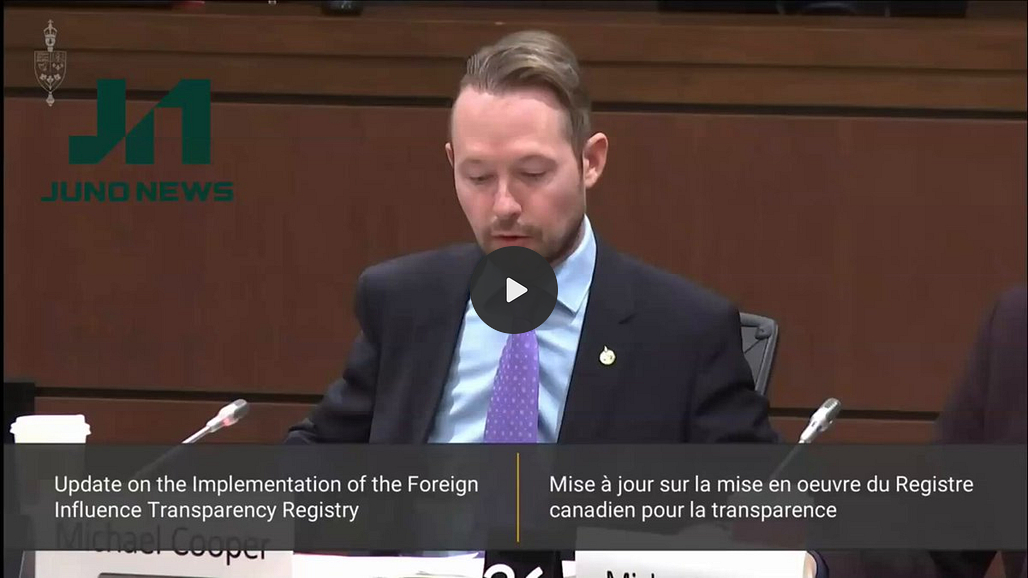
The registry operates under the Foreign Influence Transparency and Accountability Act, legislation enacted as part of Bill C-70 in 2024 and brought into force on August 4, 2026.
Registration itself does not establish wrongdoing or foreign interference. The registry is designed to make covered arrangements with foreign principals transparent.
At its launch, Anandasangaree called the registry a “significant milestone” and said greater transparency would help Canadians understand when foreign entities seek to influence the country.
Boegman similarly said the public registry would give Canadians greater insight into how foreign influence is exercised, on whose behalf and how it could shape public decision-making.
Just found Brian Lilley's little show/podcast. About twenty minutes, but very knowledgeable:
Mark Carney can’t be honest and upfront with Canadians...
https://www.youtube.com/watch?v=92YUUQF4ODg