

China is deepening its ties with Canadian First Nations as Indigenous control over land and resources becomes increasingly consequential — despite longstanding warnings about Beijing’s efforts to influence Indigenous communities.
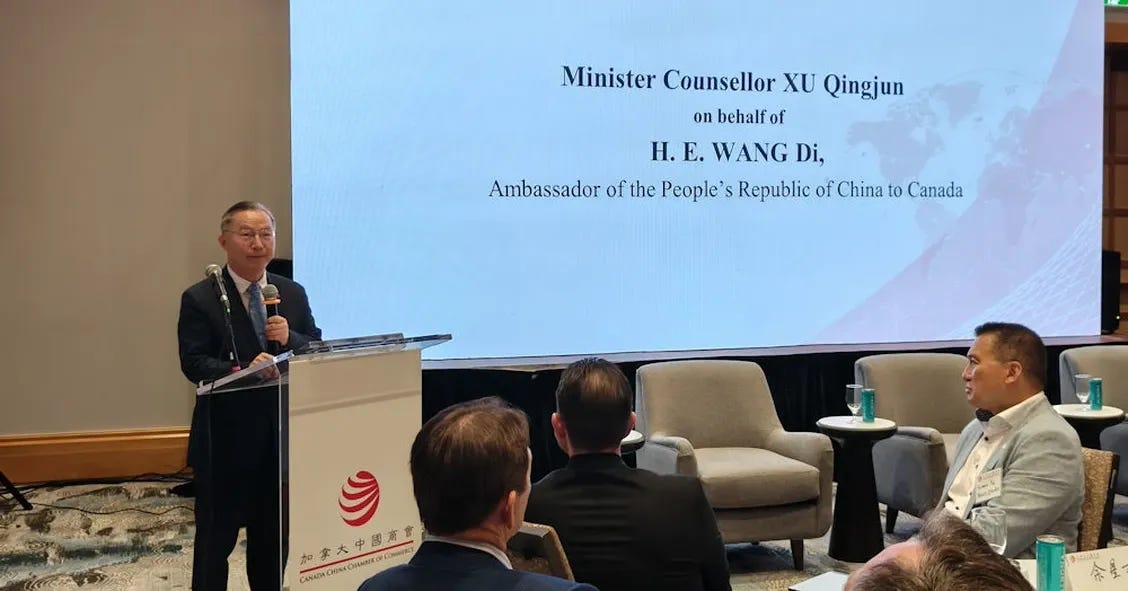
Chinese Ambassador Wang Di hosted an economic roundtable in Vancouver on September 3 with nearly 60 representatives from Chinese and Canadian companies and institutions, as first reported by Business in Vancouver.
The meeting focused on China-Canada trade, the green transition, Indigenous finance and community development, according to the Chinese embassy.
Among those attending were First Nations Finance Authority president and CEO Ernie Daniels, former Liberal finance minister Bill Morneau and Sen. Yuen Pau Woo.
Wang specifically called for Chinese and Canadian businesses, financial institutions and First Nations communities to strengthen their ties.
He said the cooperation could “lay an even more solid foundation for the China-Canada new strategic partnership”.
The outreach comes as Indigenous land rights and control over resources have become increasingly consequential in British Columbia — and as Ottawa looks to advance major projects requiring Indigenous consultation, participation or partnerships.


The Vancouver meeting was not the first effort to build economic ties between China and First Nations.
The Canada China Business Council has organized three Indigenous business missions to China, including one in 2024.
A 2022 Canada China Business Council report highlighted the opportunities created by “increased Indigenous control over lands and resources.”
“The potential for economic activity between China and Canadian Indigenous businesses and communities is immense,” the report said.
Those opportunities are growing as First Nations acquire greater economic stakes in major Canadian resource and infrastructure projects.


Prime Minister Mark Carney is currently courting investment for Ottawa-backed “nation-building projects,” many of which involve Indigenous participation or support.

Among them is the proposed US $28.5-billion Ksi Lisims LNG project developed in partnership with the Nisga’a Nation.
The First Nations Finance Authority itself has also grown rapidly.
As of March, the organization reported $4.4 billion in loans, compared with $790 million in 2020. Eligible projects include infrastructure, economic development, land purchases, power projects and housing.


Canada’s national security establishment has previously warned that Indigenous governments and officials can be targets of Chinese foreign interference.
A 2019 report by the National Security and Intelligence Committee of Parliamentarians, exclusively obtained by The Bureau, identified Indigenous officials, alongside federal, provincial and municipal officials, as potential targets of Chinese influence operations.
Chinese officials reportedly researched delegates on a 2011 Indigenous trade mission for their “potential usefulness,” while a PRC diplomat described the trip as a “beipian” — a ploy to conceal Beijing’s desire to control Indigenous-owned natural resources.

More recently, CSIS accused Beijing of attempting to exploit tensions between Indigenous communities and the Canadian government.
“The PRC tries to undermine trust between Indigenous communities and Canada’s government by advancing a narrative that the PRC understands and empathises with the struggles of Indigenous communities stemming from colonialism and racism,” a CSIS spokesperson told the Financial Times in 2024.
Separate reporting citing CSIS has characterized Indigenous governments as “soft targets” for foreign interference.
Reporting on the 2019 NSICOP material also showed that Beijing sought to exploit jurisdictional tensions between First Nations and Ottawa, while tactics used against federal officials were replicated with “provincial, municipal, and indigenous officials”.
There is no evidence presented that the September 3 Vancouver roundtable itself constituted a foreign interference operation.


The Chinese outreach comes amid a heated debate over Indigenous title and land transfers in British Columbia.
Historical treaties cover roughly five per cent of the province, while modern treaties cover an additional portion. Large areas remain subject to overlapping assertions of Aboriginal rights and title, negotiations and litigation.
According to an internal B.C. Ministry of Finance document previously reported by the National Post, more than 120,000 hectares of Crown land are in the queue for transfer to First Nations as treaty lands.
Court rulings have further reshaped the legal landscape.
In 2025, a Cowichan Tribes case resulted in an Aboriginal title declaration that overlapped with fee-simple lands in Richmond held by governments, the Vancouver Fraser Port Authority and private landowners. The decision is under appeal.
Against that backdrop, Beijing is openly calling for closer relationships with First Nations communities.
Wang said he hopes Chinese businesses, Canadian financial institutions and First Nations will strengthen their collaboration to help build the “China-Canada new strategic partnership.”
The economic opportunity may be significant.
But Canadian intelligence officials have also warned that Beijing has sought to cultivate influence among Indigenous communities and exploit tensions between First Nations and Canadian governments.