

OP-ED: Surprise! Ottawa lobbyists support more federal government
Caitlyn Madlener writes, "We should not allow the fear-stricken political has-beens of a bygone era to bludgeon Alberta into submission."
Caitlyn Madlener is a former political consultant and activist who has worked both inside and outside formal political organizations. She is now a full-time stay-at-home mother raising her three toddlers.
The referendum on Alberta independence has been set, and the usual players have emerged to throw their hats into the ring. On the federalist side, notable opportunists include Monte Solberg (CEO, New West Public Affairs), Stephen Carter (President, Decide Campaigns), Ken Boessenkool (Partner, Meredith, Boessenkool and Philips), Dimitris Soudas (Strategic Advisor, TACT Conseil), and others of similar pedigree.
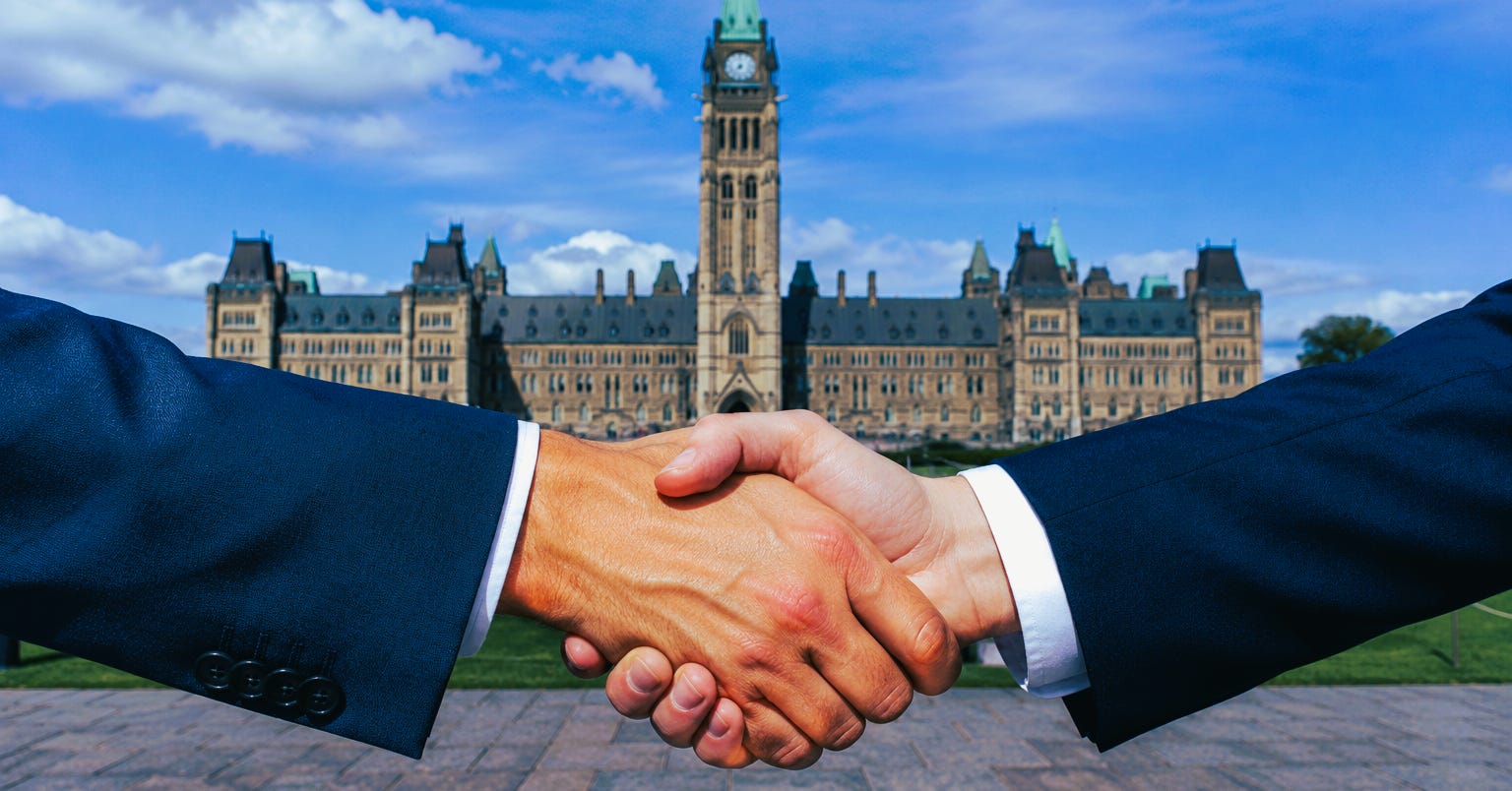
A pattern quickly emerges: former politicians and political staffers who now earn their living greasing the cogs of government on behalf of special interests are all jockeying for a slice of the “Stay Vote” pie. (One cannot help but wonder where the money to fund these campaigns is coming from, and which special interests are so eager to preserve Ottawa’s imperial reach.)

One would hope that, with all the experience and insider knowledge these individuals possess, they might offer a coherent strategy for communicating the federalist case. Yet their collective political brilliance appears capable of producing little more than a barrage of defensive and illogical whataboutisms.
What about your Canadian passports?
What about federal parks and military bases?
What about oil and gas reserves?


And on and on it goes.
One of these esteemed political “strategists”, Dimitris Soudas (currently living in Montreal), even produced a fever-dream list of catastrophes so detached from reality that it reads less like political analysis and more like a late-night panic attack.

It is a disservice to the people of Alberta that the argument being presented to them is not a persuasive case grounded in logic, principle, or evidence, but rather a guided tour through a fictional dystopia that exists solely inside the minds of Ottawa’s most devoted admirers.
To understand how such arguments came to dominate the federalist side, one must first understand the people making them.
Unsurprisingly, many of these federalists were once part of the Ottawa establishment. Whether as Members of Parliament, political staffers, or government insiders, they spent years immersed in the culture and worldview of Parliament Hill. Given that background, one might reasonably expect them to hold a positive view of Ottawa’s intentions. Instead, they seem haunted by visions of what the federal government might do to a province bold enough to pursue independence.
Imagine being consumed by fears that Ottawa might seize Alberta’s oil, confiscate its parks, or otherwise punish the province for asserting itself, and still concluding that Alberta is better off remaining under Ottawa’s supposedly benevolent stewardship.
Perhaps, however, it is not fear of Ottawa’s malice that drives these predictions of doom. Maybe it is something simpler: an inability to confront difficult situations and a reluctance to take meaningful risks.
After all, many of these same individuals worked in Ottawa during a decade of Conservative government and have remarkably few accomplishments to show for it. Perhaps it is that experience in Ottawa that has also made them reliant upon the federal government to make their living. After all, without the federal government, who will Ottawa lobbyists wine and dine?
It should, therefore, come as no surprise that Alberta’s grievances remain largely unresolved when the very people tasked with fighting for the province are so adept at finding reasons not to fight at all.
Federalists seem like the sort of people who would see a weed in their grass and decide to start cultivating dandelions.
Perhaps it is this deeply ingrained fear of hardship that prevents many federalists from understanding the resilience and pioneer-spirit of Albertans.
The culture of Albertans derives from the hardy settlers who were promised fertile land and prosperity, but instead, encountered drought, hardship, and unforgiving soil. Yet these rugged individuals persevered. For decades, pioneers poured blood, sweat, and toil into the land in pursuit of a better future. Through determination, innovation, and sheer stubbornness, they helped build one of the world’s great agricultural regions, producing tens of millions of tonnes of food each year and cultivating nearly a third of Canada’s farmland.
That same determination is woven throughout Alberta’s oil and gas industry. Similar to the hard-fought agricultural revolution, the province’s energy wealth did not arrive as an effortless gift from beneath the prairie soil. Early discoveries brought as much frustration as optimism, presenting technical challenges that many believed were insurmountable. The famous Leduc No.1 was not as simple as sticking a pipe in the ground and hoping oil poured out; it took innovation in technology, pioneering geophysicists and geologists, as well as risk-taking entrepreneurs and engineers, to turn a challenging industry into Canada’s most prosperous asset.
These challenges were not just confined to geology and engineering. For decades, Alberta’s energy sector also faced political obstacles imposed by Ottawa. Time and time again, Albertans have encountered federal policies, interventions, and restrictions that treated the province’s economic engine as something to be managed or controlled rather than encouraged. Yet despite these barriers, Alberta continued to grow, innovate, and produce for the benefit of all Canadians.
Alberta’s history is not one of retreat in the face of adversity. It is a history of confronting difficult circumstances and using our ingenuity to overcome them.
The people who built Alberta did not shrink from drought, hardship, or uncertainty, and neither should we. We should not allow the fear-stricken political has-beens of a bygone era to bludgeon Albertans into submission with their hysterical visions of Ottawa retaliation. Albertans deserve better. They deserve a debate rooted in present realities, not imagined catastrophes; a discussion about what Ottawa can offer Alberta today and a vision for the future built on hope rather than fear.
 | A guest post by
|
The parasite class knows how to feed itself.