
OP-ED: Is the separatist movement Canada's missing populist party?
Caitlyn Madlener writes, "Both Carney and Poilievre suffer from the same fundamental problem: a widening gap between rhetoric and credibility."
By: Caitlyn Madlener
Caitlyn Madlener is a former political consultant and activist who has worked both inside and outside formal political organizations. She is now a full-time stay-at-home mother raising her three toddlers.
As voters across the Western world grow increasingly disillusioned with the stale left-right binary, third-party movements are finding fertile ground. In the United Kingdom, that alternative has emerged as Reform UK. In Canada, the question is becoming harder to ignore: is our own insurgent movement not a political party at all, but the cause of Alberta separation?
“The traditional two-party system that has long defined British politics is now over.”
Nigel Farage delivered that line in April at a packed rally for his relatively young party. It was a bold statement, but one increasingly supported by reality. Reform UK has gone from political afterthought to the current government-in-waiting, with a commendable lead in the polls and a landslide win in the recent municipal elections. They have performed a remarkable ascent for a party that, until recently, was treated as little more than a protest vehicle.
So what explains its meteoric rise?
According to Reform’s leadership, the answer is simple: they have stepped outside the suffocating confines of conventional left-right politics and addressed the concerns ordinary people actually have.
Chief among those concerns is immigration. Reform’s supporters cite it as a defining issue, and polling suggests they are hardly alone. Large portions of the British public express deep concern about immigration levels and little confidence that either Labour or the Conservatives are willing to exert political capital to effectively act on the issue. While the Labour Party has acknowledged the immigration question, its inability to effectively act on addressing the issue reinforces its dwindling support across the country. Economic anxiety and the cost of living are closely tied to these concerns. While the political class performs semantic gymnastics to avoid drawing any connection between immigration, housing costs, and strained public services, ordinary citizens are less interested in euphemisms. They notice home prices rising beyond reach and hospital wait times stretching into absurdity. When mainstream parties refuse to acknowledge what voters plainly see, they should not be surprised when voters look elsewhere, and when the leaders suffer from a lack of confidence in following through on their promises, people will move towards leaders they deem more reliable.
Ironically, Farage has said that Reform UK was inspired in part by Canada’s own Reform Party, a party that once offered a genuine, ideologically unconstrained alternative to the establishment.
That was true then.
We do not have that populist alternative now.
Canada today suffers from the same timid and exhausted political landscape as Britain. Each election cycle, the Liberals and Conservatives seem locked in a contest to see who can poach the other’s voters while offending as few people as possible. It is politics as risk management, an uninspiring race to the bottom conducted by consultants breathing one another’s hot air inside the Ottawa bubble.
Meanwhile, Canadians are left asking why their most pressing concerns are treated like embarrassing relatives to be hidden when company arrives.
Like their British counterparts, Canadians consistently rank the economy and the cost of living among their top priorities. Yet no major party inspires much confidence that it can meaningfully improve either. Views on immigration, once broadly positive, have deteriorated sharply, but this too is addressed with the ignorance of someone closing their eyes to pretend the sun doesn’t exist (you’ll get a sunburn either way).
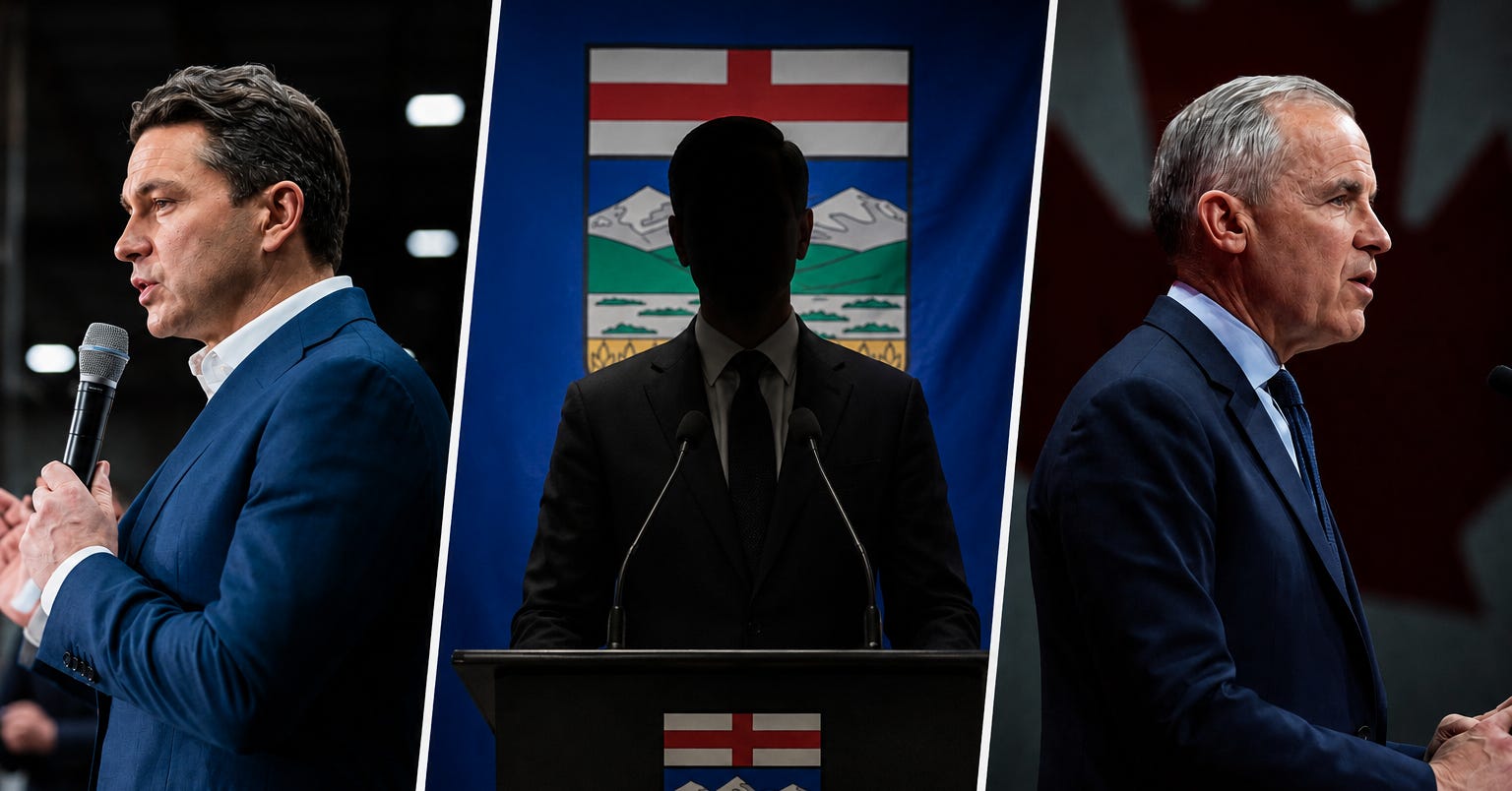
Both Carney and Poilievre suffer from the same fundamental problem: a widening gap between rhetoric and credibility. Occasionally, they gesture toward reducing TFW numbers or addressing affordability, but voters have become increasingly skeptical that either man possesses the willingness to follow through once they have the power.
Mark Carney has acknowledged the problems associated with the ballooning Temporary Foreign Worker program, yet his record suggests the political equivalent of applying a bandage to a severed artery. The same pattern is visible in his promises surrounding major national projects: grand announcements, ambitious timelines, and very little evidence that anything tangible will ever materialize beyond another press conference backdrop.
Even Pierre Poilievre, often marketed as a political disruptor, recently released a lengthy video on the Magna Carta. One can appreciate the historical significance, but when families are struggling to pay their mortgage, a history lecture on medieval England feels out of touch. If I wanted to listen to a cork-sniffing Professor pretend to relate to the middle class, I would throw on an old Michael Ignatieff speech.
So where does that leave Canadians looking for a genuine alternative?
As is so often the case in this country, one must look to the West.
Since a large concentration of political and economic power lies with Ontario, major political movements are rarely born there. The West, by contrast, has long served as the incubator of political disruption. Both the Reform Party and the NDP emerged from western discontent before reshaping the national conversation.
The federal Conservatives under Stephen Harper were once the political expression of western frustration. But that purpose has faded, sanded down by years of electoral defeats and the irresistible urge to appear “reasonable” to Ottawa commentators.
Nature, however, abhors a vacuum.
Into that vacuum has stepped the Alberta separation movement, a diffuse, leaderless, but increasingly significant expression of political dissatisfaction.
For a movement lacking a nationally recognized figurehead, its momentum is striking. More than 300,000 Albertans signed a petition supporting a referendum on separation in a relatively short period. That is not a fringe outburst; it is a political statement. Indeed, it almost certainly represents more people than hold a federal membership in any party in the province.
Predictably, the response from establishment voices has ranged from dismissive to openly contemptuous.
That reaction is as revealing as it is counterproductive.
Albertans have every right to be frustrated with a federal system they believe no longer reflects their interests. To mock or belittle those concerns is not to defeat them; it is to validate them. Nothing fuels alienation quite like being told by comfortable political insiders that your grievances are imaginary.
Western separatism is not new. The Western Canada Concept won a provincial by-election in Alberta in 1982. What is new, however, is separatism functioning less as a constitutional argument and more as a vessel for broader public frustration. It has become a way for politically alienated Canadians to signal that the existing system is no longer responding to mainstream concerns. Little wonder, then, that the moment it became public that more than 300,000 Albertans had signed the petition, establishment figures suddenly developed a deep moral concern about allowing people to vote on the matter.
Former Alberta deputy premier Thomas Lukaszuk’s own proposed anti-separation referendum question — “Do you agree that Alberta should remain in Canada?” — was quietly reconsidered after fears it might, somewhat predictably, become a referendum on separation itself. Even the supposed reasonable arbiters of justice are ‘blind’ to the notion that negating Albertans’ ability to utilize their democratic right to even ask the question fuels their concerns over the political class.
Incidentally, one should be concerned about the state of political strategists when the anti-separatist movement is so short-sighted they can barely see the view through a window.
The reality is that a significant number of Canadians feel politically homeless. Their concerns are obvious, their frustrations are genuine, and the existing parties seem either unwilling or unable to respond with candour.
When no meaningful federal alternative exists, voters will inevitably seek other avenues.
In Canada, that avenue may not be a new party at all.
It may be separation.


