

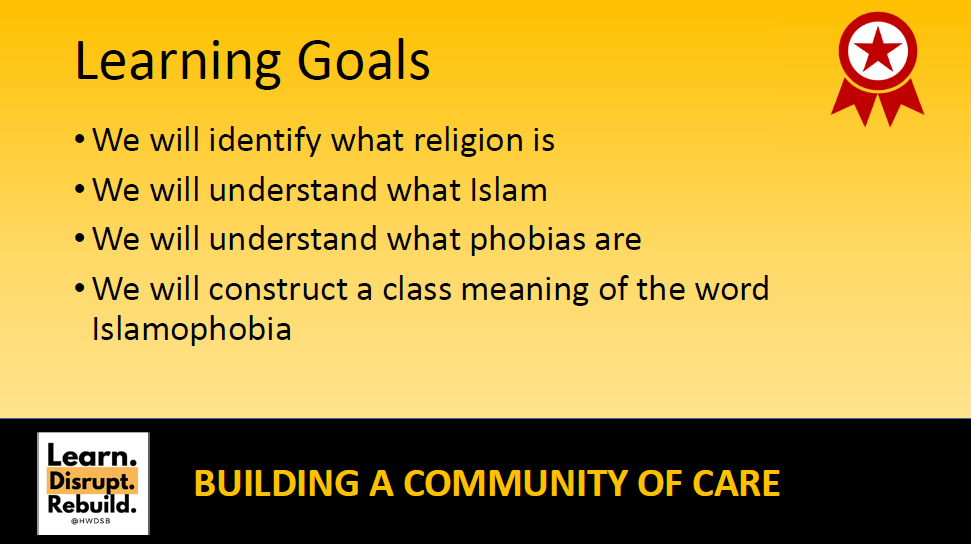
Freedom of information documents reveal a stark double standard inside the Hamilton-Wentworth District School Board, where Islamophobia is woven deeply into the curriculum across math, art, literacy and social studies, at the expense of antisemitism education.
Despite Jews facing the overwhelming majority of hate crimes in the region, the subject of antisemitism barely earns a handful of standalone handouts.
In total, the documents contained 19 branded “Learn.Disrupt.Rebuild.” modules across the primary and junior levels and numerous additional worksheets and exercises, including a 92-page guide about Islamic innovations.
The antisemitism package contained five external documents produced by the Friends of Simon Wiesenthal Center and Liberation 75, with no additional worksheets or exercises. The documents are designed as standalone resources to discuss harmful stereotypes, how those stereotypes harm Jewish people, and why antisemitism persists today.
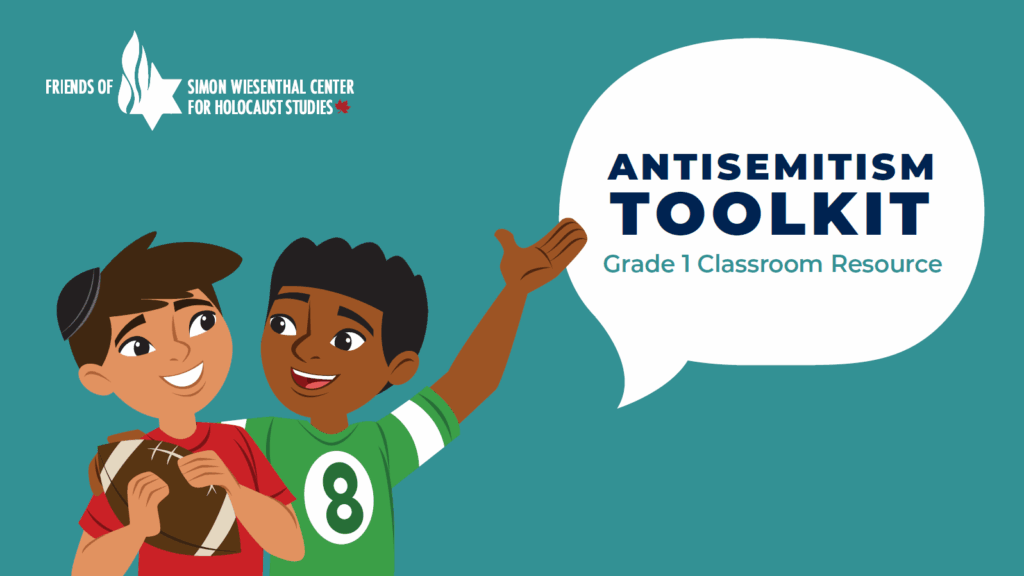
Antisemitism is described as hatred against Jews connected to conspiracy theories and Holocaust denial, while helping students understand the Jewish religion, holidays, and cultural symbols.
Nothing in these modules suggests antisemitism education has been embedded in other parts of classroom life. The documents are designed as reference materials for lessons about empathy, history, and responsible citizenship. Contemporary anti-Zionism—now a major source of antisemitic hostility—does not appear anywhere in the material provided by the board.
The Islamophobia modules look quite different. Most of the documents are lesson plans pre-prepared for teachers to follow. They form part of the same internal “Learn.Disrupt.Rebuild” branded series and each module is rooted in intersectional anti-oppression ideology.
The Islamophobia modules are easily an order of magnitude more numerous and vastly more extensive. Instead of a handful of third-party toolkits, the Islamophobia modules form an extensive series of lessons and exercises with companion slide decks and detailed teacher guidance.
The modules explain Islamic religious practices, celebrations, and values associated with the religion. They encourage cross-curricular work in art, math, literacy, and social studies. Students build tessellations, design exhibitions, write reflective poetry, and complete empathy and activism assignments.
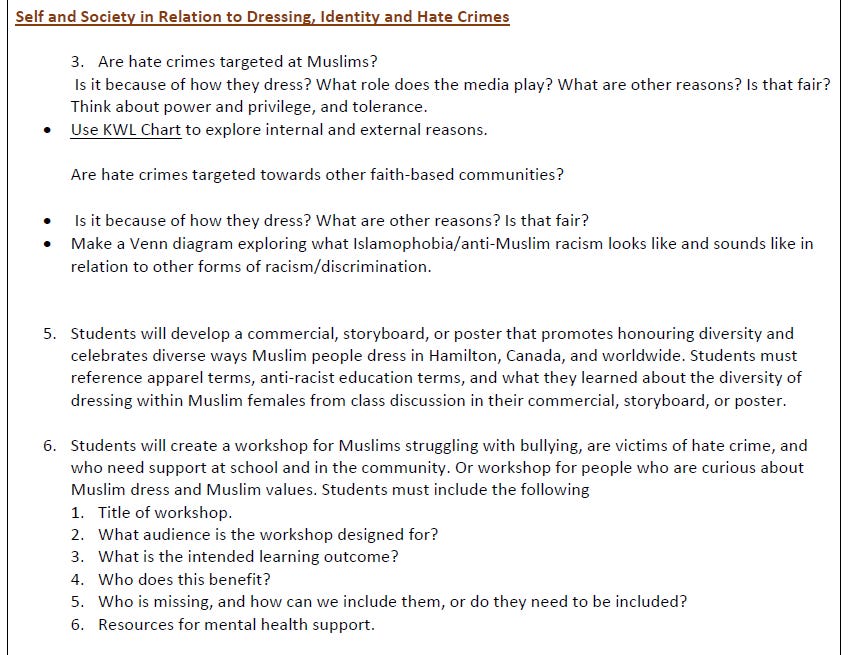
Islamophobia is described as a form of “systemic racism” that intersects with anti-Indigenous and anti-black racism shaped by Canada’s national security and policing history. Muslims are described as a racialized group who experience discrimination and surveillance by national security agencies.
There’s no question that the Islamophobia lens is primarily political, adapting religion as a protected form of identity that fits into the intersectional social justice worldview.
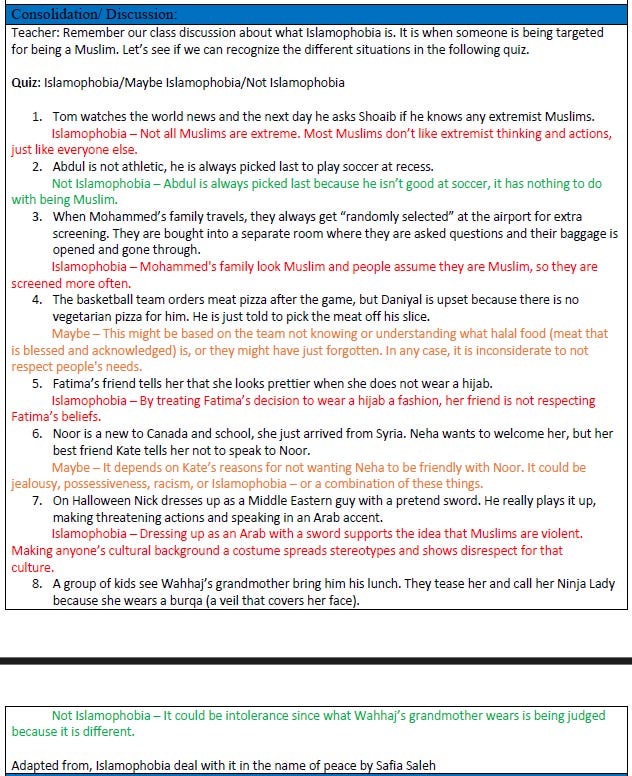
While largely framed as “anti-racism,” the Islamophobia modules do more than describe religious prejudice. They instruct students to practise “allyship,” “interrupt” racism, take special care of Muslim classmates and create projects to celebrate Islam and Islamic culture. Students are encouraged to recognize their own “privilege,” challenge stereotypes, and develop long-term commitments to “solidarity.”
It’s worth noting that True North has obtained hundreds of “Lean. Disrupt. Rebuild.” modules and Islam appears to be the only featured religion.
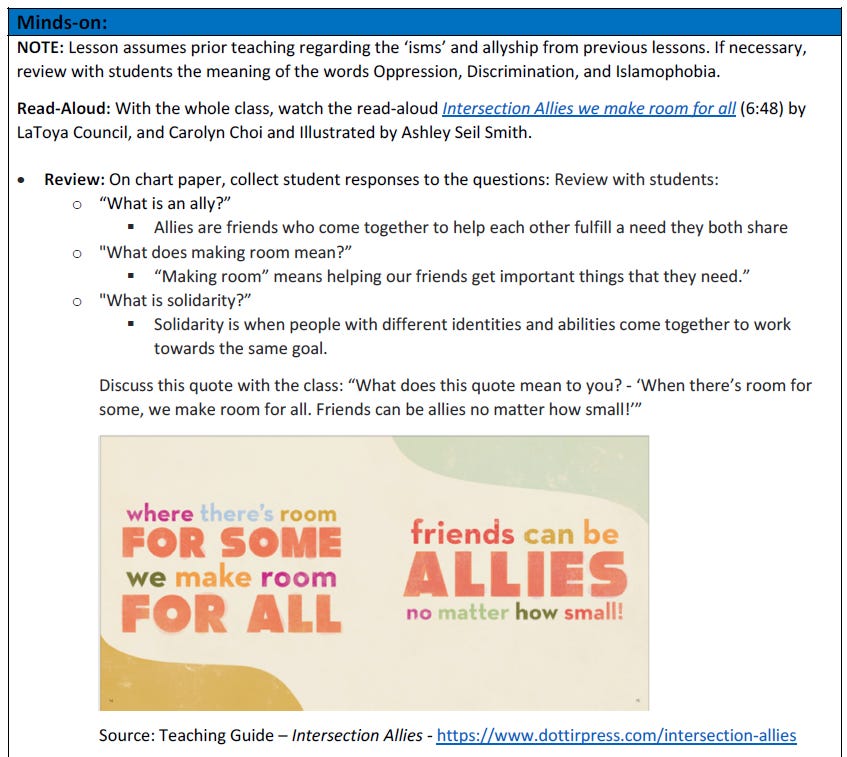
When analysing the difference in scope and impact of the antisemitism and Islamophobia documents, there’s an obvious gap between them that isn’t representative of civic and school life. Antisemitism is presented as a serious historical and contemporary problem—which it clearly is—but the lessons are few and limited in scope. What it doesn’t do is address the contemporary flavour of antisemitism, especially since the October 7 Hamas attacks in Israel.
The Islamophobia program is vastly broader, more widely embedded, and more instructive. It extends into multiple subjects and shapes how students are expected to interpret culture, identity, privilege, and power in a way that gives the impression that Muslim students are especially prone to hateful incidents.
Police data show that the Jewish community has been the primary target of religious hate for years. In 2023, Hamilton Police recorded 44 hate and bias occurrences against Jews compared to 15 against Muslims.
According to Canadian Jewish Advocacy, Hamilton recorded 53 antisemitic hate incidents, accounting for 80 per cent of all religiously motivated incidents in Hamilton, even though Jews make up about 0.5 per cent of the local population.
A recent federal report on Ontario schools found 781 antisemitic incidents reported by Jewish parents between October 2023 and January 2025, with nearly half of all incidents occurring in the first three months after October 7.
The decision to build an extensive, cross-curricular Islamophobia framework embedded throughout the curriculum while keeping antisemitism instruction narrow raises questions about how the board is reading its own community.
True North has reached out to the board for comment, but they did not respond in time for publication.
Unfortunately these school boards know absolutely nothing about the religion known as Islam. I lived for 18 years in the strictest Islamic country in the world. I understand the Arabic language and every Friday the hate for the western society spewed from speakers of the mosque was constant. We are seen as infidels and the religion teaches that all must be converted to Islam or be taxed extra and in some cases be killed.
These school boards must be reined in and teach only that which is necessary for our children to be prepared for their entry into society. They do not need to be socialized to one group or another especially based on religion.
My this seems very drastic.
Get back to the basics.