
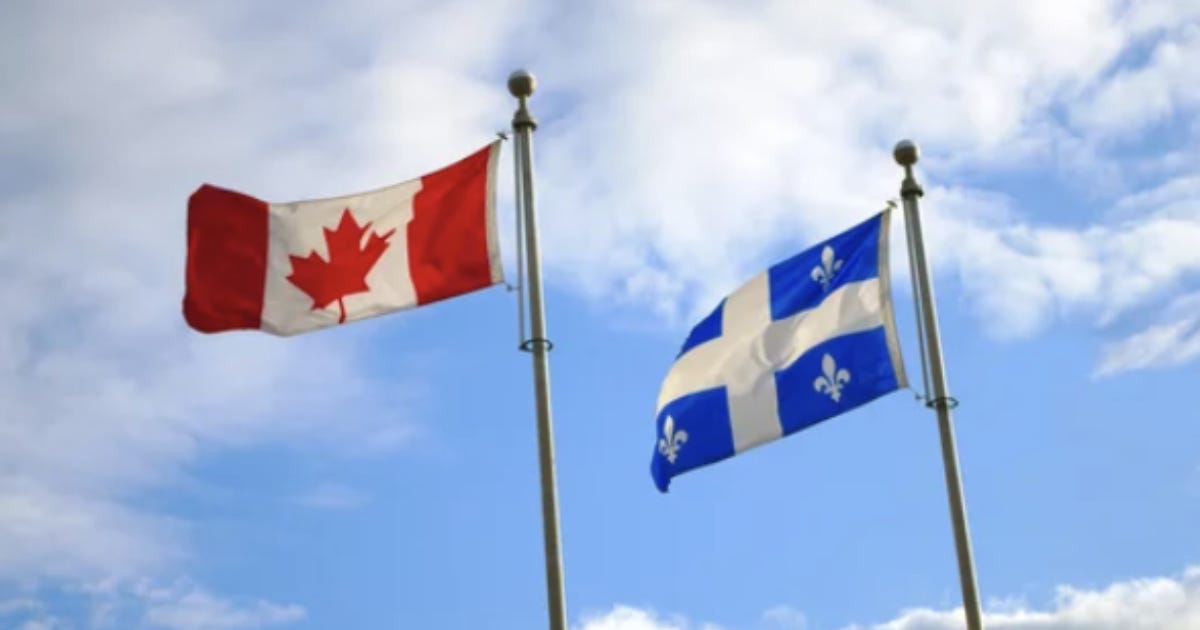
Quebec poised to receive nearly half of all 2026-27 equalization payments
Taxpayers will be shocked to learn that nearly $30 billion is set to be paid out in federal equalization transfers for 2026-27, with Quebec poised to grab almost half of the massive payment.
Quebec is expected to receive $13.9 billion of the total $27.2 billion in Equalization payments over the next fiscal year, with Manitoba also poised to get $5 billion.
Quebec Premier François Legault cited the importance of these transfers during a Tuesday interview with Radio-Canada, stating that the idea of his province separating right now would be “too risky” economically, given how much money it would soon be receiving.
“When I did the finances for a sovereign Quebec, Quebec was receiving $4 billion a year in equalization payments. Equalization is the money that we receive from the rich provinces to Quebec, which is less rich,” said Legault in French on Tuesday. “Currently, we receive $13 billion a year in equalization payments. The other thing, and this has been said, even by Ms. Marois, is that there would be a period of economic hardship for Quebec.”
The Quebec premier went on to say that the money received from these transfers was enough to change his stance on pushing the province toward separation.
Nova Scotia is expected to get $3.5 billion and New Brunswick $3.4 billion.
Prince Edward Island will receive $723 million, Newfoundland and Labrador $182 million and Ontario $406 million.
However, Alberta, Saskatchewan and British Columbia will receive nothing, as they will be providing much of the money distributed to the other provinces.
In May, Alberta Premier Danielle Smith called for Alberta to stop subsidizing provinces with major productive economies like Ontario, Quebec and British Columbia.
While Smith said her government had “no issue with Alberta continuing to subsidize smaller provinces with their needs,” she argued that there was “no excuse” for provinces like Ontario, Quebec and B.C. to be “subsidizing one another.”
“That was never the intent of equalization, and it needs to end,” Smith said at the time.
Her stance garnered the support of Newfoundland and Labrador’s Liberal government, which also called for a reset on how the federal government distributes equalization payments.
“Equalization is intended to ensure … fairness for all citizens. Currently, this fairness is not achieved for Newfoundland and Labrador,” said Greg Gill, spokesperson for Newfoundland’s Liberal government.
Newfoundland’s government said the equalization program hurts residents by negating the high cost of delivering services to the remote areas of the sparsely populated province.
“(We) service… more than 500 communities across a large, geographically dispersed, and aging population connected by almost 10,000 kilometres of roads,” Gill continued.
Additionally, he argued that the program currently penalizes the province for developing offshore oil and its other natural resources.
Last year, Newfoundland filed a court challenge against the federal program on the basis that it doesn’t fulfill its constitutional purpose.
The lawsuit seeks relief over several issues: the exclusion of service delivery costs in payment calculations, the fiscal capacity cap, the inequitable distribution of excess equalization program funding and the gross domestic product growth ceiling.
“From our perspective, the Government of Canada’s equalization program is insufficient in that it does not consider the cost of delivering services in a province such as ours with a geographically dispersed population; nor does it consider the inequity caused by including 100 per cent of our natural resource revenue in the formula,” Deputy Premier Siobhan Coady said at the time.
“We want the equalization program to treat provinces equitably,” he added.


And yet this welfare province, contributing nothing economically to what's left of Canada, gets to dictate national policy, and national governments.
It continues to stifle Canada's economic growth by blocking access to any eastern pipeline. This is a virtual middle finger to Alberta, the source of their ongoing welfare cheques.
It continues to inflict their dairy Supply Management System on us, keeping all dairy product prices artificially high and stifling the possibility of dealing with the USA. This system benefits no one but Quebec-based multinationals. It does not benefit Canadian consumers.
The BLOC Quebecois continues, against all logic, to exist, adding to Quebec's control of Canada.
SNC Lavelin, Quebec-based and one of the most corrupt companies on the planet, continues to erect enormous, taxpayer-funded pork barrels such as the now-approved high-speed rail system from Quebec City to Toronto. Not asked for, not needed, not wanted. This particular trough should be big enough to accommodate every single politician, local, provincial, and federal, in Quebec. All funded by the rest of Canada.
And Legault stands up and actually says, out loud, that the equalisation funds are just enough to keep him from 'pushing the province towards separation'.
Well Mr. Legault? That threat might have had some weight back in the 70's, when your Separatists were blowing up mailboxes and kidnapping British diplomats, but not so much today.
Quebec, granted everything it wanted, and more by Trudeau the Elder, has already been operating as a separate country in all but name.Today, we've seen how 50 years of actual separatism turns out.
Quebec, with all its natural resources, is a welfare province. And it's dragging Canada down to the same level.
You might want to tone down the Separatism rhetoric Francois. To Canadians, that's more of a promise than a threat.
Equalization needs to be completely discontinued along with Supply Management.
The longer these old programs persist, the longer Canada drifts into obscurity.