

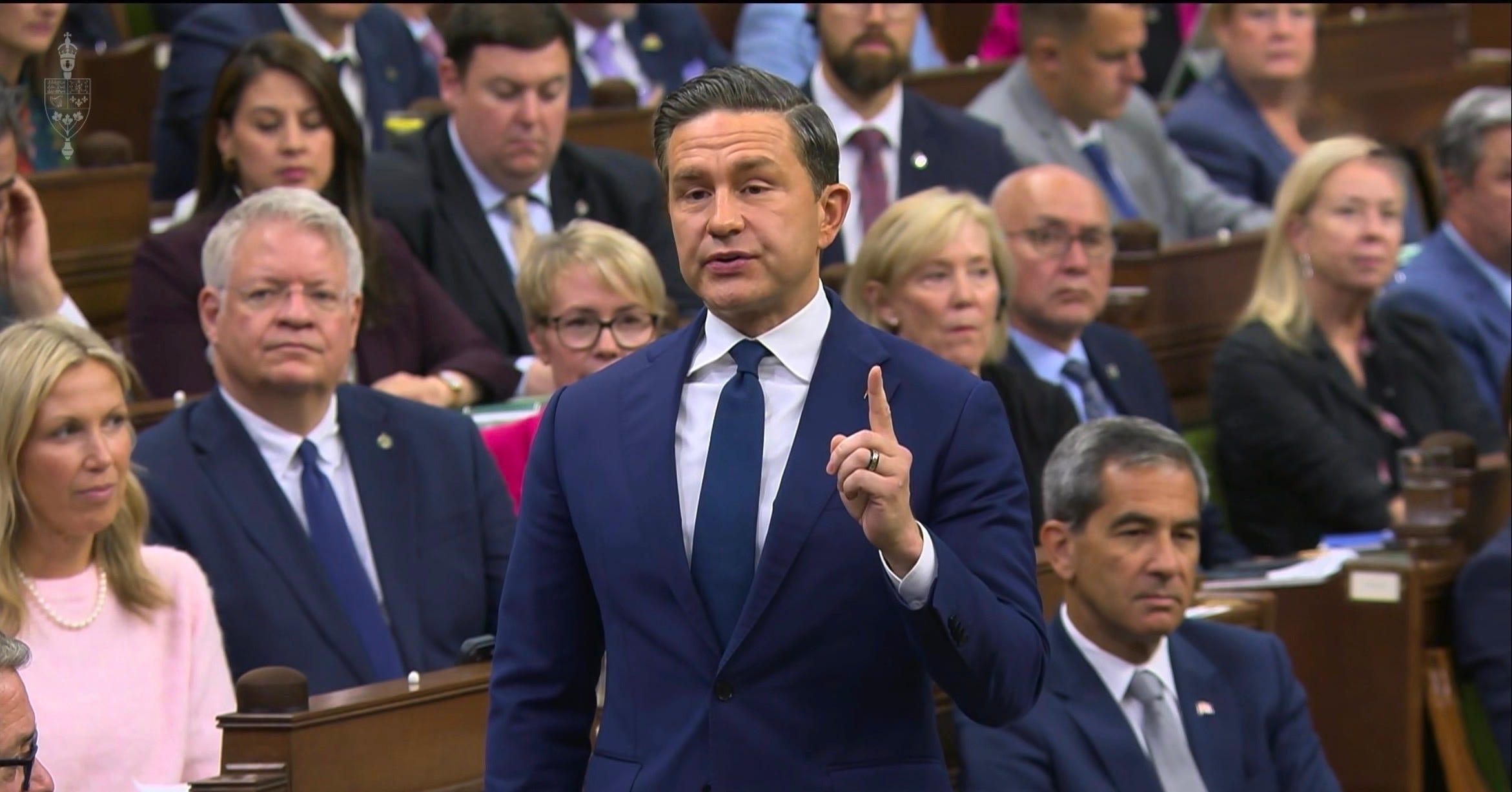
Conservative Leader Pierre Poilievre is demanding Ottawa scrap all taxes on diesel through at least Canada Day as fuel prices soar and U.S. President Donald Trump backs restricting diesel exports.
Poilievre unveiled what the Conservatives call an emergency “Diesel Price Relief Action Plan,” warning higher fuel costs are hammering farmers, businesses and families.
“It is not an exaggeration to say that we are now facing a full-scale diesel price crisis,” Poilievre said Thursday in the House of Commons.

Poilievre noted diesel had climbed as high as $2.76 per litre, citing a Bruce County, Ontario, farmer who spent $3,000 on fuel in a single day. Conservatives say a combine can burn more than $1,100 in diesel daily, while one Saskatchewan family farm faces an extra $91,000 in fuel costs.
“Diesel prices in the U.S.: $2.44 a litre. Global average diesel price: $2.33 a litre. Here in Canada: $2.76 a litre,” Poilievre said.
His plan calls for eliminating all diesel taxes until at least Canada Day and providing emergency pre-permitting and tax relief for fuel refining and transportation infrastructure.
“We should not have to rely on the Americans to give us diesel that comes out of our own ground,” Poilievre said.
Prime Minister Mark Carney blamed higher prices primarily on global pressures and provincial taxes.
“There are things in Canada called provinces,” Carney said. “The provinces put taxes on diesel.”
Carney said Ottawa is extending its federal fuel excise tax reduction and working with refiners to maximize diesel availability. He also pointed to the Build Canada Strong Act as a way to facilitate new refining capacity.
The impact of diesel prices extends beyond what Canadians pay at the pump. Diesel powers much of the machinery and transportation used to produce and move food and other goods, meaning higher fuel costs can ripple through household expenses.
Canadian Taxpayers Federation federal director Franco Terrazzano argued Ottawa could ease those costs by cutting fuel taxes.
“The fastest, simplest and easiest way for the government to make life more affordable is to stop taking so much money in the first place,” Terrazzano told Juno News.
He called on Ottawa to permanently scrap its fuel tax and carbon taxes while cutting spending to avoid adding to the debt.
“Fuel taxes make it more expensive to drive to work and take your kids to school,” Terrazzano said. “And because fuel taxes also hit diesel, they make everything trucked to store shelves more expensive.”


Adding to the uncertainty is the possibility of restrictions on U.S. diesel exports.
Trump said Tuesday that he supports banning diesel exports, while Treasury Secretary Scott Bessent said officials were examining whether a full or partial restriction would be feasible. No restriction has been announced, and it remains unclear whether Canada would be affected.
Despite those concerns, Canada does not currently face a national diesel-volume shortage.
Canada was a net exporter of distillate fuel over the 12 months ending June 2026, exporting roughly 190,800 more barrels per day than it imported. Finished distillate imports were also relatively small, accounting for about 0.8 per cent of demand in Quebec and 1.3 per cent in Ontario.
The potential vulnerability is instead concentrated in regional supply chains.
Ontario and Quebec produce virtually no crude oil and rely on supplies from western Canada, the U.S. and overseas. In 2025, Quebec imported about 126,000 barrels of crude per day from the U.S., while Ontario imported roughly 87,000.
Ottawa has emergency powers to redistribute petroleum during a shortage, but the logistics of replacing disrupted U.S. supplies have not been fully tested.

The Conservatives argue years of insufficient pipeline and refining development have left Canada unnecessarily exposed to decisions made in Washington.
“More Canadian fuel, more ways to get it to Canadians, and supply set aside for emergencies would have made us more self-reliant,” Conservative MPs Shuvaloy Majumdar, Carol Anstey and John Barlow said.
“Canadians need fuel to bring in the harvest and get to work. They cannot afford a government that waits for a shortage before making a plan.”