

Ottawa ordered to release Kamloops grave records after access law breach
The federal government has been forced to release documents related to the unproven claim of 215 graves at the former Kamloops residential school.
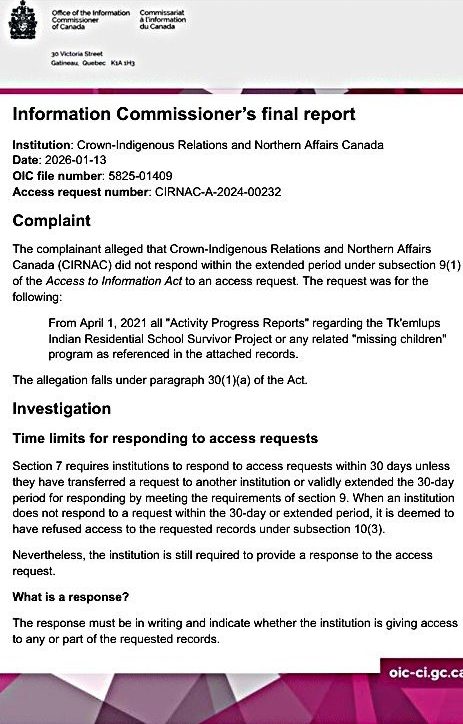
The federal government has been forced to release documents related to the unproven claim of 215 graves at the former Kamloops residential school after the Information Commissioner ruled Ottawa broke access-to-information law.
Blacklock’s Reporter first reported the ruling.
Information Commissioner Caroline Maynard said Crown-Indigenous Relations failed to meet its obligations under the Access to Information Act after delaying the processing of a request for activity progress reports submitted by the Tk’emlúps te Secwépemc First Nation under federal funding agreements.
“The department must respond to the request without further delay,” Maynard wrote, directing the department to begin releasing the records within 36 days.
The Tk’emlúps te Secwépemc First Nation announced in 2021 that it had identified what it described as 215 graves in an orchard near the former school site in Kamloops, B.C. The discovery was based on ground-penetrating radar findings. No skeletal remains have been recovered.
The federal government provided $12.1 million in funding to the First Nation for work connected to the reported burial site, including “exhumation of remains” and forensic DNA testing.
As part of the funding arrangement, the First Nation was required to submit regular activity progress reports to Crown-Indigenous Relations and Northern Affairs Canada.
The department attempted to withhold the activity reports in full on December 15 in response to an access request, describing them as “confidential information.”
A second access request remains active seeking “all Activity Progress Reports regarding the Tk’emlúps Indian Residential School Survivor Project or any related ‘missing children’ program.”
Maynard said the department received 576 pages of relevant records but claimed it lacked the capacity to begin analysis of the file after more than a year.
“I find the time taken by the department to advance the processing of this request unacceptable,” Maynard wrote. “Nothing in the Access to Information Act allows the department to delay processing requests due to limited staff or other competing priorities,” she added, warning that continued delays deny requesters their rights and “undermine the credibility of the access system.”
The Information Commissioner’s ruling comes as debate continues over public claims surrounding unmarked graves and how governments, schools, and professional bodies have described the Kamloops announcement.
In March of last year, the Kamloops issue triggered internal political fallout in British Columbia, when then-B.C. Conservative leader John Rustad expelled MLA Dallas Brodie after she pointed out on her social media that no remains had been recovered at the site.
Rustad said at the time it was “objectively true that no new bodies have been found,” though he argued her caucus expulsion was not connected to the fact dispute itself.
The controversy also intersects with renewed federal political debate over proposed “residential school denialism” legislation.
NDP MP Leah Gazan has reintroduced a bill that would expand hate speech law to criminalize wilfully condoning, denying, or downplaying what the bill describes as the genocide of Indigenous peoples through residential schools, with penalties of up to two years in prison if prosecuted by indictment.

A recent Angus Reid Institute survey found 62 per cent of Canadians oppose criminalizing residential school denialism, including 36 per cent who said they strongly oppose it. The poll found Indigenous respondents were divided on the question.
No parliamentary committee has investigated the Kamloops graves claim.
Then-prime minister Justin Trudeau ordered the Peace Tower flag lowered for five months following the 2021 announcement and later visited the site, saying he had come to “pay my respects to the graves.” Since the still-unproven discovery of unmarked graves at residential schools, at least 123 churches have been burned, vandalized, or desecrated across Canada. No national inquiry has been called to address these attacks.
finally the truth will be told you would think if there is a possibility of mass graves that there would be full discloser to get to the bottom of it so we can learn from our mistakes and move on , i believe the liberals are hiding the truth , there was no mass graves all it did was bring in billions of dollars to the chiefs
It’s way past time for Canada to establish a Canada Citizenship Act and eliminate all other designations.