
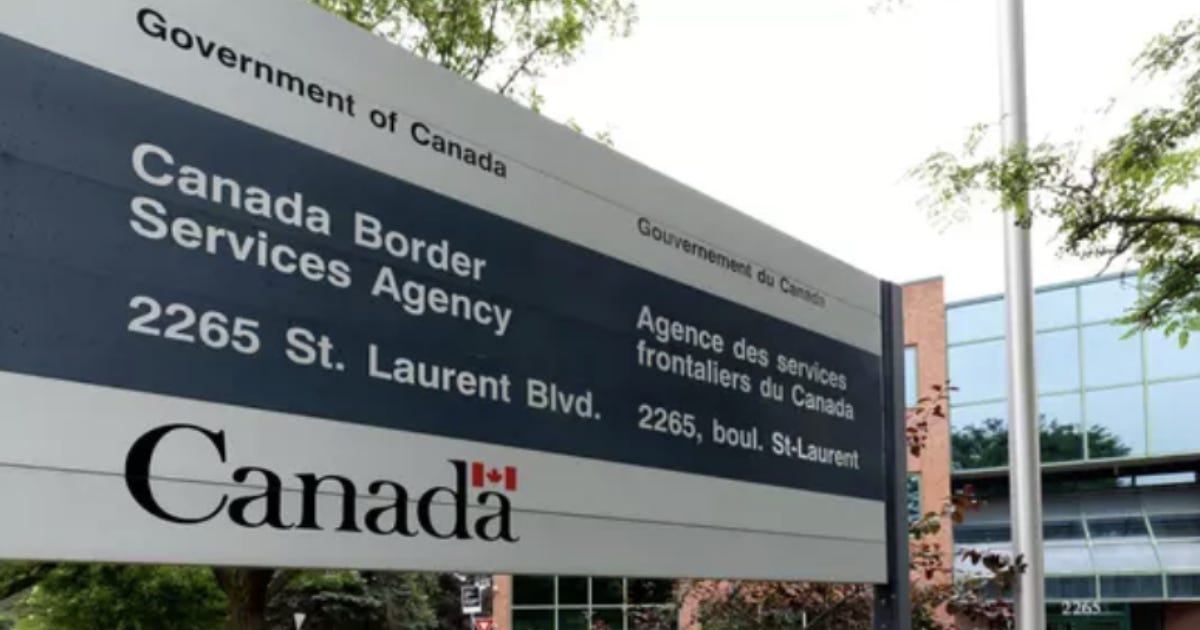
No answers from CBSA after terror suspect remained in Canada for years despite removal order
The Canada Border Services Agency refused to tell True North why a suspect in an investigation into ISIS-linked hate-motivated attacks targeting Jewish Canadians and women was still in Canada.
The Canada Border Services Agency refused to tell True North why a suspect in an investigation into ISIS-linked hate-motivated attacks targeting Jewish Canadians and women was still in Canada six years after being deemed an illegal immigrant.
A Global News report revealed through court records that one of three Toronto-area men charged with attempting to kidnap three women with guns in hate-motivated attacks, 18-year-old Osman Azizov, was still in Canada despite his family’s asylum claims having been rejected years earlier.
When asked how Azizov was still in Canada despite being a rejected asylum claimant, CBSA told True North that it was “unable to disclose” an individual’s citizenship or status in Canada but affirmed that it was the agency’s legal responsibility to remove inadmissible foreign nationals “as quickly as possible.”
“Our priority is to remove inadmissible individuals from Canada with a particular focus on individuals who are inadmissible for safety or security reasons,” spokeswoman Rebecca Purdy said in an email. “Removals can only be enforced by the CBSA for foreign nationals who are the subject of enforceable removal orders.”
Azizov came to Canada with a family whose asylum claims were rejected by the Immigration and Refugee Board in 2018.
The report details that Azizov’s family, Azerbaijani nationals, crossed into Canada at a border point near Lacolle, Que., in 2017, their asylum claim was rejected in 2018, and the Refugee Appeal Division declined to review their case in 2019.
Despite being illegally in Canada since 2019, Azizov was living in Toronto when he allegedly attempted to kidnap three women at gunpoint with two other men, 26-year-old Waleed Khan and 19-year-old Farad Sadaat.
Khan was later charged by the Royal Canadian Mounted Police with terrorism offences, including providing support to and making himself available to commit terrorist attacks on behalf of the Islamist terrorist group ISIS.
Purdy told True North that following an investigation, if an individual is alleged to be inadmissible to Canada, a report is written alleging their inadmissibility, which may be referred to an authorized decision maker, the Immigration Division of the IRB, who “may” issue a removal order.
“Any criminal proceedings take precedence over immigration matters. If an individual commits a crime in Canada, the sentence must be completed through Canada’s judicial system before removal processes can take place,” she said. “While many of the steps in the removal process can be conducted concurrently to a person serving their sentence, ensuring the removal can take place once a criminal sentence has been completed, other impediments may exist that prevent the CBSA from enforcing a removal order in a timely manner.”
The CBSA removed 18,785 individuals in 2025, according to the agency, but had a backlog of just over 10,000 individuals who had been on the agency’s “wanted list” for over a year.
In October, Immigration Lawyer Sergio Karas recommended a host of reforms to Canada’s immigration system to prevent fraudulent asylum claimants from delaying deportations, including stronger federal powers to reject claims when in the public interest and to impose financial penalties on migrants who commit fraud.


