

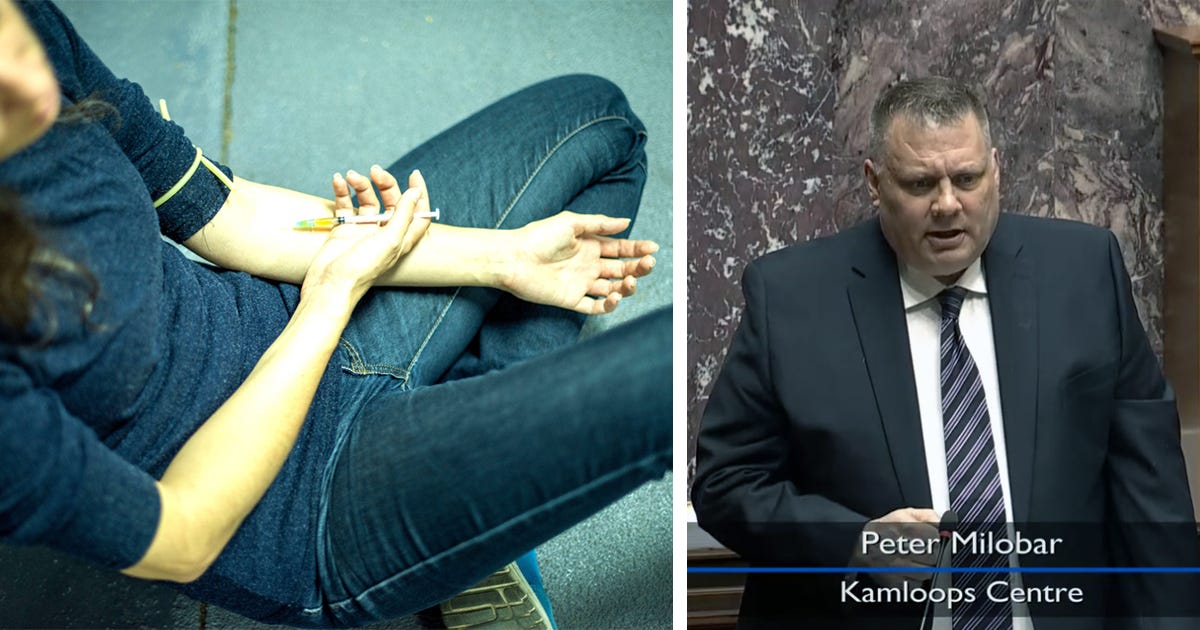
B.C. Conservative leadership candidate and MLA Peter Milobar supported bringing so-called “safe injection sites” to Kamloops while serving as mayor, and data shows local overdoses continued to skyrocket after he left for greener pastures in provincial politics.
Milobar, who held the top municipal post from 2008 to July 2017, vocally supported the introduction of government-sanctioned drug injection facilities in Kamloops starting in 2016.
While he has since criticized the B.C. NDP’s decriminalization policies, he has not publicly acknowledged the impact of the sites he ushered into Kamloops. This comes as new research out of Alberta shows that such facilities have failed to reduce overdoses in areas where they are established.
Kamloops’ adoption of supervised injection services followed provincial directives during a declared public health emergency.
British Columbia declared a public health emergency over opioid overdoses on April 14, 2016. Interior Health identified Kamloops and Kelowna as priority locations for overdose prevention services.
While Vancouver had the world’s first operating supervised injection facility in the Downtown Eastside since 2003, Kamloops led the way in opening the first injection sites within British Columbia’s Interior.
By late 2016, Kamloops had two fixed injection sites: the Crossroads Inn site at 569 Seymour Street, operational December 16, 2016, and the ASK Wellness site at 433 Tranquille Road soon after.
Both sites were integrated into existing service hubs and quickly saw high visit volumes in the Interior Health region. Milobar finished his tenure as Kamloops mayor on July 1, 2017, after he was elected as a B.C Liberal MLA on May 9 of that year, initiating his entry into provincial politics.
Now seeking the helm of British Columbia’s Official Opposition, Peter Milobar’s current rhetoric is critical of government programs enabling drug use. This contrasts with his permissive support as Kamloops mayor, when he approved drug injection sites.


In September 2016, he said he backed the programs as a means to “minimize the impact” of overdoses, although there was no precedent or data beyond assurances from safe supply activists to suggest the programs would have any effect.
“I’m not supporting this because I think this is the magical solution to everything, but it’s certainly another step...to minimize the impact on personal lives, as well as the community in general,” Milobar told CFJC Today.
Earlier this month, the Canadian Centre of Recovery Excellence released a study on the closure of an overdose prevention site in Red Deer, Alberta. It found that shutting the facility did not lead to increases in overdose deaths, emergency department visits, or ambulance calls among its users.
Researchers tracked 381 former Red Deer clients and compared them to 300 users in Lethbridge, where a site remained open. They found that health-care utilization remained largely unchanged, while former Red Deer drug users were more likely to seek evidence-based addiction treatment both before and after the site’s closure. The peer-reviewed study challenges many claims by drug injection site advocates that such sites are necessary to prevent fatalities.
Kamloops City Council voted unanimously in favour of pursuing a supervised injection site concept, and the sites were fast-tracked into operation throughout Kamloops. The city went further by spearheading the introduction of mobile injection sites. In March 2017, council approved two mobile drug injection units in retrofitted RVs, one on each side of the Thompson River. Concern over public safety incidents surrounding the mobile units has grown since they were introduced.
Juno News reached out to Peter Milobar for comment, providing a detailed list of questions regarding his role in supporting the introduction of Kamloops’ first fixed and mobile supervised consumption sites. Additionally, we asked Milobar directly whether he would support shutting down existing supervised consumption sites, including those in Kamloops.
As of publication, Milobar had not responded by the deadline.

