

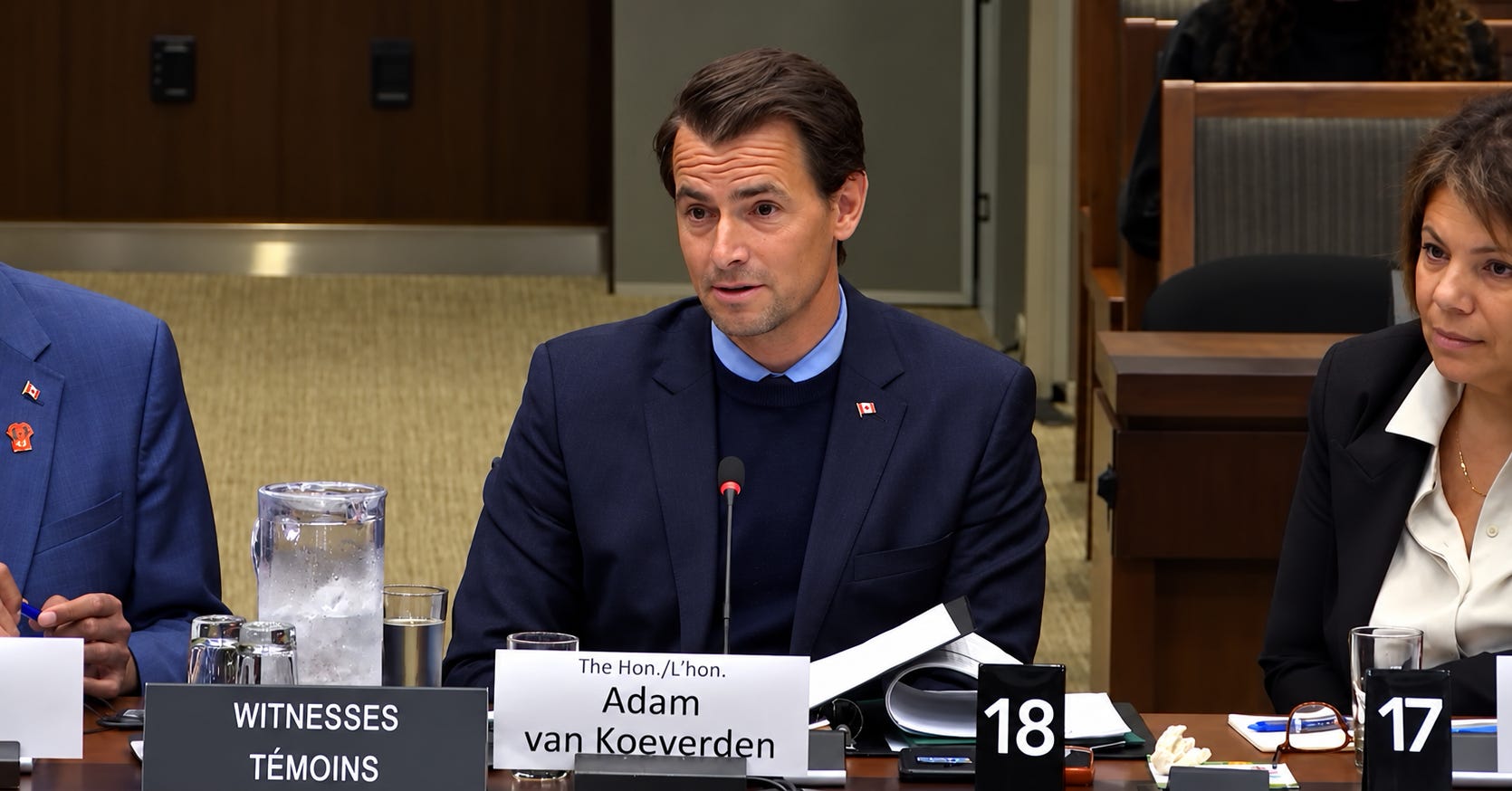
Liberal sports minister Adam van Koeverden sidestepped Conservative questions about federal research cited on male athletic advantages in women’s sports and repeatedly declined to spell out Ottawa’s position on transgender athletes during a heated committee hearing Thursday.
During an October 8 meeting of the House of Commons Standing Committee on Canadian Heritage, Conservative MP Andrew Lawton challenged Van Koeverden over his previous description of a conservative argument about transgender athletes in women’s sports as a “stupid conservative pseudo fantasy.”
“I have heard from many women and girls who do not believe they should be expected to compete against biological males who have a competitive advantage, especially when we’re dealing with upper body strength,” Lawton said.
Lawton questioned why Van Koeverden dismissed concerns about competitive fairness and why the issue was absent from the federal Future of Sport in Canada Commission’s final report.
“I can give you a number of examples of this happening, which you are well aware of,” Lawton said. “Why do you believe this is not a real problem?”


Van Koeverden did not directly address those examples, instead emphasizing the independence of international sporting organizations and the experiences of women who testified about abuse in Canadian sport.
“The IOC and other international sport federations are independent in nature,” he said. “They undertake their own eligibility priorities, and we respect them from Sport Canada.”
He also questioned the value of debating sex-based eligibility with Lawton.
“I don’t know if it’s terribly productive for two men to sit at this table debating rhetorically the definitions of various categories,” he said.
Lawton then cited a federal briefing note prepared for Van Koeverden’s predecessor.
“The most current peer reviewed science demonstrates significant male advantage in sport amplified through and after puberty,” Lawton quoted from the document.
“Agree or disagree? It’s from your government,” he asked.
“I would like to read the report before I, you know, provide my full endorsement of a paper,” Van Koeverden replied.

Conservative MP Rachael Thomas also pressed Van Koeverden to explain the Liberal government’s official position on biological males competing in women’s sports.
“It’s a nuanced issue. It’s not cut and dry. It’s not simple, and ultimately, we are dealing with human beings who deserve dignity, respect, and an opportunity to play,” Van Koeverden replied.
When Thomas repeatedly asked whether the government had an official position, Van Koeverden said it did but argued that Sport Canada should not undermine the independence of sporting organizations responsible for determining eligibility.
He also suggested the “alt-right” was using the debate to make transgender people feel excluded from society.
“What I don’t want to see is the notion that if trans people don’t belong in sport, then they don’t belong in society either,” he said.
Thomas rejected the response, demanding that Van Koeverden state the government’s position or provide it to the committee in writing.
“You’ve said that the government has an official position, and I’m not sure why you’re refusing to provide that position today,” she said.
Van Koeverden maintained that the information was available on Sport Canada’s website but did not provide a direct answer to Thomas’s question about biological males competing in women’s categories.
A 2022 federal briefing note stated Sport Canada had no official transgender inclusion policy. In March 2026, Van Koeverden reaffirmed Ottawa’s support for inclusion while leaving eligibility decisions to independent sporting bodies.


The commission’s 949-page final report, released March 24, contained 98 calls to action addressing athlete abuse, governance failures and weaknesses in Canada’s sporting system.
The confrontation follows Van Koeverden’s earlier criticism of the IOC’s eligibility policy during a July 27 press conference in Calgary.
“I’m quite concerned that going back in time 30 years, to a time when [gender verification testing] was commonplace, will be harmful to sport, and specifically women’s participation in sport,” he told the National Post.
The IOC announced its policy March 26, introducing one-time SRY gene screening for women’s Olympic events beginning with the 2028 Games. The rules restrict eligibility to biological females, subject to limited exceptions.
Despite his objections, Van Koeverden said the rules would not prevent Canada from pursuing a future Olympic bid.
Alberta has taken a different approach. Its Fairness and Safety in Sport Act, effective September 1, 2025, restricts female-only competitive amateur sports divisions to biological females aged 12 and older.
The rules cover designated sports organizations and educational institutions but exclude recreational activities, intramural sports and physical education classes.