

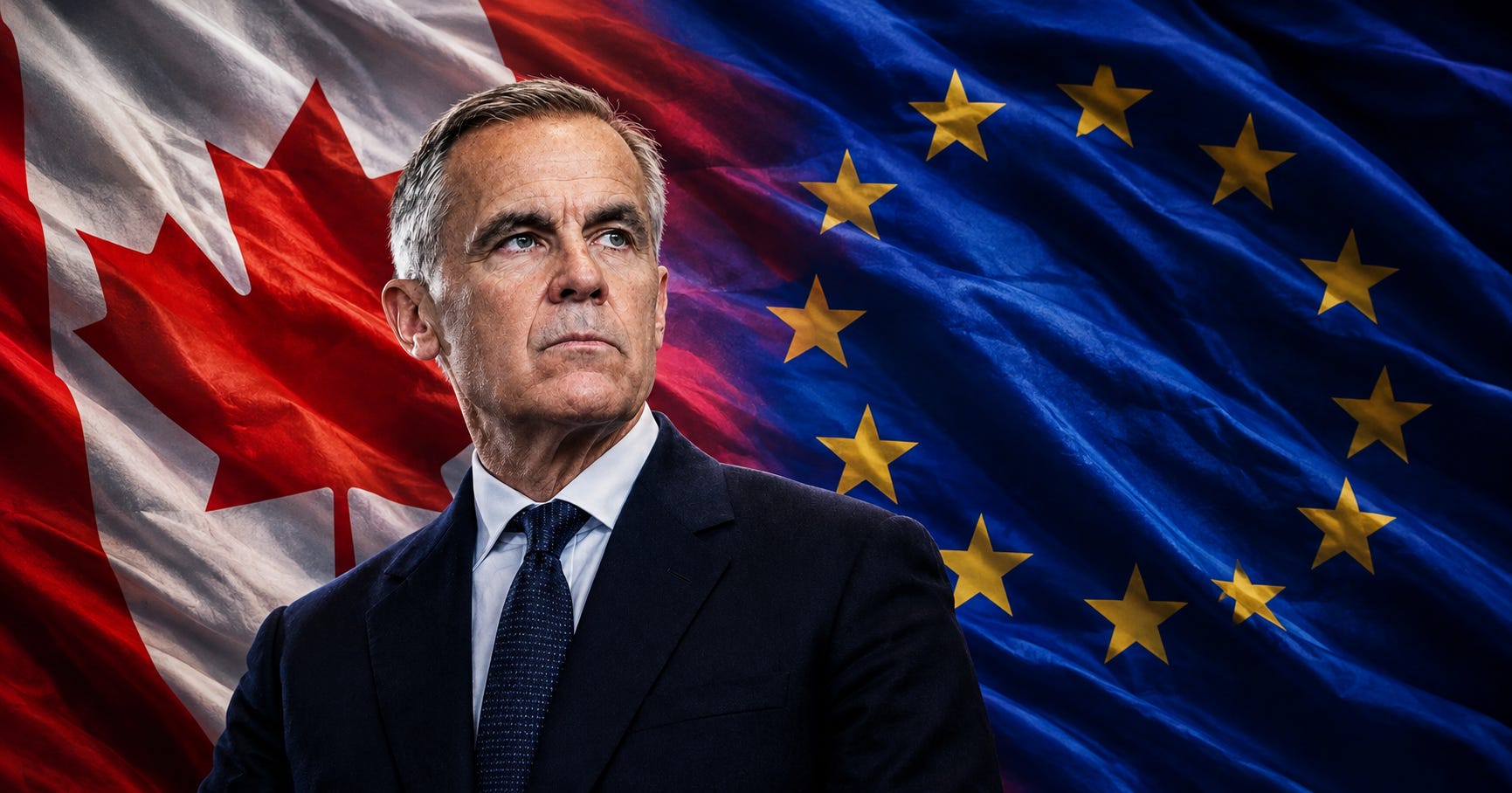
Even though no one voted for this, since Carney is in Europe to plead Canada’s case for EU “associate membership” or a “unique alliance” — whichever term he feels like telling the public today — and EU President Ursula has confirmed this is something she wants, it’s worth discussing what EU membership would actually entail for Canada.
Because it looks like it might actually happen.
On the surface, it may look like there are benefits to such an agreement, especially in the wake of America’s trade war with Canada, but it would be naïve to think any potential benefit wouldn’t come with immediate, possibly nation-changing consequences.
And that’s because what starts out as a simple trade alliance always morphs into a one-sided abusive relationship, with the EU dictating everything from immigration policy to member states’ climate agendas, all while waving the threat of total economic annihilation for not conforming.
Some might argue this is the slippery slope fallacy. The only problem with that is that it happens every single time and without exception, and it takes something like Brexit to escape.
But let’s start with the most immediate issue being used to argue for bargaining away our country’s sovereignty: trade.
Trade with the EU
Canada is in need of a new major trade partner to offset the fallout of the Canada-US tariff war, made all the worse by Trudeau’s bankrupting of the country beforehand and Carney’s inability to sign a deal. In terms of good replacements for the US, it’s becoming apparent there aren’t many good options.
In fact, there are really only three: the EU (Canada’s second largest trading partner), the UK, and China.

Ignoring the latter two options for now, the EU and Canada already have a free trade agreement, CETA, which was thought up, negotiated, and agreed upon while the country was led by the Harper government. Moreover, we have increased trade recently and slightly reduced the sizeable deficit in the last two years without concocting a new deal.
Specifically, Canada’s deficit with the EU in 2025 declined by $3 billion as Canadian exports took off (increasing 23.4% from 2024), though imports from the EU into Canada still sit at more than double ($42.8 billion vs. $91.6 billion).
More importantly, though, is the fact that the EU has been practically begging Canada to sell its oil and gas since the Liberals took power in 2015, with European leaders stating that Canada could be the key to offsetting dependence on Russian oil.

This represents a clear, tangible means for Canada to easily close its trade deficit with the EU in a way that’s mutually beneficial for both parties and could significantly lessen the blow of US tariffs — using the existing trade agreement and without signing up to anything that compromises our sovereignty.
Canada doesn’t need to embed itself in the EU to sell its oil and gas or other natural resources. The EU is already pleading with Canada to sell to them without special EU membership.
A tighter relationship with the EU may bring in investment and force the Liberal government to finally build the pipelines they’ve been delaying, but that just highlights the main issue: Canada’s leadership.
Canada had the investment and the workers ready to go to build the infrastructure needed so that Canada could be the energy powerhouse Europe was looking for, but unfortunately, the country has been saddled with leaders who actively hampered this development at every turn.
The argument stands, though: We don’t need EU membership to increase trade with the EU. We need more pipelines.
Other perks alluded to in a possible membership deal
Beyond trade, other perks outlined in the initial WSJ report, which detailed Carney’s many backroom meetings, include potentially allowing Canadians to live and work in Europe visa-free, as well as creating more international study-abroad programs between Canada and the EU, which many young Canadians would likely benefit from and enjoy and vice versa.
Great. But we don’t need to be an EU member to expand the scope of study-abroad programs (we’ll come back to the work shortly and what that might actually mean).

Other more lofty reports touched on the possibility of jointly laying underwater cables to link Canada to Europe and undertaking joint data centre projects to move beyond “the reach of American tech giants”, which could be a significant source of investment for Canada.
Again, Canada doesn’t need to be an EU member to collaborate on joint ventures. We already do that.
Immigration policy under the EU
Without a doubt, one of the most devastating policy decisions of the Trudeau government was what he did with Canada’s immigration.
What once was lauded as the best policy in the world devolved into a low-bar free-for-all, with every entry-level Tim Hortons job being filled by temporary foreign workers instead of Canadian teens and half the seats at Canadian colleges being occupied by international students who often don’t even attend classes.
We are still recovering from this and may never fully recover if we’re being honest.
Carney has rolled this back a little (it would be career-ending if he didn’t), but within the EU, there would be nothing to protect Canada from Europe exporting its own migrant crisis.

As mentioned, one of the most pernicious aspects of EU membership, special or otherwise, is the Union’s total dominance over immigration policy in the form of migrant quotas.
In 2015, at the height of the migrant crisis, the Czech Republic, Slovakia, Latvia, and Hungary all voted against accepting mandatory migrant quotas. It didn’t matter. The EU enforced them anyway, waving economic destruction over the heads of those who dissented.
Two years later, when a formal challenge to migrant quotas finally made it through all of the bureaucracy and was heard by the EU court, they simply rejected it, signalling the beginning of an ongoing struggle between the central authority of the EU and the countries that wanted control over their borders again.

This has continued to the present day, with Hungary, Poland, and others still trying to defy the EU’s rebranded 2023-2024 EU Migration and Asylum Pact, which forces members to take a certain share of the total migrants that come to the EU (legally or otherwise) each year.
As an “associate member” with an abundance of land, it’s likely the EU would see Canada as a perfect host nation to handle the seemingly endless influx of migrants into the EU, which currently holds 23% of the world’s refugee population.
In fact, Mark Carney has already stated that “enhanced labour mobility” would be part of the deal.
That doesn’t just include Canadians vacationing in Europe. It goes both ways.

Footing the bill for Europe
Beyond immigration, Canada would also have to pay the EU for the privilege of having less control over its own laws, as each member state must contribute a portion of their gross national income to keep the lights on in Brussels. On paper, this sum isn’t too high compared to our already inflated tax rates, but it still amounts to billions each year.


Then there are tariffs for doing business with countries outside the EU (which would be collected by Canada only to be sent to the EU in full or in part), something which Canada is actively trying to avoid at the moment.
Canada already has some of the highest taxes in the world (ironically only overshadowed by European countries), and the Liberals, even when led by a banker, have shown they’re totally incapable of balancing a budget. This, coupled with other expectations, such as abiding by Europe’s Green Deal, would undoubtedly exacerbate Canada’s financial woes.

Lastly, as previously reported by Juno News, the EU is in an even worse situation when it comes to debt. As of early 2024, the average government debt in the EU’s eurozone countries rose to 88% of their GDP, higher than Canada’s already high rate of 76.2% debt-to-GDP. Some countries within the EU are even worse off, including Greece (163%), Italy (137%) and Belgium (108%), showing how little there is to gain from being in the EU.
If they can’t manage their own finances, it’s baffling why Carney believes they’re going to help with ours.
We don’t elect the people who run the EU
All of these issues go back to the core issue with EU membership: a loss of sovereignty.
While the people of each member nation do elect Members of the European Parliament to represent them every five years, they have no say beyond that point.
That’s one to a handful of people who are expected to represent the interests of an entire nation and advocate for them above the interests of competing nations in the parliament — and that’s assuming they don’t end up being corrupt.

In this way, rather than directly voting on who will lead the country, Canada would have a separate election to merely have a voice in the European Parliament and hope that it’s heard over the 720 other members and their competing agendas.
And since the EU’s mandates are binding and often supersede the national agenda, it would possibly become the focal point of Canadian politics going forward. That is, the focus wouldn’t be ‘who is going to run Canada’, but ‘who is going to represent Canada in Brussels’.
Canada does not need an overseas master to beg for its will to be carried out. That’s the duty of our elected officials that Canadians personally choose and can hold accountable.
This is not progress.
"Joining the EU as an “associate member” may represent the greatest existential threat to Canada thus far."
YES.... BIG TIME....
BUT....
Actually THE SECOND BIGGEST EXISTENTIAL THREAT TO CANADA.
The prime, first and most prevalent and dangerous existential threat to Canada is pictured at the top of this article.
What this complete AH is doing cannot be allowed to continue or stand.
Simply... Somebody has to mitigate the huge damage this AH is attempting to do and is doing to Canada.
Conman Carney is Dangerous.
EVIL DANGEROUS
the EU is a disfunctional mess on the brink of war with Russia, being overrun by uninvited freeloaders;. Theres a reason Britain voted Brexit