

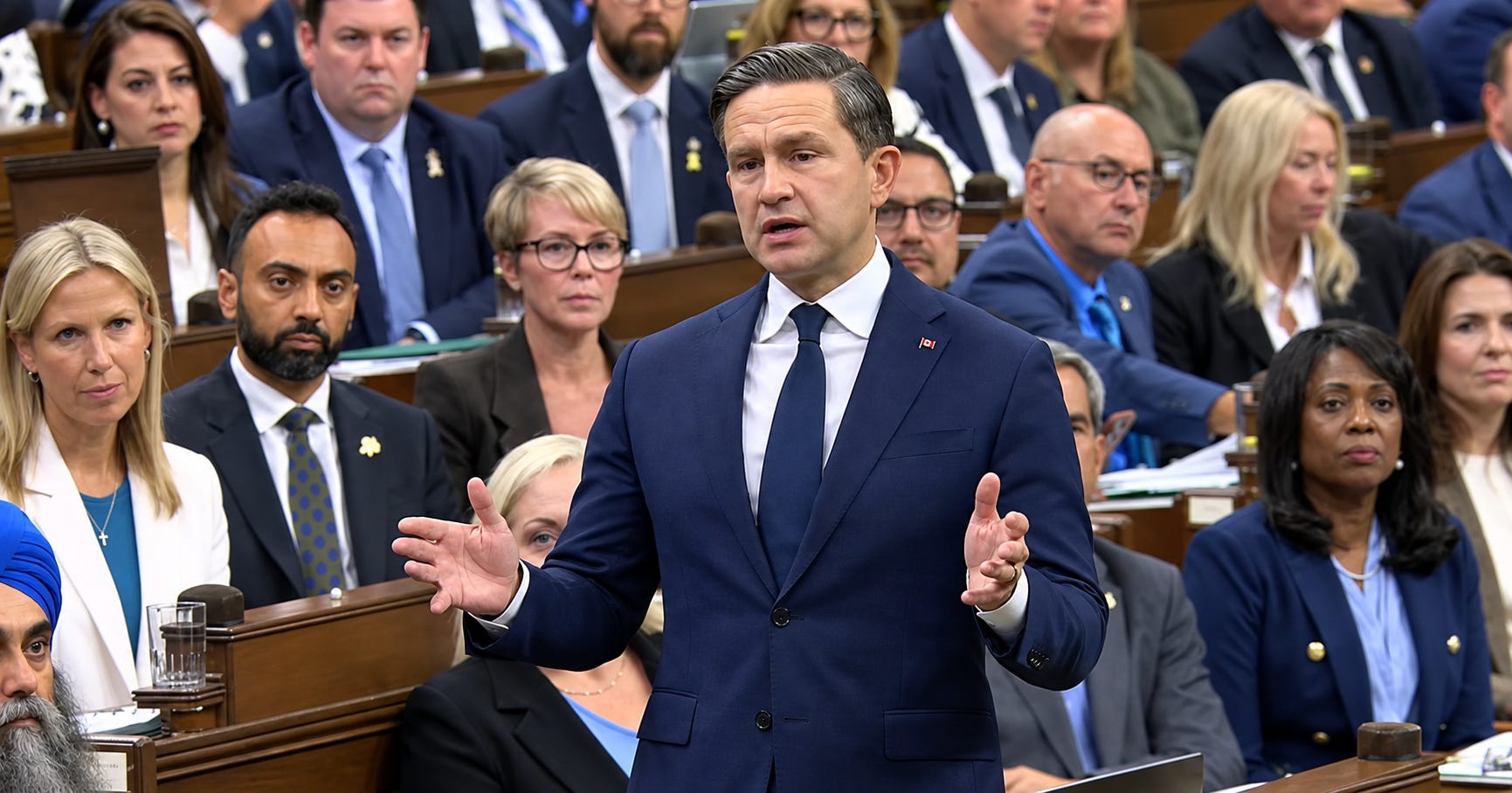
Seating is finite in the House of Commons, so who sits where has a big impact on egos, careers, and the stability of the leadership.
Significant changes to the seating plan compared to May have seen pro-freedom, pro-Western Canada, anti-WEF agenda, anti-digital ID candidates rapidly rise through the ranks while other representatives fall to the wayside.
BC MP Aaron Gunn is one of the most prominent examples of this. Despite being a first-term MP, Gunn has been moved from the sixth row to the second and replaced Michael Barrett as the Shadow Minister for Ethics and Accountable Government.
Gunn has been a steadfast advocate of freedom, truth, bodily autonomy, and privacy throughout his time in politics while simultaneously taking a hard-on-crime stance in the wake of BC politicians’ limp-wristed, free-for-all approach to crime and the opioid epidemic.
He went so far as to release a one-hour-long documentary in 2022 called Vancouver Is Dying on YouTube, which was viewed millions of times and has been attributed to the ousting of then-mayor Kennedy Stewart that same year.
Andrew Lawton, another first-term MP, has also seen notable gains in the most recent shakeup, moving from the far back sixth row to the third and taking over as Platform Lead.
It’s a position that suits him, too. As the former Managing Editor for True North, Lawton has years of experience getting his (and his team’s) message out there, r. Regardless of how much censorship, shadow banning, and algorithmic manipulation stand in his way.
He was also a very notable chronicler and advocate of the Freedom Convoy, penning a book on the topic in 2022 that’s full of exclusive interviews detailing the concerns and motivations of Convoy supporters that the CBC didn’t care to document.
Jacob Mantle, yet another first-term MP, has moved from sixth row to fourth and been made the Associate Shadow Minister for Foreign Affairs.
While perhaps not as infamous as the former two MPs, Mantle has been extremely vocal about the threat of government surveillance, digital IDs, and the expansion of the Carney government’s power and the Liberals’ bankrupting of the country.
He also managed to defeat a much-favoured opponent in the 2025 federal election and was previously the youngest councillor (at 21) in Uxbridge’s history — and the youngest councillor in the GTA at the time.
What these three have in common is that they are movers. They actually do things that have an effect in real life. They don’t just wave their hands in Question Period and hope for the best.
That is to say, they’re all pro-freedom, they can all make their voices heard, and they’re all what the Conservative Party needs right now.
There are some exceptions, however.
Matt Strauss, like those mentioned, was very vocal against COVID lockdowns and mask and vaccine mandates, yet he remains in the sixth row following the cabinet shakeup. So it’s clear that being pro-freedom isn’t the only factor coming into play.
It’s also worth noting the prominence of Albertan MPs in the Conservative cabinet now that Poilievre is the MP for Battle River—Crowfoot.
Tim Uppal (Edmonton Gateway) sits immediately beside him, while Stephanie Kusie (Calgary Midnapore), Shannon Stubbs (Lakeland), Michelle Rempel Garner (Calgary Nose Hill), Rachel Thomas (Lethbridge), Jasraj Hallan (Calgary East), and John Barlow (Foothills) are all in the first row, with even more Alberta MPs sitting in waiting behind them.
Including Poilievre, that’s 8 of 23 MPs in the front row who represent Alberta compared with 7 from Ontario.
Here, too, there are some exceptions, though.
Laila Goodridge, representing Fort McMurray—Cold Lake, was demoted from third row to fourth; however, she retained her position as Shadow Minister for Families, Children and Social Development.
As well, Kevin Waugh, from Saskatchewan, has been moved from the third row to the fifth.
And while not a full row change, Jasraj Hallan has moved from two seats away from Poilievre to nine, having also lost his role as Shadow Minister for Finance to Michael Chong (who sits three seats from Poilievre) in June.
Those who haven’t moved are also worth mentioning.
For instance, Leslyn Lewis still retains a spot three seats from Poilievre and occupies the position of Shadow Minister for Digital Government and Artificial Intelligence.
Lewis is one of the loudest and most persistent critics of digital IDs, 15-minute cities, and CBDCs in Canadian politics. Her disgust for Carney’s push to have Canadians lose their privacy rights and basic autonomy in day-to-day life is palpable, and there’s perhaps no MP who wants to reverse course on Canada’s adoption of anti-freedom tech more than she does.
Given how vocal she’s been and the threat this overarching agenda poses to Canadians, it’s understandable why Poilievre wants her to stay where she is.
With all of this in mind, it appears that Poilievre is charting a new course with the Conservative Party — one that is vocal, effective, and unabashedly pro-freedom — and his seating arrangement is revealing it.