Author: Hymie Rubenstein
Hymie Rubenstein, editor of REAL Indigenous Report, is a retired professor of anthropology at the University of Manitoba and a senior fellow at the Frontier Centre for Public Policy.
Portugal’s recent decision to ban face coverings in public spaces mirrors measures countries like France, Belgium, Bulgaria, Austria, Luxembourg, Denmark, and the Netherlands put in place years ago.
Even Canada has implemented measures on face coverings in certain settings.
As for Portugal, proponents of the new law argue that an uncovered face builds social trust and security. Portuguese President Antonio Jose Seguro stated that the face is central to human identity and communication.
There are several types of Muslim head coverings, the main ones being the hijab, which covers the hair and neck but leaves the face visible; the niqab, which covers the face except for the eyes; and the burqa, which covers the entire body and face, often with a mesh screen for visibility, a practice confined to Afghanistan.
The photo below shows the controversial niqab, a form of total female body covering almost as extreme as, but culturally distinct from, the burka.
But Portugal’s left-wing parties opposed the law, a decision that is somewhat confusing given the left’s strong support for female bodily self-determination.
Equally problematic, woke government and human rights campaigners have long pointed out that such bans effectively erode women’s rights by telling them how to dress. But this implies that orthodox Muslim women, whether in their home countries or in the diaspora, are free to choose what to wear outside their homes.
Muddying the waters even more, Seguro acknowledged that the issue was one of “great social and cultural sensitivity,” weasel words if there ever were any.
“For the president of the republic, the uncovered face constitutes a structuring dimension of social trust, a characteristic of Portuguese society,” according to an English translation of a Portuguese-language press release.
Most problematic of all is that this legislation takes for granted that Islam commands Muslim women to wear a full-face veil. If true, this assumption invites claims of discrimination based on deeply held, foundational religious beliefs and practices while confining orthodox women to virtual house arrest.
As for its actual religious underpinnings, though face and body covering continues to be debated among Islamic scholars, nowhere in the Quran, the Muslim holy book, is there a Surah [Chapter] that obliges Muslim women to wear a hijab, let alone a niqab or burqa.
Instead, the Quran offers two basic guidelines for women’s dress.
First, revering God is the most important principle for women when they choose their dress. A righteous woman will therefore dress modestly and in line with God’s requirements for decency and morality. Any woman knows full well what clothes are considered decent and what clothes are revealing. Indeed, she will not need to be told.
This open-ended guideline explains why Muslims have several different head and body coverings.
Second, God commanded women to cover their cleavage (Surah 24:31).
Moreover, the broadly defined Arabic word hijab literally means barrier or veil and includes screens, coverings, mantles, curtains, drapes, partitions, divisions, dividers, and barriers.
More particularly, Surah An-Nur (24:31) directs women not to display their beauty except what is apparent, and to “draw their head coverings over their chests.” At the same time, Surah Al-Ahzab (33:59) instructs the Prophet’s wives, daughters, and believing women to “bring down over themselves part of their outer garments,” so they are recognized and not harassed.
Many classical and modern scholars view the face and hands – but never a woman’s breasts – as exempt from mandatory covering, arguing that the instruction to be “recognized” implies that the face must be visible.
More important still, the face-covering meaning of hijab has nothing to do with Islam, nor with the Quran.
In fact, the hijab is an old Jewish tradition that influenced the sayings of the Prophet Muhammad, the founder of Islam. In this way, it is like many innovations that infiltrated Islam through the hadith – a recorded collection of the alleged sayings, actions, and silent approvals (tacit permissions) of Muhammad – released after his death.
Indeed, a careful examination of the Quran even shows that Muhammad borrowed liberally from Old Testament beliefs and practices.
Religious Jewish women, for example, also cover their heads most of the time, especially in synagogues, at weddings and religious festivities. This Jewish tradition is cultural, not religious. The hijab was observed by women of the civilizations that preceded the Jews and was passed down to Jewish culture.
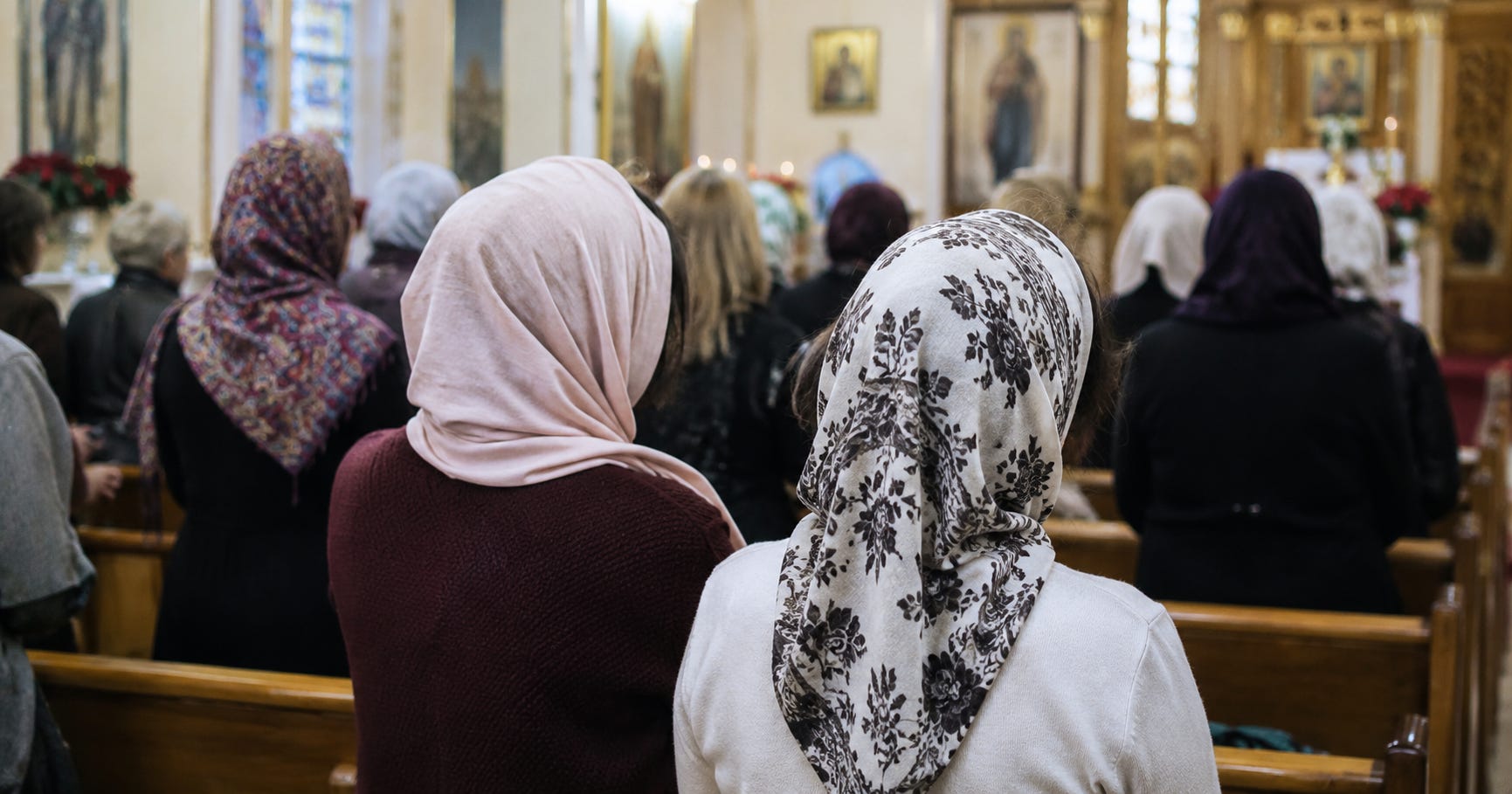
Many Christian women also cover their heads on certain religious occasions, while nuns cover their heads all the time. The tradition of covering the head was practiced thousands of years before so-called Muslim scholars claimed the hijab as a Muslim dress code without properly grounding it in Quranic texts.
In fact, traditional Arabs, of all religions – Jews, Christians, and Muslims –continue to wear a hijab, not because of religion, but because they are accustomed and expected to do so. In Saudi Arabia, for example, all men cover their heads not because of Islamic law, but because it is part of their cultural heritage.
As for the widespread belief that face covering is confined to men, among the mainly Muslim Tuareg of the Sahara, a people who accepted Islam in the seventh century, it is men rather than women who wear a face veil (tagelmust), a tradition tied to their cultural identity and coming-of-age rather than strict religious mandates.
If there is so much reason to reject the religious origin and meaning of the non-face-covering hijab, could there be any more doubt about the face-covering niqab and burka, garments never mentioned in the Quran?
Although this examination of the misinterpretation of Muslim dress codes weakens the freedom of religion position, at the end of the day, such bans in secular countries like Portugal should have been given more careful interrogation, regardless of their real or alleged public safety implications.


