
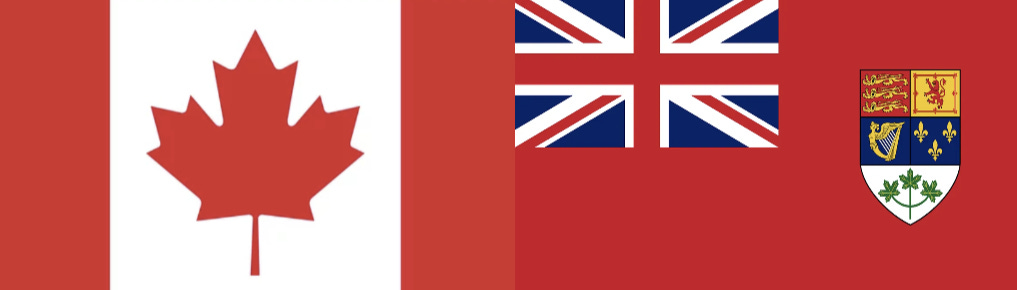
OP-ED: Leaf vs Shield: The Great Flag Debate
"In hindsight, this was the beginning of Canada’s post-national cultural revolution and the redefinition of what it meant to be Canadian."
Author: Daniel Tyrie
Today, February 15, marks the 61st anniversary of the adoption of the Maple Leaf as Canada’s official flag.
In hindsight this change — controversial at the time — marks a turning point in Canada’s history. The beginning of a shift away from Canada’s founding ethos toward the modern post-national, multicultural state we know today.
Many young Canadians are unfamiliar with this saga or the profound consequences that came along with this change. As is often the case, it is crucial that we understand where we came from if we are going to understand where we are going.
Prior to 1965, Canada’s official flag was the Union Jack — as was true of most British possessions. Like many post-colonial nations, Canada adopted a series of distinctive civil flags which were flown on government buildings and elsewhere expressing our unique identity within the British Commonwealth.
Initially this civil flag was the Union Jack in the top left corner, a red backdrop, and a crest composed of each of the province’s coats of arms. As more provinces were admitted into the Confederation, this crest became increasingly unwieldy.
1907 version of the Red Ensign, once Alberta and Saskatchewan had joined Confederation.
In 1922, changes were made to streamline the design. The crest was replaced with a simplified version of Canada’s coat of arms, creating what many Canadian history buffs will know as the Red Ensign.
The Red Ensign, in its various forms, is the flag our sons carried into both World Wars — the flag they fought, bled, and died under. In those pivotal moments, Canada emerged as a nation, truly distinct from our colonial parents.
In this retrospective on national symbols, it is important to understand what this word truly means. A nation is not just boundaries or a legal entity. A nation is a people united by shared history, culture, language, and memory.
The Red Ensign very carefully symbolizes Canada’s national heritage. The four quadrants on the shield represent the four groups who settled and built Canada: three golden lions representing the English, the red lion rampant representing the Scottish, the golden harp representing the Irish, and the three fleur-de-lis representing the French.
In 1867 when Canada was confederated these four groups represented 97% of Canada’s population, the remaining 3% being largely various First Nations groups.
The Maple Leaf flag introduced by the Liberal government of Lester B. Pearson was developed explicitly to bury this heritage in place of a “New Canada”.
“I believe that today a flag designed around the Maple Leaf will symbolize and be a true reflection of the New Canada.”
Pearson was of the belief that a new flag was necessary to represent the evolution of Canada. Specifically to distance ourselves from Great Britain through the removal of the Union Jack, as well as removing the references of Canada’s ethnic foundation in order to make the flag more inclusive to new groups of settlers and immigrants.
The resulting flag is more of a modern, minimalist corporate logo than a national symbol. Intentionally lacking symbolism, the new flag aimed to be a unifying force — between English and French, between heritage Canadians and immigrants.
In hindsight, this was the beginning of Canada’s post-national cultural revolution and the redefinition of what it meant to be Canadian. The New Canadian was simply a citizen, an interchangeable economic unit, rather than a part of a national continuity stretching back to the pioneers who built and settled this land.
This is what defines post-nationalism, a vague, hollow, civic identity. Avoiding controversy even if it means being dishonest or unsubstantive.
None of this is to deny that the Maple Leaf has become meaningful to many Canadians. But symbols matter not only for what they represent today, but for what they erase from memory.
What truly unifies a nation is a clear understanding and pride in a country’s history, identity, and culture, not erasure and redefining of these elements.
Just because a citizen may not be represented by the symbols on the Red Ensign does not change the fact that it is representative of our Canada’s heritage.
It is more important than ever for Canadians to understand our history and identity. It’s becoming increasingly clear that we are entering a transformational period of global politics.
During his diplomatic trip to China in January, Prime Minister Mark Carney declared the start of a “new world order”. Days later during his speech at the World Economic Forum he described the collapse of the “rules based international order.”
During his speech at the “Harper20” anniversary event, former Prime Minister Stephen Harper explained that we are living in an “age of nationalism.”
There is a growing nonpartisan consensus that nationalism is on the rise. This can’t just be superficial rebranding of current dysfunctional systems or ideas. We cannot just have a repackaging of failed concepts of post-war liberalism.
We need an honest nationalist rebirth in this country and that includes taking back the symbols that have been stolen from us, understanding our history that has been misrepresented, and remembering what it truly means to be Canadian.
There is a growing nostalgia for the Red Ensign and what it represents amongst Canada’s ascendant New Right.
If Canada is going to fulfill her destiny and become the greatest country in the universe — as her founders believed she could — we must rediscover our roots and unify around them.
I leave you with a quote from one of our former Prime Ministers, an exceptional orator, and the greatest champion of the Red Ensign: John Diefenbaker.
“Canadians. We in this party over the years have said we would have no objection to a distinctive flag. But ladies and gentlemen, a flag that does not contain the greatness of your heritage is no flag for a nation. Out goes the coat of arms. Away goes the colours. Goodbye to the Union Jack. I said to the Prime Minister this: A flag must represent the soul and heart of the nation. It must be something that raises in one’s being the pride of his nationhood.”
Long live Canada.
Daniel Tyrie is the Founder and Chairman of the Dominion Society, an advocacy group promoting Canadian nationalism and immigration reform. He previously served as the Executive Director of the People’s Party of Canada.


I didn’t leave Canada, Canada left me. Long live the independent republic of Alberta. Our flag is a beaut!
I still fly the Red Ensign from my dock on Sproat Lake on Van Isle. Drives some of my neighbours crazy. Our flag now was a sop to Quebec, but they tend to fly the fleur-de-lis, not the red maple leaf. And of course the flag is red bars and red leaf, which just happen to be the colour of the Liberal Party of Canada. Coincidence? I think not.