
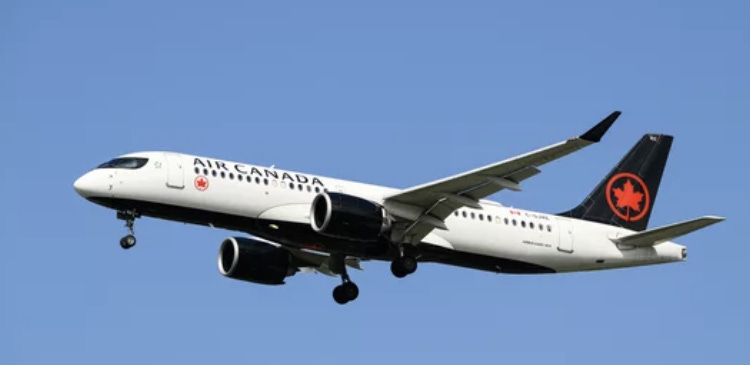
OP-ED: Jet lag, Canadian-style and the case for airline deregulation
"Canada doesn’t have a functioning airline market. It has a rent-seeking duopoly."
Author: Simon Michell
Canada doesn’t have a functioning airline market. It has a rent-seeking duopoly.
By all measures, Canada ought to be a country with a thriving airline industry. We boast a modern, wealthy economy heavily dependent on trade and with a long and proud history of aircraft design and manufacture. Flying is the quickest and most efficient way of moving around the country – and yet the skies of Canada have never been very friendly for flyers.
The gradual deregulation of the airline industry in the 1980s, culminating with the privatization of Air Canada in 1989, was supposed to set off a boom in competition. That never happened. Instead, by the 1990s, two major airlines dominated the skies: Air Canada and Canadian Airlines.
WestJet has since stepped into the shoes of the now-departed Canadian Airlines as Air Canada’s smaller, main competitor. But full-throated airline competition remains an elusive dream.
Numerous discount-focused carriers – Canada 3000, Royal Airlines, CanJet, Swoop and Lynx among them – have tried and failed to break up Canada’s cozy airline partnership. Today, Flair, the current “value priced” competitor, is still struggling to establish itself while upscale Porter Airlines offers limited service. Meanwhile, basic service metrics for Canada’s domestic airline industry, including customer satisfaction, frequency of flight delays and overall cost of travel, are among the worst in the world.
While strict government control of Canada’s air passenger industry was eliminated under Prime Minister Brian Mulroney in the 1980s, several key federal regulations still remain. In particular, foreign airlines are not permitted to operate domestic services between Canadian destinations, what is known as “cabotage”. Further, foreign ownership of any Canadian air carrier is capped at 49 percent, and no single non-Canadian investor can own more than 25 per cent of a domestic airline.
These foreign-ownership and cabotage restrictions have significant implications. According to a 2025 report by the Competition Bureau of Canada, “Canada’s domestic aviation sector is highly concentrated, with two leading carriers.” According to the bureau, Air Canada and WestJet together account for up to 78 percent of all domestic airline traffic on key routes. This means, in economic terminology, that Canada’s airline industry essentially operates as a duopoly.
The bureau’s research further shows that prices are lower when there is an additional competitor. A third airline flying a particular route can lower prices by about nine percent. “This shows that competition drives airlines to improve, and passengers benefit,” the report states. In 2017, online travel agency Kiwi.com calculated that Canadians paid nearly double the price as Americans for flights of similar distance.
Of further concern, in 2022 Air Canada and WestJet took steps to divide the country’s air travel market between them, with WestJet retreating to Western Canada and Air Canada focusing more on Eastern Canada. This is a classic duopoly move: two competitors recognize their interdependence and take steps to boost their profits because of it.
Beyond affecting pricing and capacity, duopolist behaviour can also degrade quality. In 2022, Air Canada and WestJet were ranked worst in North America for flight delays. In 2023, Air Canada had the worst on-time metrics among all North American airlines.
Given the significant impact on travellers from higher prices and lower-quality service, the question arises: who defends such a situation? Proponents of the status quo frequently mention national security as their prime concern – domestic air travel is so important that only airlines based in Canada should be allowed to fly Canadians from place to place.
While national security is important, evidence from other parts of the world suggests greater competition can occur without putting this at risk. The European Union, for example, liberalized its air travel market in 1993. Airlines based in any country in the EU can pick and choose what routes they serve without regards to their home base since they are all allies. Competition need not degrade national security.
There is also ample evidence that airline deregulation lowers fares. In the EU, the rise of low-cost carriers has dramatically reduced airline fares and led to vast growth in the number of air passengers. Today, for example, Ireland’s budget airline Ryanair will fly you from London to Geneva for about $49; flying from Calgary to Vancouver, a slightly shorter trip, will cost you roughly four times that amount.
How can Canada get what Europe has? The solution is straightforward: lift cabotage restrictions and remove foreign ownership limits. Opening our skies to competition will allow well-capitalized airlines to go head-to-head with Air Canada and WestJet, increasing capacity and putting downward pressure on prices.
Some analysts, including the Competition Bureau, favour gradual reform. Others argue for a more dramatic approach. Economist Vincent Geloso from MEI and George Mason University has proposed eliminating Canada’s cabotage prohibitions almost entirely in what he calls “shock therapy”. Doing so, he argues, would create an onrush of new providers and immediate benefits. “A larger number of providers, a larger number of service points and, most importantly, lower fares,” he predicts. The Fraser Institute advocates a similar approach.
By embracing the spirit of competition in air travel, Canadians could soon find that the sky’s the limit.
Simon Michell is a second-year student in McGill University’s joint Economics/Mathematics honours undergraduate program. This is an edited and expanded version of his third-place-winning entry in the 3rd Annual Patricia Trottier and Gwyn Morgan Student Essay Contest as first appeared in C2C Journal.


The cost to fly within or outside of Canada is disgusting when you look at the prices in the U.S. The gov't is purposely preventing competition in the airline industry in order for Air Canada and Westjet to gouge consumers. This is another example of Canada falling towards bankruptcy and a Liberal gov't that does nothing to support Canadians.
It's a joke--Westjet Edmonton to Grande Prairie (400 km) cheapest return $550
Westjet Edmonton to Toronto (2690 km) cheapest return $292
It used to be that only Air Canada had the following motto--now they both do!
"We're not happy until you're not happy"