

OP-ED: False memory syndrome, mass hysteria, and greed propel indigenous grievances
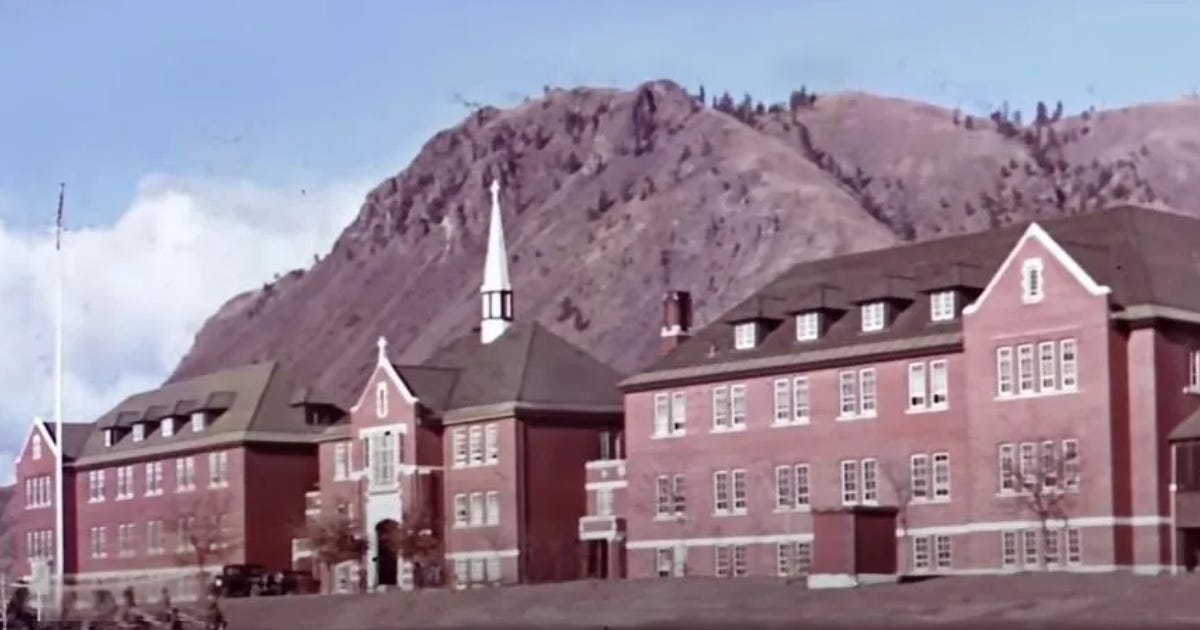
"In August 2024, one of us — retired psychiatrist Dr. Brian Talarico — visited the long shuttered Indian Residential School on British Columbia’s Kamloops Indian Reserve."
Authors: Hymie Rubenstein and Brian Talarico
In August 2024, one of us — retired psychiatrist Dr. Brian Talarico — visited the long shuttered Indian Residential School on British Columbia’s Kamloops Indian Reserve.
Two young men were hanging about offering to show visitors around. They told factually unsupported stories about the school designed to elicit sympathy and money from visitors. They matter-of-factly told Talarico that the school’s Catholic priests pushed a child off the third-floor fire escape to the ground below, that the priests routinely impregnated aboriginal girls followed by the incineration of their babies in the school boiler or drowned them in the adjoining Thompson River.

The former school is located across the river from downtown Kamloops and adjacent to the main highway running to northern BC. It employed local aboriginals as teachers and other staff. During the years of school operation there were no reports of missing or murdered children.
None of this prevented horrific stories of residential school murders from being shouted from the rooftops following the May 27, 2021 announcement from the Kamloops Indian Band that the remains of 215 children who were students of the local boarding school had been found.
This gruesome accusation immediately lead to moral panic at home and sensational headlines around the world. Absent from all this hysteria and inflammatory rhetoric was any recognition that aboriginal parents had not reported the loss of any of their children during the school’s long operation, 1890-1978.
So, what was learned from Talarico’s visit to the long-shuttered boarding school?
Most of all, that the band is unlikely to ever attempt to identify the alleged remains of students buried in reputed graves, because it knows there are no interred children at the site.
Still, a sensational as the Kamloops “discovery” has been and as much as it has created a national moral panic, it is no gruesome outlier. Instead, it is a painful reminder of the cultural hysteria known as the Satanic Panic that began in BC in 1980, spreading around the world over the next 10 years.
Published in 1980, Michelle Remembers was written by Dr. Larry Pazder, a Victoria, BC psychiatrist, and his patient Michelle Smith, a local housewife who’d sought treatment after a miscarriage.
Under Pazder’s care, Smith underwent “recovered-memory therapy” — a practice that’s since been discredited. The result was a best-selling work of horror with the compelling paperback: “The shocking true story of the ultimate evil — a child’s possession by the Devil!”
That child was Smith and her nightmare allegedly began at the age of five. It was then, Smith claims, that her mother gave her away to a Satanic cult resulting in years of terrible abuse.
For the next 10 years, Satanic Panic resulted in over 12,000 reports of children being abused or even physically sacrificed.
Still, after exhaustive police investigations in Canada and America not a single report was ever proven, so the panic gradually died away.
Two facts about these reports of Satanic abuse are important to remember. Most individuals did not recover memories in therapy: they recovered memories by interaction with others. Second, the contents of the reports were remarkably similar. Often, priests and the Catholic Church were the falsely reported abusers. Yet, because of the commonality in the reports, trauma advocates uncritically took this as proof that the reports were trueful.

There is also considerable experimental evidence that people distort their memories, that human memory is often not faithful to objective facts, and that false memories can be implanted in people through suggestion.
The Myth of Repressed Memory: False Memories & Allegations of Sexual Abuse, a 1994 book by Elizabeth Loftus, then a psychologist at the University of Washington, has convincingly shown how false traumatic memories can be caused by interviews. Loftus has also demonstrated that that the potential for financial rewards could cause the human brain to create a false traumatic memory.
What does this research about the fallibility of memory tell us about the current shared recollections by former students at Canada’s Indian Residential Schools, including memories of students murdered at these schools, the cumulative result amounting to a genocide?
The first indication that false memory syndrome and undeserved moral panic lie behind the murder and genocide accusations is the carefully collected and compiled records of school attendance.
Funding from Ottawa for the indigenous boarding schools between 1883 and 1996 was tied to the attendance of children. Any deaths or chronic absence was carefully reported together with ordinary attendance records.
Still, though the Truth and Reconciliation Commision interviewed thousands of people, it reported only a single murdered child which RCMP researchers concluded never occurred.
Tob be sure, historical trauma exists on a personal and a community level around the globe. Japan suffered the devastating effects of two atomic bombs and the loss of belief in the emperor as a direct descendant of God. Germany experienced the blanket firebombing of Dresden, the suicide of Hitler, and a resounding defeat by the allied forces. The country was then divided, with nearly one-third given to Russia. Meanwhile, Jewish families experienced the torture, starvation and murder of some six million of their relatives in the world’s largest and most carefully orchestrated genocide.
But Japan, Germany, and Israel have built strong, resilient, and democratic societies since that time.
What can we learn from those examples that can be applied to Canada’s aboriginal population? If we truly wish to help people give up victimhood and live fulfilled lives, we need to do things differently. We cannot continue to make victimhood the main avenue to financial gain. The drive for monetary compensation alone does not eradicate blame, anger, addiction, depression or anxiety, and the resulting dysfunctions.
Most important of all, just as the remarkable commonality of false memories of Satanic abuse was not evidence of the truth of those remembrances, the unproven commonality of memories of residential school abuse is not evidence of actual abuse and murder, let alone genocide.
Hymie Rubenstein, editor of REAL Indigenous Report, is a retired professor of anthropology at the University of Manitoba and a senior fellow at the Frontier Centre for Public Policy
Brian Talarico, MD, FRCPC, is a retired psychiatrist.
Well, shoot, if someone offered me money to talk about all the abuse I suffered as a child (and the more lurid the story, the higher the payment), I could probably come up with some pretty good material too. No memories required - just imagination.
Isn't it amazing how large amounts of other people's money can improve memory and story telling when there is zero validation or investigation as to the truth and reality of those memories or stories.
Isn't it also amazing that with all the time, money and energy spent in creating what appears to be an incredibly false narrative that to this day not a single cent as been spent on validating even a single memory or story or tale told.