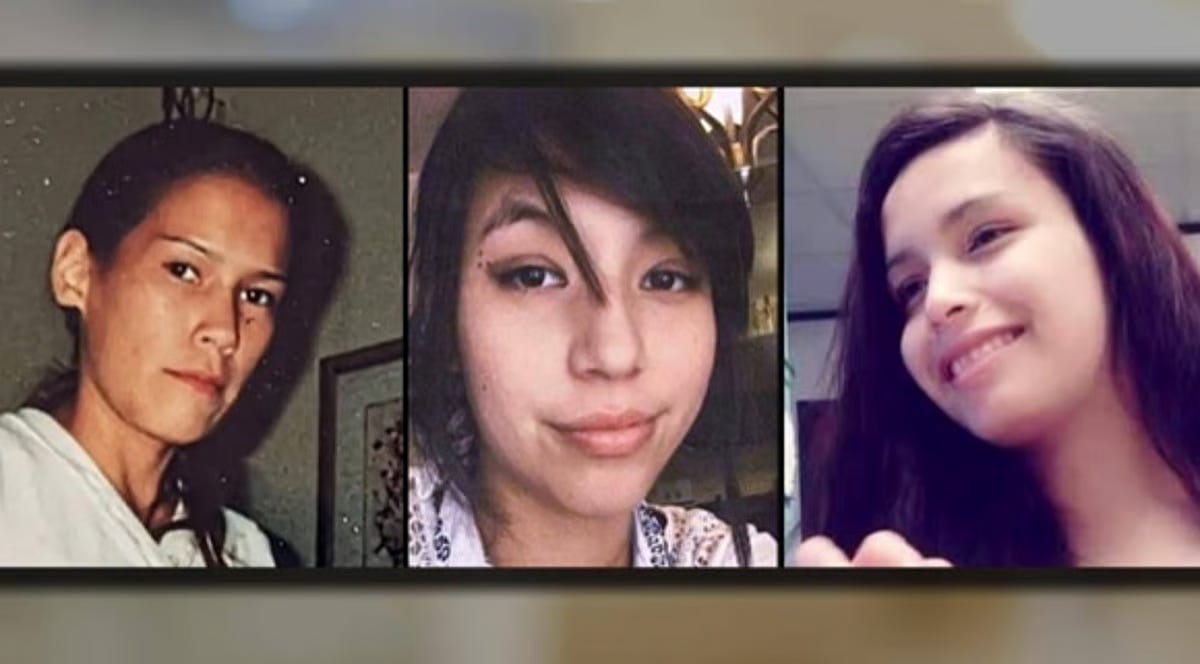
OP-ED: Do all of us suffer when one of us goes missing?
"Nigaan Sinclair, an Anishinaabe professor of native studies at the University of Manitoba has recently argued that 'We all suffer when one of us goes missing.'"

Author: Hymie Rubenstein
Nigaan Sinclair, an Anishinaabe professor of native studies at the University of Manitoba and an indigenous issues weekly columnist at the Winnipeg Free Press, has recently argued that “We all suffer when one of us goes missing.”
“Goes missing,” for Sinclair, refers to that fact that:
“Nearly every First Nation in this province has had at least one of their daughters, sisters, cousins, aunties, mothers or grandmothers go missing. In some First Nations, such as Sagkeeng First Nation, dozens are missing.
“This is not to mention the many missing Indigenous men and boys in this province.
“This has all been reported before. Manitoba has one of the highest rates of murdered and missing Indigenous people on the continent; many cases have gone cold.”
Elsewhere, Sinclair opined that, “The epidemic of violence Indigenous women and girls have experienced, and continue to endure, is a national emergency” because it bears the features of a genocide against aboriginals.
Words like these, nearly always highlighted by the genocide charge, are part of a non-stop refrain loudly promoted for decades now by indigenous leaders, activists, advisors, hangers-on, and other members of the highly lucrative and powerful Indian Industry.
Is there any legal, moral or factual basis for their assertions?
On its face, there isn’t, since none of the United Nations Convention on the Prevention and Punishment of the Crime of Genocide’s features readily apply to the random murder or disappearance of some 1,200 Indigenous women and girls between 1980 and 2020.
Despite the many differences and the varying definitions of genocide, there is one necessary and sufficient feature that distinguishes a genuine genocide: that the murder of members of another group be deliberate, systematic and organized, as opposed to coincidental, unconnected and uncoordinated.
This is why the United Nations General Assembly resolved in 1946 that, “Genocide is a denial of the right of existence of entire human groups, as homicide is the denial of the right to live of individual human beings.”
What this means is that lots of indiscriminate murders, however heart-breaking and outrageous they may be, do not add up to genocide.
Indeed, while the high level of murdered and missing indigenous people should worry all of us, as should the disproportionate number of murdered and missing indigenous people, for Sinclair the “we” in “we all suffer” refers only to missing and murdered aboriginals, even though multiple times more non-indigenous people go missing or are murdered in Canada every year.
Moreover, combining missing and murdered women inflates the toll because 14 percent of the total comprises missing persons, many of whom are eventually located alive. This reduces the estimated murders to 32 per year between 1980 and 2012, as determined by two RCMP reports. This, in turn, yields an annual Indigenous female murder rate of 5 per 100,000 during the period in question.
By way of comparison, Honduras, a country with an indigenous population proportionately twice as large as Canada’s, has 12 times this murder rate, but has never been accused of genocide.
These data simply do not support the use of words like “epidemic” or “emergency” when compared to real genocides.
Rather than being an inter-group form of violence, the evidence from Canada also shows that the murder of aboriginal females is largely confined to the indigenous community itself. RCMP statistics reveal that 70-90 percent of murders are committed by indigenous men who knew their victims; 72 percent of Indigenous women are murdered in their homes; and very few women in the sex trade, indigenous or otherwise, are murdered by their clients.
Contrary to urban mythology based on the vile Robert Pickton saga, the RCMP reports conclude that, “… it would be inappropriate to suggest any significant difference in the prevalence of sex trade workers among Aboriginal female homicide victims as compared to non-Aboriginal female homicide victims.”
Every random murder should be seen as a civil outrage, and the murder and disappearance of some 1,200 indigenous women and children is undeniably a tragedy. Sadly, however, it is shared with non-aboriginals suffering from similar domestic pathologies including broken homes, negligent parenting, family trauma, physical and emotional abuse, substance addiction, joblessness, and the hopelessness of inter-generational welfare dependence.
Add to this the destructive burden of the special status aboriginals have based on the Royal Proclamation of 1763, the treaty-based Indian Reserve system, the Indian Act, Gladue sentencing principles, and sections 25 and 35 of the 1982 Canadian Constitution, none of which are considered by Sinclair.
As one commentator has just argued:
“If the policies proposed in the [Pierre Trudeau’s] White Paper had been implemented 56 years ago [abolishing these privileges], Canada would be a stronger, more united country. Instead, indigenous people live in misery on reserves in a form of racial apartheid while constant pandering to the indigenous industry is cratering the Canadian economy.”
Sinclair would surely strongly oppose ending these special rights. Instead, he simplistically argues that the root causes of these murders are “a toxic mixture of societal apathy, systemic paralysis, and widescale belief that Indigenous people — and women and girls and two-spirit [homosexual] people in particular — aren’t human beings on par with everyone else.”
Translation: systemic racism is the cause of all these indigenous murders, even though they are mainly at the hands of other indigenous people.
This is why Sinclair’s reductionistic, monocausal explanation that “If Indigenous people were treated as human beings, one could say with certainty that none exist in landfills – but one cannot say this” is nothing more than rhetorical nonsense.
Hymie Rubenstein, editor of REAL Indigenous Report and REAL Israel & Palestine Report, is a retired professor of anthropology at the University of Manitoba and a senior fellow at the Frontier Centre for Public Policy.


Natives are victims of other natives. Stop blaming whitey. Abuse in homes causes runaways. Native men abuse their women. They become prostitutes. Prostitutes often are abused and murdered and die of drugs use. Native men die of drug use in the cities, so the reserves don't know where they went. This problem is a native problem, not a society, not a white man's problem.
Excellent op-ed by Rubenstein. One caveat, though. He quotes the RCMP report as saying: "“… it would be INAPPROPRIATE to suggest significant difference in the prevalence of sex trade workers among Aboriginal female homicide victims as compared to non-Aboriginal female homicide victims.” What does this mean exactly? Inappropriate is a strange word to be using in statistical analysis. You would expect the report to say that Aboriginal female sex trade workers have or don't have a significantly higher or lower homicide rate than non-Aboriginals, but it doesn't say that. I won't review the data myself as it is too unpleasant a subject, but perhaps Rubenstein or one of his colleagues could do that.