
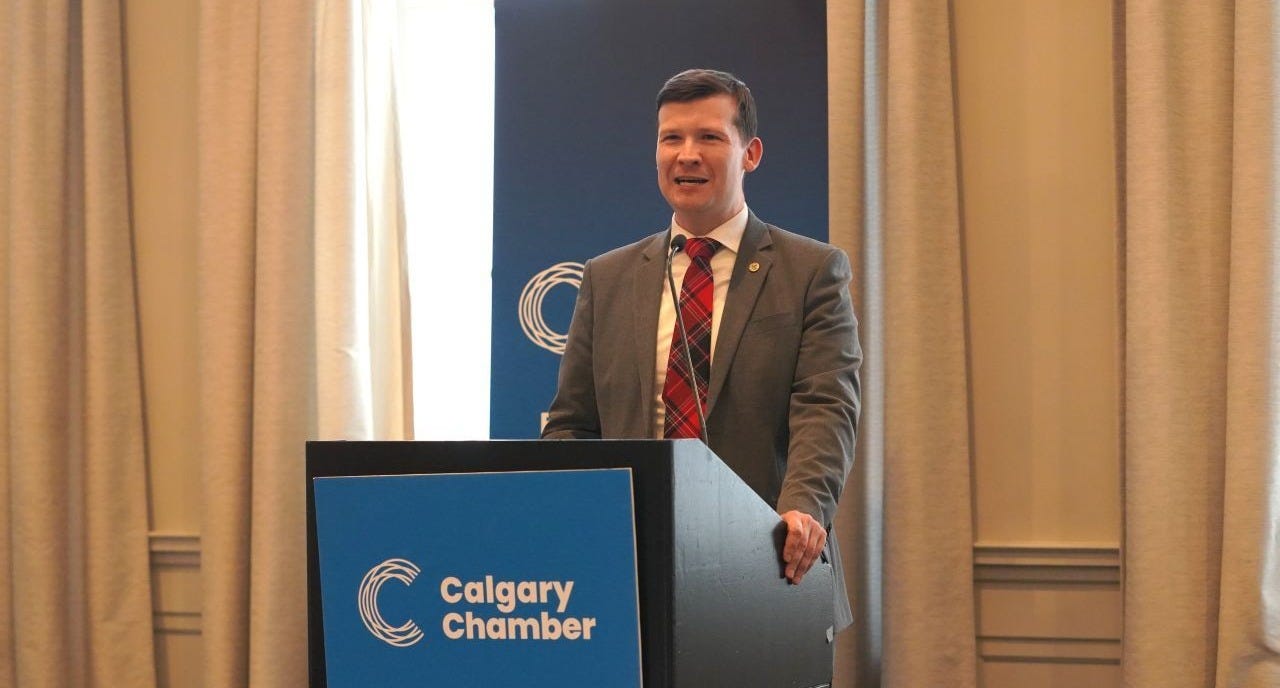
“Bullsh*t.”
This was Calgary Mayor Jeromy Farkas’s performative response to a damning Global News story that revealed the City bureaucracy’s preliminary recommendations for the upcoming four-year budget cycle.
Their ask was incomprehensible.
If City Council were to approve all the spending requests put forward by the bureaucracy, Calgarians would face a single-year 20.2% increase in property taxes and a 55% compounded increase over the next four years.
Such a massive budget increase request, from the same bureaucracy that has been mismanaging Calgary’s water pipes for decades, should have been laughed out of the room.
Instead, City Council made the meek 8-7 decision to ask the City bureaucrats to come back with a revised plan for an eye-watering 15% increase next year and a compounded 49% increase over four years
Oh, how kind of them. At a time when Calgarians are facing an affordability crisis and uncertainty from the federal Liberal government’s revived trade war with the United States, City Council believes it is acceptable to ask, as representatives of its residents, for a mere 15% increase.
Of course, the next question anyone would ask is: what was the breakdown of spending requests from the City that led to such a massive increase in the first place?
Well, unfortunately, Calgary taxpayers may never know.
Why? According to the Global News report, Council spent much of its July 28 meeting reviewing more than 107 additional funding requests behind closed doors in what is known as an ‘in camera session’.
Normally, these closed-door presentations are meant to be conducted when matters of privacy or discretion are fundamental; this may include items such as new proposals by developers which would prevent speculative purchases, or confidential personal information.
In Alberta, municipalities are creations of the Provincial government. The Provincial Municipal Affairs department has laid out clear rules for using in camera sessions. In fact, they have an entire document outlining when, why, and how municipalities are to use in camera sessions. There is even an entire section dedicated to providing specific examples of items which are not to be discussed behind closed doors.
And what would be the first item on the list?
“Budget deliberations.”
Specifically, the guidelines identify “tax assessments and mill rates, capital expenditures, and budget requirements for hiring additional municipal staff.”
Perhaps the Municipal Affairs minister should send a highlighted copy to Calgary City Council.
It is possible, of course, that some components of the meeting on July 28 should remain confidential, but the problem here is the principle.
If the bureaucrats at City Hall are proposing to substantially hike taxes and increase operational spending, taxpayers should not have to learn about it through a leaked document.
And that brings us back to Mayor Jeromy Farkas.
When confronted with the accusation that Council “desperately wanted to keep this a secret,” Farkas’s response was, to put it mildly, emphatic:
“Bullsh*t.”
Instead of addressing the concerns raised by Calgarians about the proposed budget - and his vote for a 15% increase - Mayor Farkas has decided to go on the attack, and nothing could be more hypocritical.
Transparency and fiscal accountability at City Hall are not new to Mayor Farkas.
They are the main pillars of his political brand.
As far back as 2013, Jeromy Farkas started his career as a watchdog of City Council. During his time at the Manning Foundation for Building Democracy, he produced a series of Council Tracker reports that gave Councillors a “taxpayer-friendly score” based on whether they chose to vote for tax increases. These reports also highlighted the extreme number of in camera sessions City Council held.
In the years before Farkas became a City Councillor, he defined himself by his scrutiny of Council overspending and their use of secret sessions.
This legacy carried into his time as a City Councillor.
In 2018, he made waves after decrying the use of closed-door meetings and explaining, “provincial law states only very specific items should be in-camera, and (Farkas) feels that’s not being followed in Calgary.”
The irony is hard to miss.
The man who once built his reputation documenting Calgary’s secretive Council meetings is now asking Calgarians to accept that a massive tax-and-spending debate needs to happen behind closed doors.
Even Mayor Farkas can see his own hypocrisy.
As part of his platform during the last election, Farkas highlighted a policy to “Limit in camera scope by adopting a ’narrow interpretation’ policy where only the specific, sensitive portion of a discussion is held in camera, while the remainder remains public. For example, Council could debate general principles in open session, moving in camera only for contract details or legal advice.”
This is an entirely reasonable policy proposal, but it is completely different from how the July 28 meeting was conducted, and the Council Watchdog version of Jeromy Farkas would be completely appalled.
Now, on the other hand, when confronted with questions of fiscal responsibility and secrecy, his answer is simply:
“Bullsh*t.”
Perhaps Mayor Farkas should spend less time blustering in front of a camera and more time reflecting on the promises he made to Calgarians.
If the City of Calgary wishes to raise taxes on Calgarians, it should do so in public and under Calgarians’ scrutiny; anything else is, as Mayor Farkas says, “bullsh*t.”


