
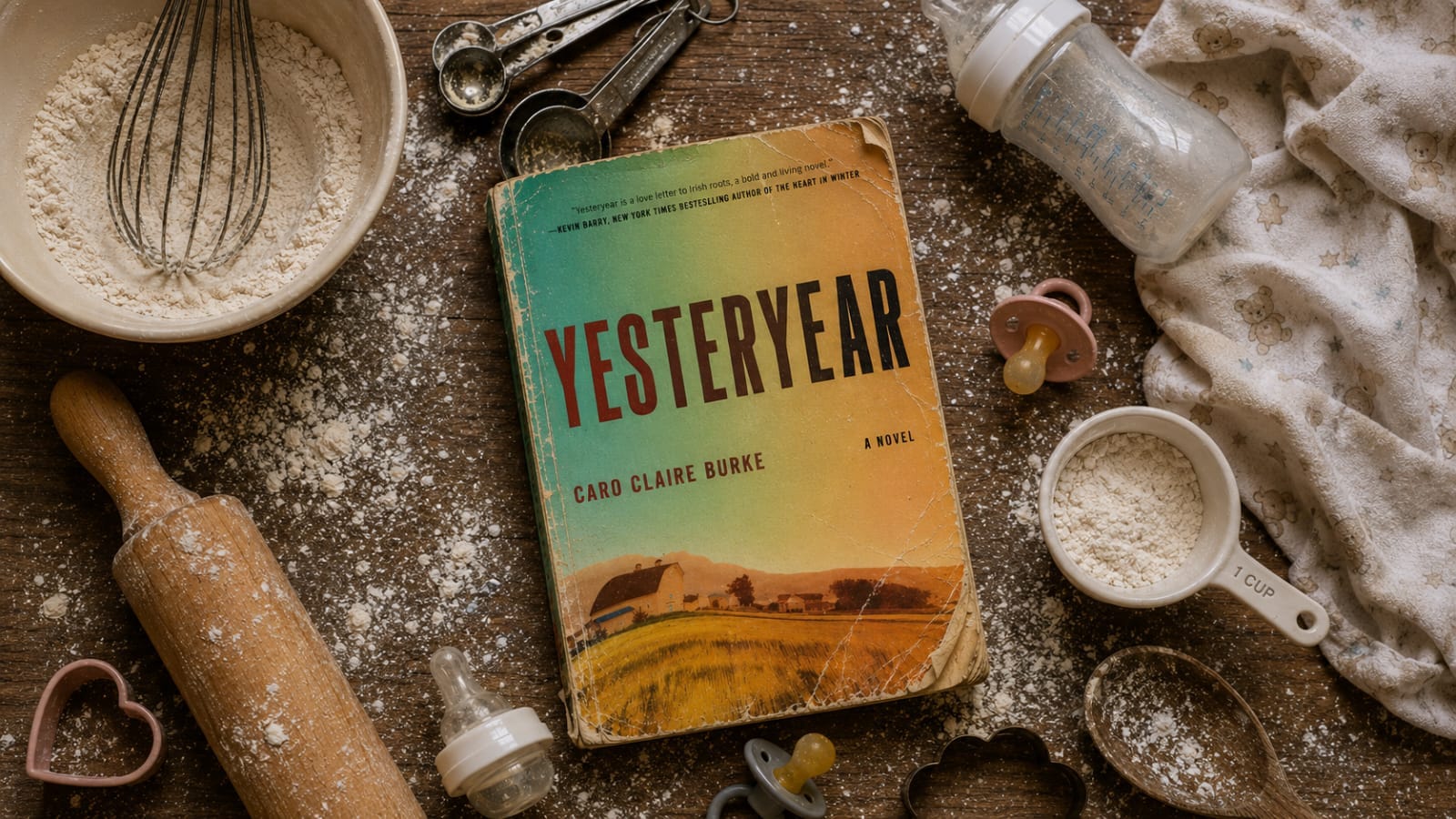
BOOK REVIEW: A trad wife's review of Yesteryear
Caitlyn Madlener writes, "Ultimately, the novel attempts to critique conservative women, religious women, and traditional lifestyles through its protagonist."
Caitlyn Madlener is a former political consultant and activist who has worked both inside and outside formal political organizations. She is now a full-time stay-at-home mother raising her three toddlers.
If one were to gently chip away at Vincent van Gogh’s vibrant painting Patch of Grass, one would find an entirely different image beneath it. Instead of the rainbow of bright blades of grass presented on its surface, the hidden painting is a moody portrait of a young man. This was a common phenomenon among artists; reusing old canvases saved money and allowed them to apply a fresh veneer over parts of their work they may not have been especially proud of.
The idea of disguising one’s shortcomings by slathering on a bit of new paint is the essential concept behind Caro Claire Burke’s debut novel Yesteryear.
The book—which has quickly become a bestseller, topping all manner of book charts and was quickly picked up for a film adaptation by Amazon Studios—tells the story of Natalie Heller Mills, a deeply troubled “trad wife” influencer who one day wakes up to find herself living in 1855 and must now contend with all the hardships of the time.
Of course, that is merely what the back of the dust jacket attempts to hook readers with. But, like Patch of Grass, what lies underneath is not at all what it appears to be.
Perhaps this is one of the novel’s central problems: it has no clear conception of what it wishes to be. If one were to believe the marketable dust jacket, one would expect a satirical novel filled with irony and witty social commentary. Yet the actual novel merely brushes against these genres. (I find more biting satire listening to Barbie Girl by Aqua than reading this book.) Instead, the novel leaves one wondering whether it aspires to be American Psycho, American Pie, or simply the lyrics of American Idiot.
If you were hoping for a fun beach read, this is not the novel for you. (Unless, of course, you enjoy reading the Unabomber manifesto while sipping mai tais in Hawaii.)
No, what was promised to readers on the back is not what the story delivers, and the irony could not be more obvious.
As stated, one of the novel’s central themes is performance as a means of concealing one’s faults, yet the book itself becomes an example of the problem it seeks to critique. The back-cover description promises sharp social commentary and quasi-fantastical elements, but the actual story is populated by characters and situations so exaggerated that they cease to resemble real human beings. At one point in the novel, our main character utilizes a turkey baster in an attempt to get herself pregnant because her husband’s sexual desires are, let’s say, “deflated”. Of course the author would have you believe this is satirical, but taken in context of the darker tones of the novel it comes off as odd and slightly disturbing.
The result of this absurdity is a novel ostensibly commenting on contemporary culture while constructing a world that bears little resemblance to it. The increasingly implausible scenarios eventually culminate in an ending so overdone that it feels less like the natural conclusion of a story and more like an exercise designed to impress a university creative writing seminar.
I was looking forward to engaging with the novel’s themes surrounding what it means to be a “trad wife” (a label that could reasonably be applied to my life) but there is ultimately very little to engage with.
This veneer of sincerity is only made worse by the fact that the main character does not genuinely believe in the lifestyle she promotes. In fact, very few characters seem to sincerely believe in anything at all. For example, our main character is presented as some kind of religious fundamentalist (the exact kind is unclear), yet she never attends church and her internal prayers with a higher being amount to nothing more than a series of apologies for swearing. If the author wished to comment on the beliefs different characters hold, one would expect them to actually hold those beliefs. Yet that is rarely the case.
It is possible this is intentional: a commentary on social media, politics, and modern identity as forms of performance instead of genuine belief. But the truth is that this ignores the reality that many people genuinely do believe in the values being discussed, whether those values concern family, religion, homemaking, or community. And this ignorance undermines any form of commentary. If every belief is merely a façade, the critique loses its target.
Another problem with the novel is that the main character shows little attachment to any coherent value system, and one would hope she might at least demonstrate some growth throughout the novel. But, as seems to be a prerequisite for many modern literary protagonists, there is no character arc to speak of. Rather than portraying a person genuinely attempting to improve herself, Natalie remains so consistently unpleasant, mean-spirited, and self-absorbed that she becomes difficult to engage with. In the opening of the book, the main character has a harmless interaction with someone she went to high school with, her internal monologue is so full of hatred it is hard to read. At the end of their interaction she thinks: “Pity. I pitied her. But also: fuck her. Sorry, Lord, but really, fuck her-”. This vitriol is incessant in every interaction the main character has, not even her own husband or children are exempt from this disgust.
Instead of feeling like a fully realized person, Natalie often reads as a vehicle for the author’s frustrations and assumptions. The author has denied that the character was inspired by figures such as Hannah Neeleman of Ballerina Farm, yet the similarities are difficult to ignore. More strikingly, the narrative’s hostility appears directed less at influencer culture itself and more at the people participating in it.
This becomes especially apparent in the novel’s treatment of influencers. I found it interesting how much of the criticism aimed at “trad wife influencers” resembled the criticism once directed at self-made women such as Martha Stewart. Stewart presented a polished homemaker persona through her television shows and books, yet behind the scenes she was also a formidable businesswoman. Critics often treated these two facts as contradictory when they were simply different aspects of the same person.
But what exactly do we expect? Many of these women are entrepreneurs, content creators, and mothers who happen to produce aesthetically pleasing content. Audiences consume that content for the same reasons they purchased Martha Stewart’s cookbooks or watched her television programs: inspiration, entertainment, and practical ideas. The assumption that viewers are being manipulated into adopting a political ideology frequently says more about the nay-sayer than the audience. Most of these women do not even describe themselves as trad wives; the term is more often hurled as a mildly contemptuous label than embraced as a self-description.
The reaction to “trad wife” figures such as Nara Smith illustrates this tendency (the model-turned-homemaker with 4.7 million Instagram followers). Critics often approach these women with the assumption that they must be promoting something sinister, only to discover that they are largely creating content about the parts of their lives they enjoy, whether that be cooking, homemaking, or family life. The hostility frequently appears disproportionate to the mundane activities they engage in.
More broadly, the novel misunderstands the appeal of homesteading, rural aesthetics, and what the author described in an interview as a fascination with “Wild West Americana.” Of course the author misinterprets the attraction as a desire to recreate the social norms of the nineteenth century. But for many people, it represents a reaction against the constant presence of technology and modern consumer culture. It is the contemporary equivalent of wanting to slow down and reconnect with tangible skills, whether baking bread, gardening, sewing, or raising animals.
Ironically, the author herself has spoken about her dissatisfaction with the overbearing nature of social media, yet she seems unable to understand why others might seek alternatives to it. Instead, the novel presents a false choice between total technological immersion and ideological alternatives many readers will find equally unappealing. Missing entirely is the reality that most people live comfortably between these extremes. They enjoy modern conveniences while also valuing traditional skills, family life, and self-sufficiency. (In one interview, the author suggested that the only alternative to life as either a corporate career woman or a stay-at-home wife was... Marxism? At that point, one begins to understand why the novel struggles to locate any middle ground.)
Likewise, admiration for pioneer life is rarely rooted in a desire to replicate every aspect of the past. Rather, it stems from respect for the resilience, determination, and sacrifices of those who lived through difficult circumstances. The stories of pioneer women are often inspiring precisely because of the challenges they overcame, not because of the restrictions imposed on them.
Famed Western author Larry McMurtry uses the following T. K. Whipple quote to open his novel Lonesome Dove: “All America lies at the end of the wilderness road, and our past is not a dead past, but still lives in us. Our forefathers had civilization inside themselves, the wild outside. We live in the civilization they created, but within us the wilderness still lingers. What they dreamed, we live, and what they lived, we dream.” This is a far more thoughtful and insightful take on the issue than Burke could ever conceive. (To be fair, comparing Burke to McMurtry is like mistaking chocolate for well…you know.)
Ultimately, the novel attempts to critique conservative women, religious women, and traditional lifestyles through its protagonist. Yet because the protagonist genuinely embodies none of those beliefs, the critique never lands. The novel spends so much time attacking a caricature that it never meaningfully engages with the real people it claims to examine.
So, we find ourselves back at Van Gogh’s Patch of Grass. The problem is not that there is another painting hidden underneath. Sometimes the image beneath is more interesting than the one on the surface. The problem is that Yesteryear spends so much effort painting over its flaws in character and commentary, it presents a meaningless mess of wayward brushstrokes whose only emotional resonance is confusion.


