

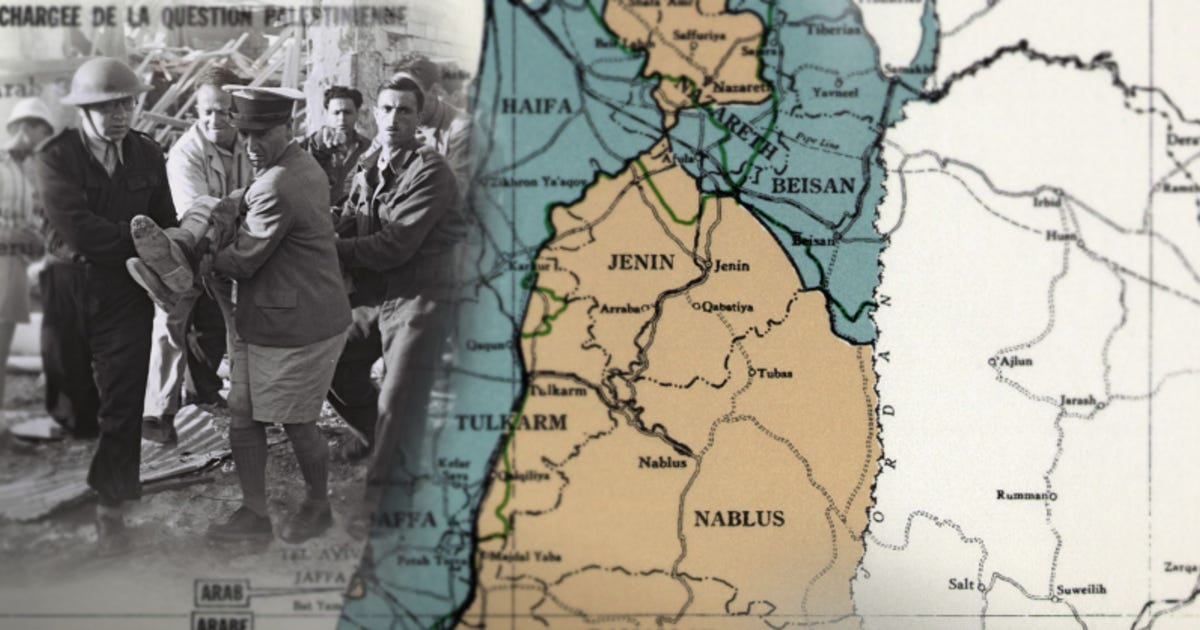
As the Canadian Museum for Human Rights in Winnipeg’s “Nakba exhibit” has come under fire for posing a one-sided perspective of the history around the displacement of 700,000 arabs from Israel following the Arab war against the establishment of Israel in 1947, a think tank is pushing back with a detailed debunking of the museum and activists’ narrative.
The Aristotle Foundation released “The Nakba: The Consequence of a War,” a 23-page study disputing the museum and activists’ narrative of what they call “the Nakba.” The term in Arabic means “catastrophe,” which anti-zionist activists say began in 1947, when the UN voted to recognize Israel in a partition vote.

The study concludes that after reviewing documented evidence, “it is impossible to characterize the displacement of Arabs from Palestine as anything other than the consequences of warfare that accompany all major modern conflicts.”
“The purpose of this study is to point out that throughout history, stretching at least as far back as the Peloponnesian War between Sparta and Athens, wars have created refugees,” the study reads in its introduction. “And that the ultimate cause of the population movements that arise out of wars must be laid on the backs of those who start those wars in the first place.”
The study explores the nuances of the time, and disputes the Canadian Museum for Human Rights’ “Nakba exhibit,” as lacking in nuance, failing to address major historical context, and for not including the work or opinions of Israeli historians.
“The attempt to paint Israeli actions and the existence of the Jewish state as a deliberate violation of human rights is inconsistent with the facts,” the study’s authors, Dr. David Bercuson and Logan Jaspers, write. “Rather than a deliberate policy of the Israeli government, Palestinian Arabs had their own refusal to accept the partition settlement and their subsequent military defeat to blame for their perceived need to leave their homes.”
The study notes that the UN created an “orderly plan” for the partition of the British Mandate of Palestine, one that the Jewish people accepted and the Palestinians outright refused.

