

Author: Hymie Rubenstein, Frontier Centre for Public Policy
Conrad Black is one of Canada’s leading historians and editorial writers, so his writing on important national issues deserves close attention.
Such is the case with his recent take on our country’s Indian Residential Schools (IRSs), titled Truth, damned truth, and reconciliation, published in his new Substack on October 30, the National Day for Truth and Reconciliation.
In a piece largely devoted to debunking the IRS cultural genocide accusation, Black begins by reminding readers that:
Words have meaning, and they matter. When the Truth and Reconciliation Commission opened its 2015 report with the proclamation that Canada had participated in “cultural genocide,” it was not providing a comprehensive assessment of Canada’s residential school policy; it was leading the witness before the testimony had begun.
The suffix “-cide” is not a decorative appendage that is open for subjective interpretation. Suicide, homicide, fratricide, infanticide, regicide: every use of it means the taking of life. Genocide is its most extreme form.
As defined by the United Nations in 1948, it means the attempted extermination of an entire nationality, ethnicity, race, or religious group. The UN convention does not mention culture.
Bolting “cultural” onto “genocide” does not somehow redefine the term. It tells a lie. It hijacks the moral weight of a word that belongs in the death camps, in Rwanda, in Western Armenia and the Khmer Rouge’s Cambodia, and transplants it where it does not belong.
What actually happened already has a name. It is called assimilation.
He goes on to note that:
“If every encounter between cultures that resulted in assimilation counted as cultural genocide, then virtually every country on Earth stands guilty of it — a verdict so broad it means nothing.”
“Many former students have gone on record to speak fondly of their time at these schools.”
“It is also worthwhile to consider what many of these children were being taken from. The conditions on many reserves in this period were hellish, unsanitary, impoverished, unsafe, and the sites of many documented instances of neglect and abuse.”
“ … the great majority of the [IRS] students were enrolled by their own parents, not forcefully torn from their arms.”
“The brutal disciplinary measures documented in Indigenous residential schools were not a feature unique to them.”
Still, I must take issue with four of Black’s assertions, which, taken together, weaken an otherwise outstanding analysis.
When Black says, “In the case of residential schools, it [assimilation] was misconceived, often badly administered, and at times, as we now know, executed with real cruelty,” he ignores that around the world during the same historical era, harsh cultural assimilation also took place in private boarding schools devoted to the education of the children of wealthy parents who sent their unruly children there to become “civilized,” an important point Black clarifies later in the essay.
“They [the IRSs] were a tragic and often cruel failure,” says Black. He also claims that “… the residential school system was a mistake.” Still, he opines that “The reality was that many native families were scattered across remote, sparsely populated areas, where it was not possible for [on reserve] schools to be built. Residential schools were the only logistically viable option.” Either they were a failure and should not have been built, or there was no alternative. Black can’t have it both ways.
Black asserts that in many documented cases, children were subjected to “sexual abuse.” But Canada has long upheld the criminal law principle of innocent until proven guilty. Criminal convictions for sexual abuse at the IRSs were fewer than 50, meaning they were the exception rather than the rule, because this works out to a minuscule 0.03 percent of the 150,000 or so indigenous students who attended these schools over the 113 years from the 1880s to 1996. Moreover, this figure is not out of line with similar sexual abuse in non-indigenous boarding schools during the same period.
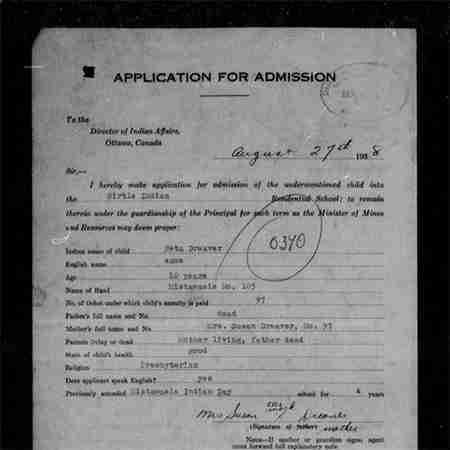
Black says, “Children were taken from their families,” contradicting his later assertion that “… the great majority of the [IRS] students were enrolled by their own parents, not forcefully torn from their arms.” The prevailing “forced to attend” canard implies that children were forcibly compelled to attend these schools. As archival data prove: school attendance, whether at a boarding, day, or public school was not mandatory until 1920; such attendance was haphazard throughout the Indian Residential School era, 1883-1996, (a pattern that continues for so-called mandatory attendance at public schools to this very day); parents or guardians were required to sign an application form (see a sample below) before they were admitted to these government-funded boarding schools; no more than one-third of indigenous children attended an IRS; those who did, attended for an average of only 4.5 years; and the only children “forced” to attend an IRS were those from orphaned, abusive, or dysfunctional homes, a legal seizure practice that continues to this very day.
Despite these criticisms and clarifications, Black still needs to be commended for producing an outstanding demolition of the cultural genocide myth.
Hymie Rubenstein is a retired professor of anthropology at the University of Manitoba and a senior fellow at the Frontier Centre for Public Policy.