


The federal government is creating another program aimed specifically at Black Canadians, backed by $135.7 million over its first five years.
Jobs and Families Minister Patty Hajdu announced the Black Canadian Communities Program during the National Black Canadians Summit in Winnipeg.
The program will begin in 2026–27. After the first five years, it will receive $27.1 million every year with no scheduled end date.
According to the government, the money is being earmarked to help Black-led, Black-serving, and Black-focused organizations grow and gain access to more funding.
It is the latest addition to a large network of federal programs created specifically for Black Canadians.
The government’s Black communities webpage lists programs for business owners, charities, housing, mental health, and the justice system. It also lists a Black-focused research institute and an advisory group that gives the minister “Black-centric expertise.”

A review of major federal announcements since 2020 found more than $1.2 billion in Black-focused funding commitments.
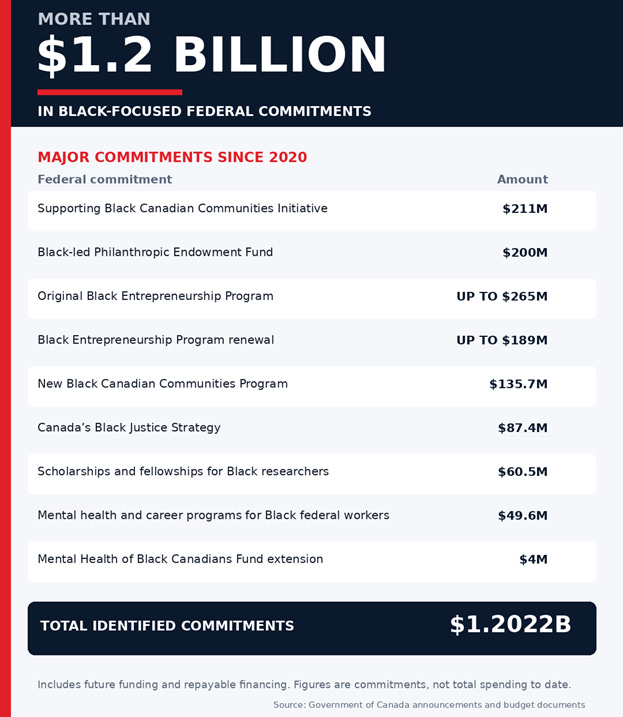
These are funding commitments, including money promised for future years and repayable business loans, not necessarily amounts already spent.
The total also leaves out several other measures.
Ottawa has set aside $50 million from an affordable housing fund for Black households and Black-led organizations. Another $10 million went to a homeownership program for Black families in the Greater Toronto Area.

The Business Development Bank of Canada has also created a separate $100-million investment fund for Black-led businesses.
Some of the programs use race as an eligibility condition.
The Black Entrepreneurship Loan Fund requires a business to be more than 51 per cent Black-owned. One community funding stream requires at least two-thirds of an organization’s leadership and governing body to identify as Black.
Federal research funding also includes scholarships and awards set aside for students who identify as Black.
Other federal spending is focused on Black Canadians without limiting every individual benefit by race. The Black Justice Strategy, for example, includes research, public-service training, and changes to justice programs.

Ottawa also funds employment, legal services, housing and community projects serving other ethnic and religious communities, but our review has not identified a comparable collection of dedicated national funding for other non-Indigenous ethnic communities.
Examples include Chinese Canadian cultural projects, Holocaust remembrance programs, and efforts to combat Islamophobia, for example.
The government says these disproportionate investments are needed to remove systemic barriers and improve life for Black Canadians.