

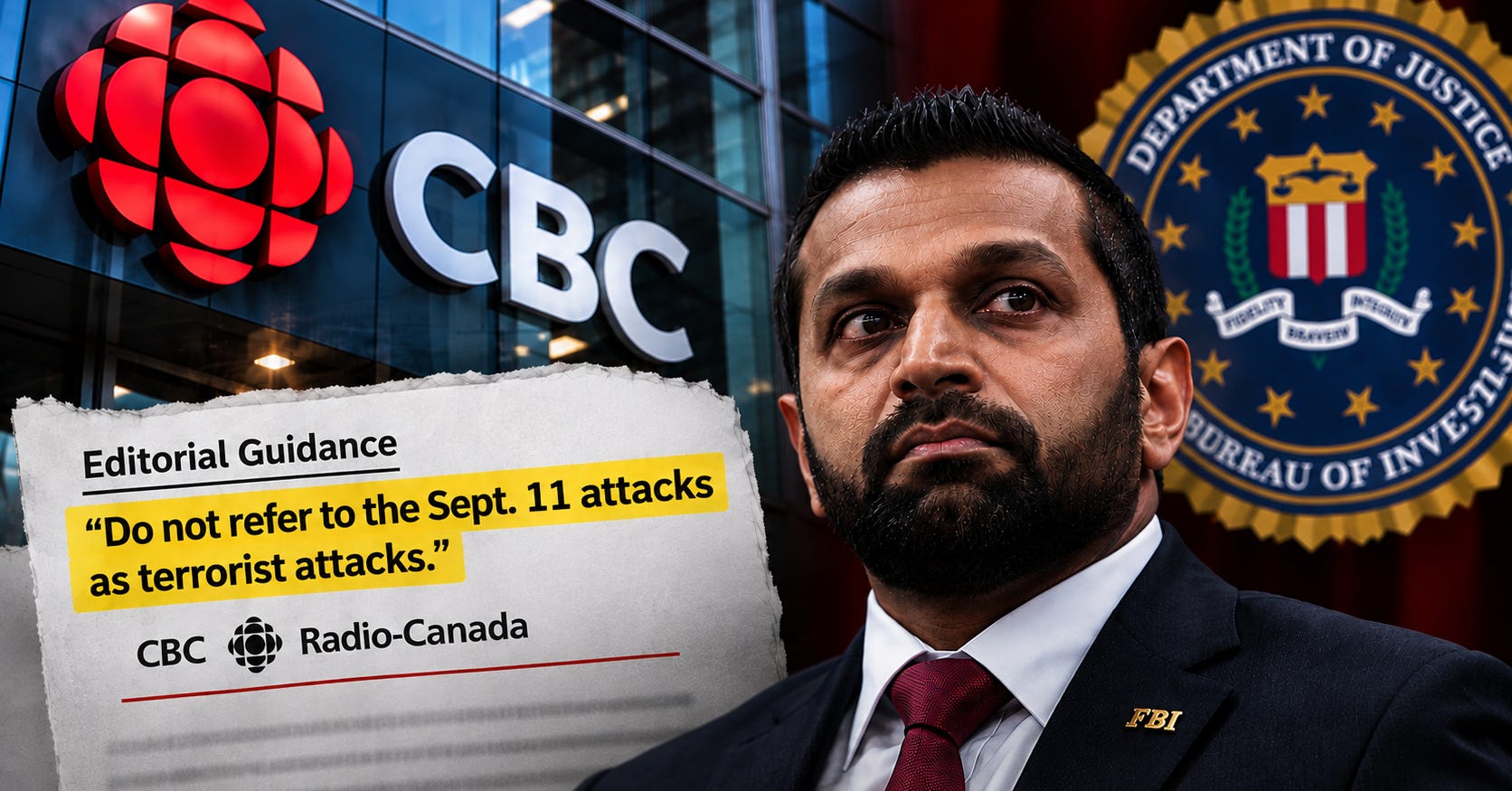
FBI Director Kash Patel reportedly made good on his threat to Canadian agencies, temporarily freezing parts of the bureau’s cooperation with the RCMP after CBC told journalists not to call 9/11 “terrorism” without attribution.
FBI officials cancelled meetings with their Canadian counterparts and warned they would be out of touch for some time, chilling relations between the two law enforcement agencies, according to multiple officials cited by the New York Times.
The freeze was short-lived and ended around the 25th anniversary of the September 11 attacks.
Not all FBI-RCMP cooperation stopped, and other parts of the U.S. government continued intelligence-sharing operations with Canada throughout the dispute.
The controversy erupted after CBC circulated longstanding internal guidance instructing journalists not to independently describe the September 11 attacks as terrorism.
“Do not refer to the September 11 attacks as terrorist attacks,” the leaked guidance reads.
Patel responded publicly with a threat to Canadian agencies that refused to condemn the policy.

“Any agency in Canada that doesn’t publicly reject this bastardization of history, and an insult to the souls lost during our largest terrorist attack in US history will no longer have friends in this FBI,” Patel wrote on X.
“WE WILL NEVER FORGET 9-11.”
According to the Times, some FBI cooperation with the RCMP stopped within days. American officials also sought some form of apology, although it remains unclear whether one was provided.
The FBI declined to comment to the Times.
The RCMP referred questions about the FBI’s intelligence-sharing practices back to the bureau.
“We value our relationship with our U.S. counterparts, as we work closely to respond to threats to national security and maintain situational awareness of emerging risks,” the RCMP said.

CBC reversed course on August 28 amid widespread backlash.
“After reviewing our current language guidance, we have decided to adjust it to clarify that direct attribution is not required for describing the historic events of 9/11 as terrorism,” Basem Boshra, CBC’s senior director of journalistic standards and public trust, said.
CBC acknowledged its guidance had caused “significant concern, anger and hurt,” while maintaining it had never denied 9/11 was terrorism.
“But to be clear, CBC News has never said what happened on September 11, 2001, was not terrorism,” Boshra said.
Nearly 3,000 people, including 24 Canadians, were killed when 19 al-Qaeda terrorists hijacked four passenger planes on September 11, 2001.


Culture Minister Marc Miller called CBC’s reversal a “welcome change to what was a piece of pedantic and foolish guidance that caused legitimate anger.”
Conservative Leader Pierre Poilievre had also blasted the original directive, calling 9/11 the “deadliest terrorist attack in American history.”

He called describing it otherwise an “appalling distortion of history” and demanded CBC apologize and retract the directive.
According to the Times, the FBI-RCMP freeze ended around the Sept. 11 anniversary.
CBC is publicly funded but editorially independent from the federal government.
CBC is publicly funded but editorially independent from the federal government. He who pays the piper calls the tune, and the Liberal government pays the CBC wages, bonuses, and expenses. "The Buck stops with the Liberal party. This can not be blamed on President Trump, Stephen Harper, (now outed a closet Carney supporter) or Pierre Poilievre.