

Authors: Ori Freiman & Lauren Frenkel
What happened at the “The Many vs The Money” counter-summit and protest at Nathan Phillips Square on September 14th should prompt CUPE members to take a closer look at the movement their union is promoting.
Held in opposition to the federal government’s Canada Investment Summit, the event brought together labour and activist groups to challenge the government’s economic agenda.
But this was more than a conventional political rally. Its organizers and affiliated activists have embraced increasingly confrontational tactics, including disruption, blockades and other forms of civil disobedience.
This was not a case of a few CUPE members independently attending a demonstration.
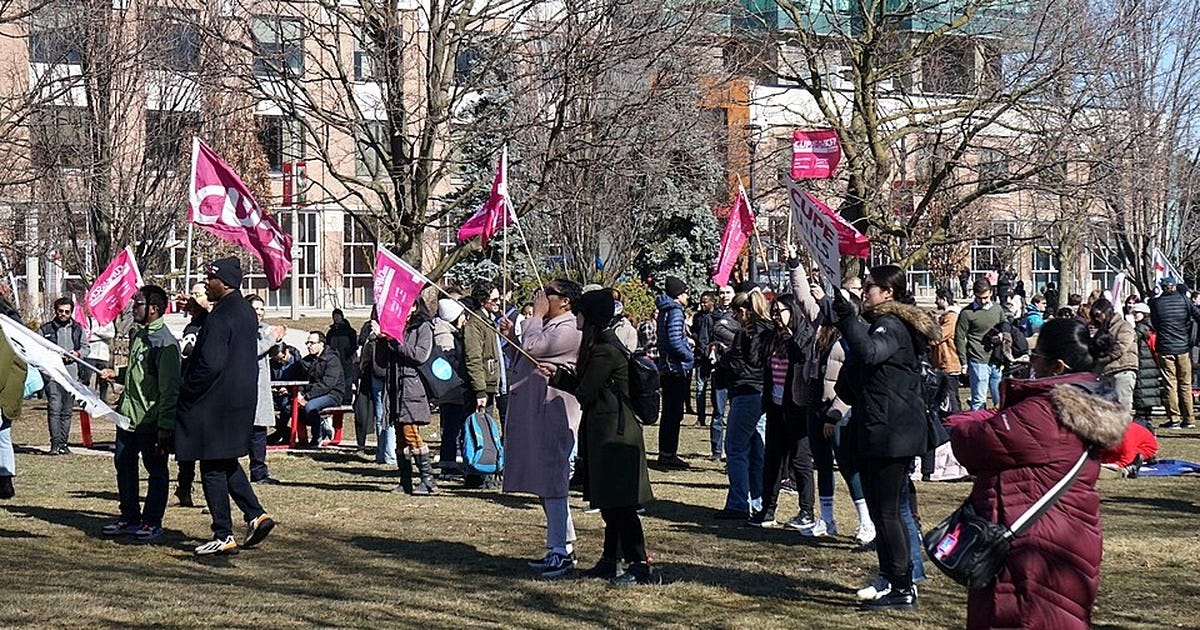
CUPE National was a formal partner of the counter-summit, while CUPE Ontario actively promoted last Monday’s event and its president, Yolanda McLean, as a speaker.
CUPE did not simply attend this event; it helped organize and promote it. All while claiming to speak for more than 300,000 CUPE Ontario members, even though fewer than 0.3% of members are eligible to vote for its president.
What is most troubling about this is the connection to World BEYOND War and its Canadian organizer, Rachel Small. Small was prominently involved in the organizing network behind Monday’s demonstration.
But World BEYOND War is not an anti-war organization, as its name suggests. Its Canadian operations are closely tied to a more radical activist network focused on targeting companies and institutions accused of supporting Israel, including through campaigns involving disruption and “direct action”.
A recent investigation by Juno News’ Melanie Bennet documented a July 2026 strategy webinar involving World BEYOND War, the Palestinian Youth Movement, Arms Embargo Now and other activist organizations.

Organizers discussed identifying Canadian companies as targets and organizing a coordinated campaign against them. Small told participants they intended to act where they could have the greatest impact, including action that could “materially disrupt” Canada’s economy. Small also praised Palestine Action UK’s campaign against Elbit and said there was “much to learn” from it.
The UK Government had already proscribed Palestine Action as a terrorist group in July 2025. The US government recently did the same.
Meanwhile, Palestine Action Canada has publicly claimed responsibility for vandalism against Canadian businesses, while the wider network has been associated with blockades and property vandalism. Small has herself been charged with two counts of mischief over $5,000 following a 2025 protest in London, Ontario. Those charges currently remain allegations.
That is the political network CUPE Ontario chose to partner with and promote — all on the dime of over 300,000 Canadian workers and taxpayers’ money.
The event itself also matters.
Organizers warned that the march would likely not be “family-friendly” and could involve an escalated police response. The rhetoric and tactics were not incidental to the event; they were part of the mobilization CUPE Ontario helped promote.
Then there is Socialist Action. They, too, are embedded within the Canadian labour movement. Its own language describes it as a “revolutionary socialist organization” and openly calls for a “socialist transformation of society” and “socialist revolution.” Their involvement is further evidence of the increasingly radical political ecosystem that CUPE Ontario leadership is leading.
The imagery at the rally was just as troubling: flags of the Islamic Republic of Iran, Soviet hammer-and-sickle symbols, Palestinian and Revolutionary Communist Party flags, along with pictures of Lenin.
CUPE Ontario should not be using workers’ dues to organize and promote events that push authoritarian and murderous regimes and violent ideologies.
This is not about CUPE members’ right to protest.
This is about CUPE National and CUPE Ontario abusing their institutional credibility, mandate, and resources as a major public sector union.
They promote events alongside organizations and activists tied to violent disruptive blockades, targeted campaigns against companies and institutions, and vandalism allegations. Those connections warrant scrutiny, particularly when the networks involved extend beyond Canada and include organizations with documented ties to proscribed groups.
CUPE’s leadership must stop their abuse of political influence.
Instead of taking care of Canadian workers and their future, they join forces with international, often radical, socialist elements. CUPE members should ask themselves whether this is really what their union is supposed to be doing with their mandatory union dues.
Fred Hahn may be gone. But the radicalization he helped normalize at CUPE Ontario clearly did not leave with him.
It’s time to re-align the public sector union’s mandate to where it belongs: the employees they represent. The global political causes belong to our politicians, not unions.
Ori Freiman, Ph.D., specializes in technology policy and is a union member; Lauren Frenkel is a health care provider and union member.