

Author: Gwyn Morgan
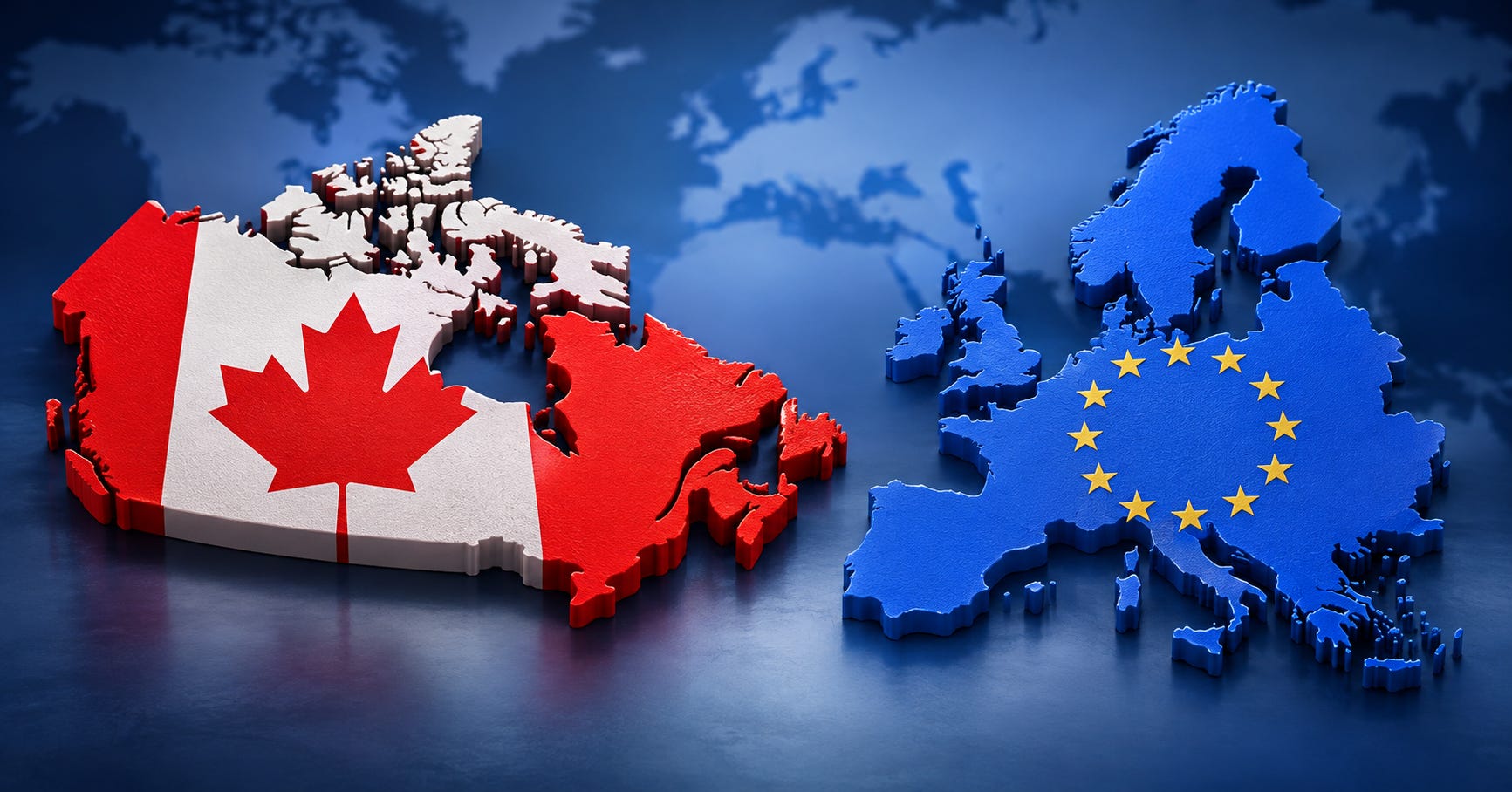
With Canada-U.S. free-trade negotiations still stalled — recent news chatter of talks restarting notwithstanding — the PM is pursuing expanded trade and stronger political ties with Europe.
His move raises two questions: What is the point, and why would Canada want closer relations with Europe at all?
Canada already has a free trade agreement with the European Union: the Comprehensive Economic and Trade Agreement (CETA). Signed in 2016, it covers nearly all trade in goods and many services.
Since it took effect, two-way trade has nearly doubled to an estimated $195 billion last year, with a reported 99 percent of goods crossing borders tariff-free.
Canada also has the Trade Continuity Agreement with Great Britain, which replicates CETA almost word-for-word, and a separate agreement with the European Free Trade Association countries of Iceland, Liechtenstein, Norway and Switzerland.
Together, these agreements have helped drive Canada–Europe trade to nearly $300 billion annually. Still, some individual EU countries still haven’t implemented CETA — so those would be good, specific tasks to focus on.
Given all of this, what does Carney’s talk of “turning to Europe” mean exactly?
If it means becoming an “associate” member of the EU, as European Commission President Ursula von der Leyen announced in late summer, Carney later confirmed, and both politicians reiterated in late October, Canadians should understand that EU membership involves much more than trade.
The EU is no mere economic bloc, but a political confederation in which the European Parliament — and, even more, the powerful European Commission — has powers superior to the governments of member countries.
This relationship substantially erodes, if not erases, the sovereignty of member nations.
It was what drove Britain to exit the EU via its “Brexit” vote in 2016. Several other nations are threatening to do so as well, while many others are in constant battle with the Eurocrats in Brussels.
And Carney wants to join?
Make Yourself Heard!
Demand a Referendum on EU Associate Membership
As Gina Pappano explained in a recent C2C Journal article, the implications could be particularly serious for Canada’s natural resource-producing provinces.
The second question is why Canada would want closer relations with Europe at all.
Former European Central Bank President Mario Draghi has described it as “a society facing a slow agony of decline.” If the slide continues, he warned, “the continent will progressively lose the ability to fund the core functions of a modern state.”
The continent faces economic stagnation and deindustrialization, while political and immigration crises deepen. The ongoing violent riots and horrific destruction we’re seeing right now all over France are taking the “slow” out of Draghi’s warning.
Canada signing on with the dysfunctional, declining, over-regulated yet increasingly lawless EU would thus be like boarding an ocean liner that’s already sinking.

Another huge factor: U.S. President Donald Trump’s warning that he could impose “very serious tariffs or stop trading with Europe on many things” if he considered Carney’s move a hostile act illustrates the huge geopolitical risks and potential economic costs.
The benefits, by contrast, are meagre and undefined.
One irony is that becoming a mere associate EU member would likely be largely ceremonial, at least for the moment, and would have little to do with trade already covered by detailed treaties.
Carney and his officials have withheld that key bit of information from Canadians.
Still, couldn’t one of Carney’s innumerable officials quietly urge their globe-trotting boss to suspend the symbolic gestures and diplomatic theatrics and buckle down to some nuts-and-bolts work at home?
There’s no end of things to do. While Canada has trade agreements with Europe and much of the Asia-Pacific, we still don’t have free trade within Canada itself. After promising to break down interprovincial trade barriers, Carney found that Quebec would have none of it and seems to have abandoned the file.
Nor can a colourful “deal book” substitute for investment.
At the Canada Investment Summit, investors were presented with 167 projects worth CAD $600 billion. But how many will ultimately prove investable rather than be abandoned like so many other great ideas during Canada’s “Lost Decade”?
Since 2015, Canada has bled a cumulative $828 billion more in capital investment than it has received.
Canadians seeking reasonable returns couldn’t find them at home and looked abroad, while foreign entities increasingly shunned Canada’s low returns and rising risks. Correcting that disastrous imbalance is vital to halting the slow-motion collapse of the Canadian dollar and reversing our industrial decline.
Canada’s domestic picture is worse: a $65.3-billion fiscal 2027 federal deficit, a gross public debt climbing to $3.4 trillion, a tax burden that consumes 42.3 percent of the average family’s income, evaporating jobs, rising unemployment, sagging productivity and sliding incomes.
These challenges merit any prime minister’s full attention.
Canada was in self-inflicted decline well before Trump became President. Carney’s fondness for palling around with European political grandees and global billionaires has not turned that situation around.
No need for overseas adventures. Plenty of work remains at home.
Gwyn Morgan is a retired business leader who has been a director of five global corporations. The original, full-length version of this article was recently published in C2C Journal.
We need to get our own house in order and stay away from the EU!
The EU is a non-elected parliament with an appointed leader, Ursula V.
This political body has absolute dictatorial control over its member states and populations.
Why would anyone person let lone any country be part or “associated” with dictators. History has shown only the worst outcomes.
Canada’s current dictator Mark Carney is already excessive, repressive and destructive, thank you very much.
The EU is nothing more than a financial black hole which needs more $$$ for its draconian needs.