

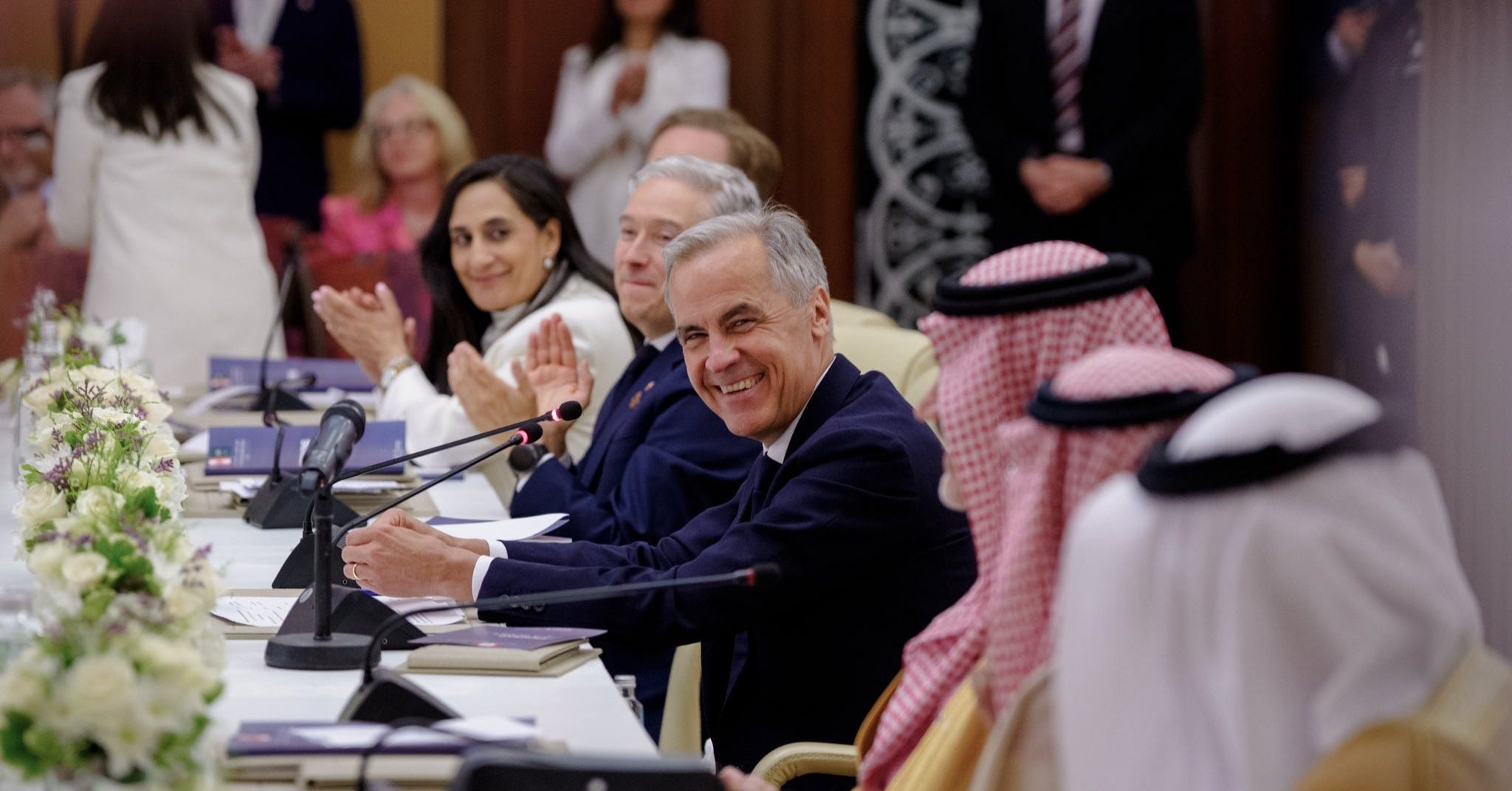
Conservative ethics critic Aaron Gunn is demanding Prime Minister Mark Carney sell his Brookfield-linked assets after his former company landed an up-to-$50-billion CPP-backed partnership, warning Canadians deserve to know whether personal profits are influencing public decisions.
“Canadians know when Brookfield benefits, you benefit too,” Gunn wrote in a letter to Carney.


The demand follows the launch of the Maple Fund, a partnership between Brookfield Asset Management and CPP Investments to pursue up to $50 billion in large-scale Canadian investments in critical infrastructure and strategic industries over five years.
Brookfield and CPP Investments can each commit up to $25 billion, with investments structured on a 50-50 basis and assessed individually.
The fund’s launch has renewed scrutiny of Carney’s former role at Brookfield and his current financial arrangements.
Carney holds Brookfield stock options and deferred shares, with staff managing a blind trust and conflict-of-interest screen designed to keep him out of potentially conflicting decisions.
According to the Toronto Star, that screen has kept Carney out of at least 17 government deliberations involving potential conflicts with his former corporate holdings, spanning files involving housing, energy and taxation.
But Gunn argues those safeguards do not go far enough.
“When Brookfield gets paid, you get paid,” Gunn wrote.


In November 2025, Brookfield chief operating officer Justin Beber told a House ethics committee that “as the value of Brookfield increases, the value of those instruments increases.”
Gunn also pointed to Carney’s interactions with Brookfield-linked interests, including what he described as lobbying by Brookfield subsidiary NorthRiver Midstream in Apr. 2025, a May meeting with Brookfield Infrastructure CEO Sam Pollock and an October meeting with Beber.
“They know that Brookfield has direct access to you as Prime Minister,” Gunn wrote.
Gunn contrasted Carney with Privy Council Clerk Michael Sabia, who helps administer Carney’s conflict screen and sold his own Brookfield shares after discovering them in his blind trust.
Beber separately confirmed under questioning that Carney’s Brookfield financial instruments could potentially be sold, bought back, cash-settled or unwound.
Asked whether doing so was possible, Beber replied: “Yes, it’s possible.”


Carney’s conflict screen has faced further scrutiny over its scope.
Conservative MP Michael Cooper previously noted that it publicly identified 103 entities, while Brookfield had roughly 2,000 owned and operated companies.
Then-ethics commissioner Konrad von Finckenstein told MPs his office did not have a comprehensive list of all 2,000 companies, but said the screen included key Brookfield holding companies that directly or indirectly owned others.
Gunn argued the screen had once failed to identify roughly 1,900 of those companies.
“This meant 1,900 missing companies that could personally enrich you if they perform well,” Gunn alleged.
Conservative Leader Pierre Poilievre has also previously called on Carney to sell his assets, arguing that a blind trust did not eliminate potential conflicts because Carney knew what he owned before the assets were placed in trust.
“Mr. Carney is clearly not blind of what he holds, because even we know what he holds due to this disclosure,” Poilievre said.

The Maple Fund has drawn further attention because the concept dates back to Carney’s tenure at Brookfield.
Brookfield previously pitched a $50-billion Canadian investment fund while Carney was its chair and advising the Trudeau government on economic policy in 2024.
That proposal reportedly envisioned $4 billion from Brookfield, $36 billion from pension funds and $10 billion from Ottawa.
The newly announced version is different: Brookfield and CPP Investments can each commit up to $25 billion over five years, with no federal investment announced.

Gunn argues the new partnership raises further questions about whether Carney’s financial interests are sufficiently separated from government decision-making.
“Canadians deserve transparency,” Gunn wrote. “They deserve to know if you are putting personal profits ahead of the national interest.”
“The solution is simple.”
“Sell them all.”
Good on Aaron Gunn who also “outed” Brookfield’s plan to acquire Powell River’s hydroelectric power dam that was originally put in place for the now defunct mill and sell it exclusively to the US for 30 years instead of using it for the town and any future development. Conservatives need to shout out Carney’s duplicity from the rooftops and let’s get him gone for the damage he is doing to our country and his dereliction of duty to OUR sovereign, parliamentary democracy.
Carney stashed his cash in a numbered company registered on an offshore tax haven, the Isle of Man. He moved Brookfield's HQ to the US for the same reason: to escape Canadian taxes. If he had a nanogram of integrity, he would resign, but he's a Liberal.