

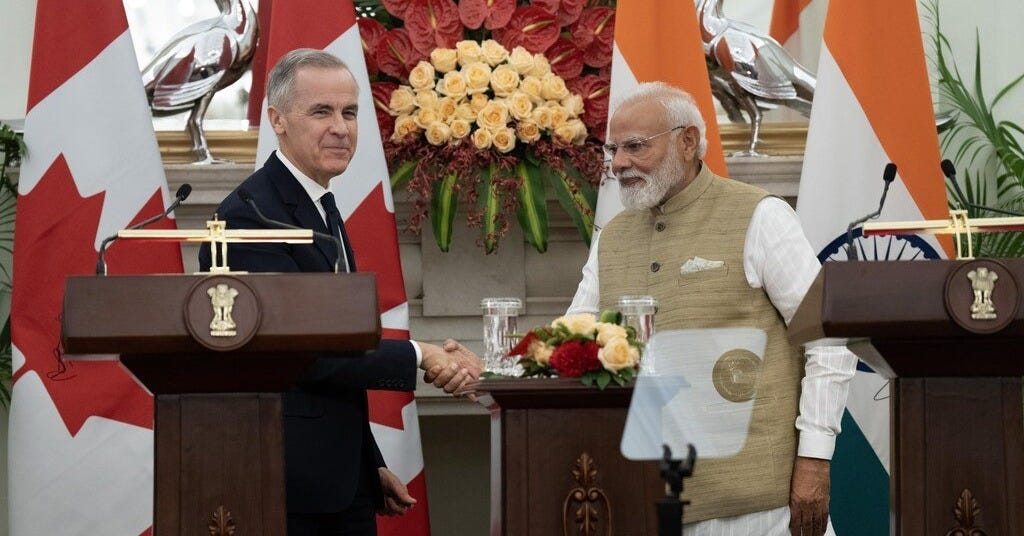
Prime Minister Mark Carney stopped short of guaranteeing India won’t once again be linked to crimes in Canada as Ottawa rapidly attempts to rebuild ties with New Delhi.
In a recent New York Times interview, Carney pointed to “some evidence” of improved security cooperation under his renewed relationship with Indian Prime Minister Narendra Modi.


Pressed on whether Canadians could expect an end to India-linked allegations involving arson, extortion, blackmail, harassment and murder, Carney offered no such guarantee.
“Can I guarantee that no crime will occur in Canada? I can’t guarantee that no crime will occur in Canada,” he said.
The response comes roughly seven months after a senior Canadian government official offered a much firmer assessment ahead of Carney’s trip to India, according to the National Post.
“We’re confident that that activity is not continuing,” the official said of previous allegations linking Indian government agents to violent crimes and threats in Canada.
“If we believed that the government of India was actively interfering in the Canadian democratic process, we probably wouldn’t be taking this trip.”


Canada’s security agencies have for years identified India as a major perpetrator of foreign interference and espionage.
In 2023, then-Prime Minister Justin Trudeau told Parliament that Canadian authorities were pursuing “credible allegations” of a potential link between Indian government agents and the killing of Sikh-Canadian Hardeep Singh Nijjar.
The RCMP escalated those allegations in October 2024, publicly accusing Indian government agents of links to violent criminal activity in Canada, including homicides, extortion, intimidation and threats.
India has repeatedly rejected allegations that its government is involved in criminal activity in Canada, calling such claims “absurd.”
Canadian intelligence warnings have continued even as relations thaw.
CSIS said in its 2025 public report that India remained among the main perpetrators of foreign interference and espionage targeting Canada and documented concerns about transnational repression against diaspora communities.
A CSIS assessment published this month described India as the “second most pervasive” perpetrator of foreign interference in Canada and said New Delhi would likely continue attempts to interfere in Canadian politics.

At the same time, Carney has moved quickly to rebuild relations with Modi’s government following years of diplomatic tensions under Trudeau.
Carney travelled to India earlier this year for the first bilateral visit to the country since 2018.
During his March meeting with Modi, the two governments moved to deepen cooperation on trade, energy, critical minerals, defence and security.
In a joint statement, Canada and India also committed to strengthening law enforcement cooperation against organized crime, extortion and criminal networks while combating transnational repression.

The economic reset is also accelerating, with a trade deal targeted for year-end and bilateral trade set to double to $70 billion by 2030.
Carney argues renewed dialogue gives Ottawa a better opportunity to confront security concerns directly.
“The security cooperation that’s part of the relationship, which obviously could not take place in a rupture, we think is helpful and good,” Carney told the Times.
“I’m a believer that, regardless of the relationship, it’s important to have a relationship so you can deliver messages directly, as opposed to preach[ing] from afar, and to limited effect.”


But some Sikh activists remain skeptical that the rapprochement has made them safer.
Queen’s University assistant professor Amarnath Amarasingam, who researches radicalization and transnational repression, called Carney’s response “a little bit dismissive.”
“One of the take-home messages is that Canada isn’t treating this as a kind of Canadian problem,” Amarasingam told the Post.
“It’s treating it almost as this diaspora problem or as a problem of ‘imported conflict’ or as a problem of ‘people not leaving their politics back home.’ And it’s not being treated with the seriousness it deserves.”
The security concerns also come amid renewed scrutiny of the Lawrence Bishnoi gang.
On Monday, the FBI added Satinderjeet Singh, also known as Goldy Brar, to its Ten Most Wanted Fugitives list and offered up to US$1 million for information leading to his arrest. U.S. authorities allege Brar is the North American leader of the Lawrence Bishnoi organized crime group.
“Goldy Brar and his network have wreaked devastating havoc on countless lives — through high-profile murders, shootings, death threats, extortion, arson, and drug trafficking,” RCMP Assistant Commissioner Lisa Moreland said in the FBI announcement.
"I can’t guarantee that no crime will occur in Canada,” Carney said.
...duh!! not while YOU'RE causing most of it , ya turd..💩