
Carney gov backs Trump admin’s stakes in Canadian mining firms
The Carney government appears to support the Trump administration’s investment in several Vancouver-based mining companies, despite its ‘elbows up’ messaging.
Last week, the Trump Administration announced it would take a 10 per cent stake in Trilogy Metals Inc. The decision is part of a $35.6 million investment to boost critical minerals projects in Alaska.
Additionally, the U.S. government acquired an interest in Lithium Americas Corp., which is developing the Thacker Pass lithium project in Nevada.
Energy Minister Tim Hodgson was asked Thursday whether this was a national security concern for the Liberals, given that Trump has repeatedly discussed annexing Canada and making it the 51st state.
However, Hodgson said it was “up to them,” referring to the U.S. government, and called the decision “capitalism in action.”
He added that the U.S. stakes are “small minority investments” in Canadian firms and that their projects are located in America.
“The fact that an ally of ours chooses to make an equity investment into a Canadian company whose sole asset is in the United States, I don’t think that bothers us at this time,” said Hodgson.
“Our two countries have been allies for many, many, many years. We have had our differences of opinions at various points in time. We’ve had our trade frictions at various points in time. We are very hopeful that we can get through this difficult time and we can resume the type of relationship that we’ve had with the Americans for a long, long time.”
This marks a dramatic shift in tone from the Carney government. Prime Minister Mark Carney repeatedly warned voters on the campaign trail that U.S. President Donald Trump intended to “break” Canada so he could “own” the country.
However, Carney immediately softened his approach to Trump after being elected, removing nearly all retaliatory tariffs against the U.S.
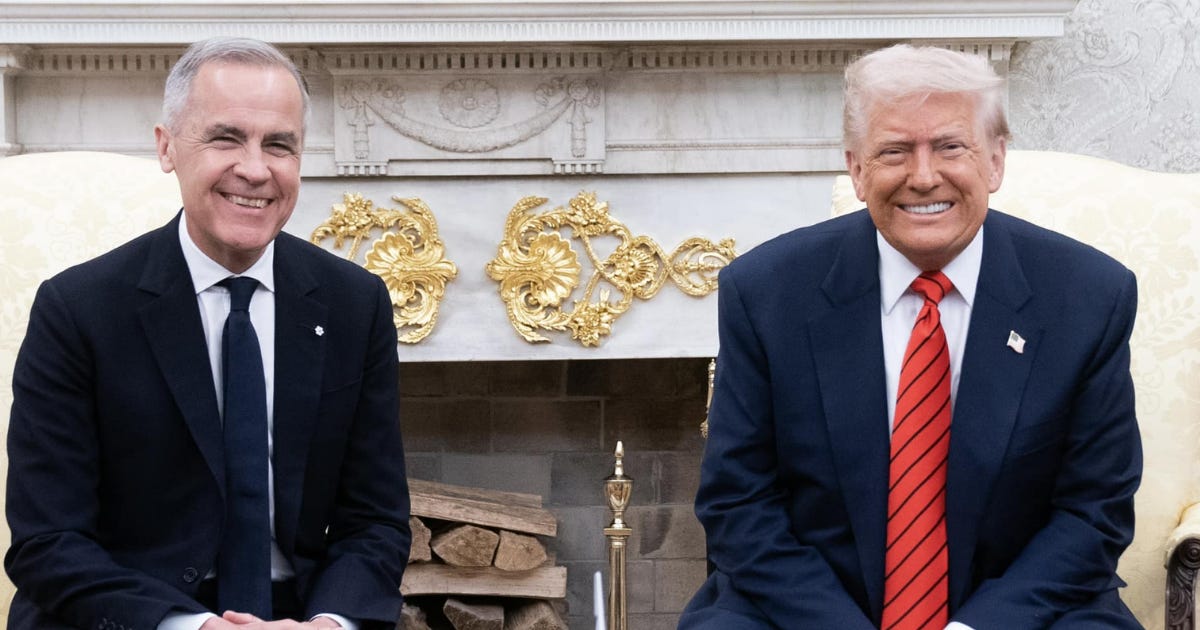
Meanwhile, Trump said there was “natural conflict” between Canada and the U.S. earlier this month before his second meeting with Carney.
The Prime Minister’s Office did not respond to True North’s request for comment.


I think many people remember all the favoritism that resulted from Canada managing the Dew Line observation system, and historically prime ministers could slide in allowances, believing they held some sway with the Americans. However, over the years, as the Dew Line became less important, the belief that Canada had influence persisted. With the collapse of Soviet Russia, Canada's perceived advantage vanished. However, Canada never arrived at terms with the fact that it needed to mature and move beyond its status as a 40-something-year-old living in their US parent's basement.
For as long as I can remember, Canadian businesses have been allowed to utilize protectionist laws initiated by the federal government, which prevent the influx of US goods while simultaneously using a weak dollar to encourage increased purchases by US firms. So now you have millions of dollars traveling in one direction while limited investment is going north. Most US administrations chose to ignore the obvious flooding of their market.
Fast forward to the migration of US jobs, during which trade pathways opened up that favored cheap human labor instead of investing in automation, resulting in the export of American jobs to economically depressed areas, including Canada. For as long as I can remember, Canada has never invested in automation to bolster the manufacturing system but rather throws people into repetitive, dangerous occupations, assuming we will just import more when the existing ones burn out. However, this approach only succeeds as long as the US economy does not support the growth of American jobs.
Trump campaigned to understand the challenges faced by American workers and to identify their main grievances. And he found what he expected: that those who used to put in an honest day's work had their jobs downsized or sent to countries like India, where for one technical person in the US, 10 full development engineers could be secured. The erosion of American jobs became evident. So Trump vowed to change this, and because he could not be bought, not being within the money stream and backscratching of the political system, he could rise into power. And put in place what the people wanted.
The real trick is Canada is still a child when it comes to marketing goods on the world stage because 77% of our goods go south (68.7% manufactured and 31.3% resource-based). Even if we do not want to admit it, Canada has been the 51st state to the US ever since the very first 2x4 went to build a house in the Midwest US. Canadians might scream "no," but ultimately stop selling to the US and find out how quickly the Canadian economy will collapse. So Canada needs a wake-up call; we need to stop living on the coattails of the US, but this would also mean Canadian-specific goods, designs, products, manufacturing, and initiatives, and not going to the store and seeing American Standard as the toilet you buy. But will this work? Demographically speaking small firms which would sell into Canada would not be able to survive because there are not enough people to buy You might be able to sell the cabinet door handles you crafted in your small shop, or the welded railings you created.
Why rage against Trump about Canadian mining companies that own mines in other countries like the USA for example? Why not bar the Canadian companies from having foreign investors? Seize the financial assets of Freedom Convoy truckers and their supporters and invest that Canadian money in these Canadian mining companies too! (tongue firmly implanted in cheek). Offer more potential mining sites in Canada if the First Nations, Quebec and BC are OK with it. Carney's nation building is similar to a two year old's Lego constructs, an incomprehensible model of something unidentifiable. Carney should stop trying to suck and blow at the same time