
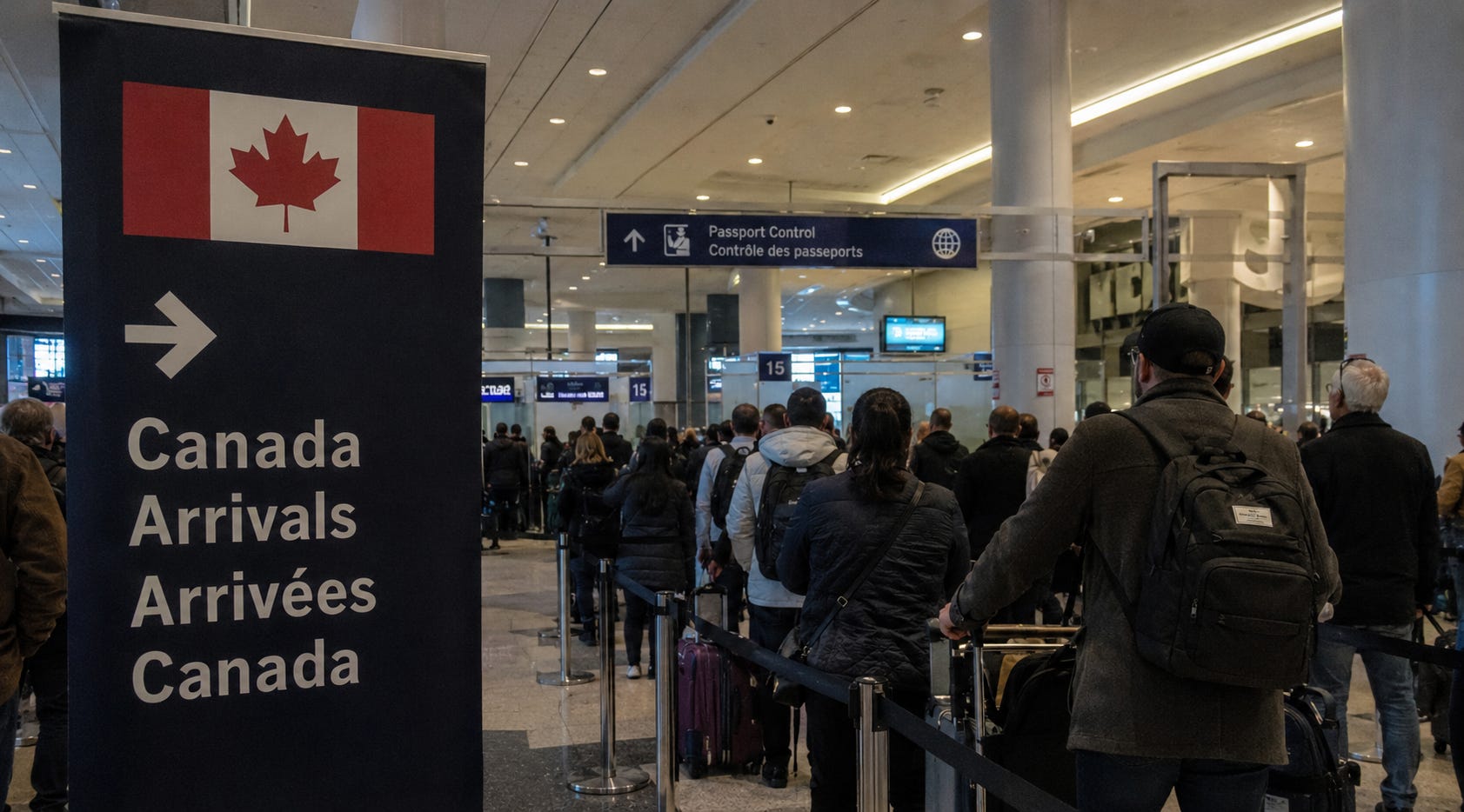
This month, Canada’s international student program has been back in the news, as former students at colleges in Calgary and Edmonton began protesting.
As previously reported by Juno News, roughly 1,000 former Indian students protested after being denied post-graduation work permits. They say they spent tens of thousands of dollars on Canadian diplomas, believing they would qualify.
Their protest lasted for several weeks before Canada Border Services Agency officers showed up and asked protesters for their immigration documents.
Canada has seen a massive explosion in the number of international students in recent years.
At the end of 2018, Canada had 572, 415 international students. By the end of 2023, that number had nearly doubled to 1,040,985. To put that into perspective, that’s more people than the populations of Halifax, Quebec City, Saskatoon, Regina and Victoria.
And about half of these students were from one country: India.
The growth was accurately described as “explosive and reckless” by Earl Blaney, an immigration consultant based in London, Ontario.
But the reality is, the situation, as it relates to international students from India, is even worse than those numbers make it appear.
A gateway for Indian gangsters
Among those who came to Canada from India through the international student program are people who would likely never have been admitted under Canada’s traditional immigration system.
In an article in Inside Policy, the flagship publication of the Macdonald-Laurier Institute, lawyer David Thomas notes that “In the 1990s, there was a different point system for immigration to Canada for an ‘independent’ applicant. Points were awarded for an applicant’s level of education, their ability to speak English and French, the type of occupation for which they had training and experience, etc.”
Thomas goes on to write “those days are over.”
An exclusive Global News story based on a classified intelligence report revealed that the Bishnoi gang, a transnational criminal organization operating primarily out of India, used Indians coming to Canada on student visas to carry out vicious crimes. The gang is listed as a terrorist entity by the Government of Canada.
The crimes include high-profile murders, a political assassination, and extortion, contributing to a nationwide extortion crisis.
According to the intelligence report, between 2019 and 2023, there were 17,929 charges laid against 4,000 Indian international students. One-third of the charges were considered serious or organized-crime related, and 97 per cent were deemed violent. Then, in 2024 alone, 13,040 criminal charges were laid against Indian international students.
A cash cow for colleges and corporations
While Canadians were subjected to the consequences of the international student program, colleges and multinational corporations saw great economic gains.
Colleges saw international students as a major revenue stream, while corporations saw them as a source of cheap labour.
Ontario’s public colleges alone accounted for more than 40 per cent of study permits issued to colleges and universities nationwide in 2023, while charging international students three to five times what Canadian students paid.
Conestoga College in Kitchener, Ont., granted more than 30,000 study permits. An audit released earlier this year alleges that the college splurged on a $636,000 salary for its then president John Tibbits, a $23,000 business class trip to Italy and a $1,300 dining expense for internal staff, where 50 per cent of the pre-tax total was alcohol.
Then there were the so-called diploma mills: private colleges often accused of failing to meet basic educational standards while serving as vehicles for funnelling international students into Canada. According to Brampton Mayor Patrick Brown, his city had as many as 80 private “diploma mill” colleges that were “using international students as an ATM.”
Then in 2022, Prime Minister Justin Trudeau removed a limit of 20 hours of off-campus work for international students, allowing someone who was supposed to be in Canada primarily to study to now work full-time hours instead.
Suddenly, multinational corporations had access to a large pool of low-skilled, low-wage workers from India and elsewhere whom they could hire instead of Canadian teenagers and seniors. This contributed to a considerable rise in youth unemployment in Canada.
Congrats Canada, you got played
It wasn’t just colleges and multinational corporations that benefited from the explosion of international students from India. The Indian government did too.
India has the world’s largest youth population, with people aged 15 to 29 comprising roughly one-third of its working-age population. But according to an article by the India Development Review notes that many of these youths are unemployed.
India has the opposite of a labour shortage: its problem is that it has too many people looking for work opportunities.
So one solution has been encouraging young Indians to go abroad.
A 2022 Migration Policy Institute article notes that “the Indian government has built multiple systems for engaging with its emigrant population,” and that “money sent as remittances represents a prime tactic for improving financial conditions.”
Remittances sent by Indians living around the world back to India amounted to approximately $120 billion CAD in 2023.
This helps explain why India’s high commissioner to Canada pitched the idea earlier this year of Canada bringing in 60 million Indians immigrants, so it can grow its population to 100 million.
“India, at this point, has a foreign policy that involves sending its low-skill males abroad, and Canada was a willing participant in it,” noted National Citizens Coalition Director of Communications Alex Brown on my podcast earlier this year.
“And it can no longer be, because it’s caused a huge problem,” Brown added.
He’s right.
Through the international student program, Canada created an immigration pathway for Indian criminals to terrorize, threaten, and, in some cases, kill Canadians. Meanwhile, Canadian colleges and multinational corporations got rich off this influx of primarily Indian students, and Canada played directly into the hands of the Indian government and its agenda to send its low-skill males abroad.
And this is why I say: Canada’s Indian Student Fiasco Is Far Worse Than It Appears.


