
Canada hands control of Vancouver to Musqueam Indian Band
The Liberal government is refusing to publicly release an agreement with the Musqueam Indian Band that recognizes Aboriginal title over a vast area of British Columbia.
The Liberal government is refusing to publicly release an agreement with the Musqueam Indian Band that recognizes Aboriginal title over a vast area of British Columbia, including Metro Vancouver and surrounding areas, potentially affecting nearly two million people.
Buried in a seemingly mundane fisheries announcement put out on February 20th, the acknowledgement could radically undermine property rights in one of Canada’s largest and most populated metropolitan regions.
On February 20, Crown-Indigenous Relations and Northern Affairs Canada issued a news release with little fanfare titled “Musqueam and Canada Sign Historic Agreements Recognizing Rights, Stewardship and Fisheries.”
The news release reads: Canada “recognizes that Musqueam has Aboriginal rights including title within their traditional territory and establishes a framework for incremental implementation of rights and nation-to-nation relations with Canada.”
That phrase “including title” refers to Aboriginal title. Under Canadian constitutional law, Aboriginal title is a contentious but increasingly recognized property interest, affirmed by recent court rulings, including the controversial Cowichan decision. Courts have recognized Aboriginal title as a prior and senior right to land that critics say threatens fee simple title or traditional private property ownership in Canada.
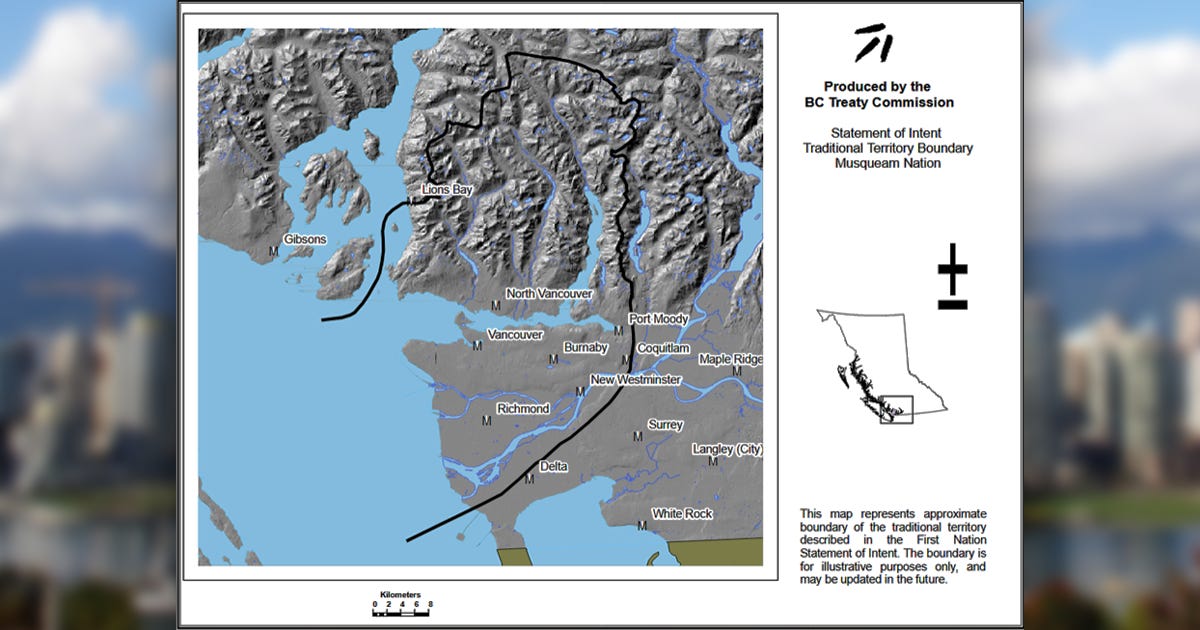
The Musqueam Indian Band’s traditional territory encompasses virtually all of Metro Vancouver, including Vancouver, West Vancouver, North Vancouver, Burnaby, Richmond, New Westminster, parts of Delta and Surrey and other regions.
Based on 2021 census and other data, that territory is home to an estimated 1.8 million British Columbians.
The federal government has now formally recognized in writing Musquem Indian Band’s Aboriginal title over that territory, yet Crown-Indigenous Relations and Northern Affairs Canada refuses to make the agreement public.
The February 20 announcement specifically refers to the “šxʷq̓ʷal̕təl̕tən Rights Recognition Agreement,” described as recognizing Musqueam’s Aboriginal rights, “including title” and establishing a framework for implementation.
Musqueam Chief Wayne Sparrow emphasized the Aboriginal title component directly in the release:
“Our Musqueam community celebrates these historic agreements as a step forward in our path to Reconciliation. In signing these agreements, the Government of Canada is acknowledging Musqueam’s Aboriginal title and rights to our traditional territory and recognizing our expertise in both marine management and fisheries management,” Sparrow said.
But when Juno News requested a copy of the agreement from Crown-Indigenous Relations, the department’s media relations spokesperson Eric Head confirmed receipt of the request and then cut communication altogether, even when pressed to ask if the agreement would be made public.
Repeated follow-ups for comment by Juno News went unanswered. As of publication, the department has not provided the document nor commented on the scope or legal implications of recognizing Aboriginal title across Metro Vancouver and surrounding areas.
A search of the Canada Gazette, the Aboriginal and Treaty Rights Information System and federal open data portals yields no publicly available copy of the signed agreement.
Aboriginal title has become a glaring problem for the governing B.C. NDP after the B.C. Supreme Court ruled in favour of Aboriginal title in the Cowichan Tribes v. Canada decision. In the ruling, Justice Barbara Young recognized Aboriginal title over portions of Richmond, which Cowichan Tribes claimed as a historic fishing settlement, declaring it “a prior and senior right to land.”
The ruling threatens to invalidate certain land titles held by Canada and the City of Richmond and instructs governments to negotiate in good faith. The case affects private homes, commercial properties and land surrounding key infrastructure and has sent a shockwave of concerns among local property owners.
That decision is now under appeal with multiple parties involved, including the Musqueam, the City of Richmond and both federal and provincial governments.
Ottawa’s recognition of Musqueam Aboriginal title across its traditional territory complicates things further. If courts affirm that Aboriginal title can supersede or significantly constrain fee simple ownership, then an agreement signed by the federal government that recognized Aboriginal title over all of Metro Vancouver could be called upon in future court showdowns.
Additionally, Musqueam’s traditional territory overlaps with areas also claimed by the Tsleil-Waututh and Squamish Nations. The North Shore and Burrard Inlet region have long been the subject of layered historical occupation and conflicting claims.
The federal agreement reportedly establishes a “framework for incremental implementation of rights and nation-to-nation relations.” But without public disclosure, neither residents nor journalists can assess what that framework entails.


Thank you for doing the work on this article.