

Author: Gwyn Morgan, C2C Journal
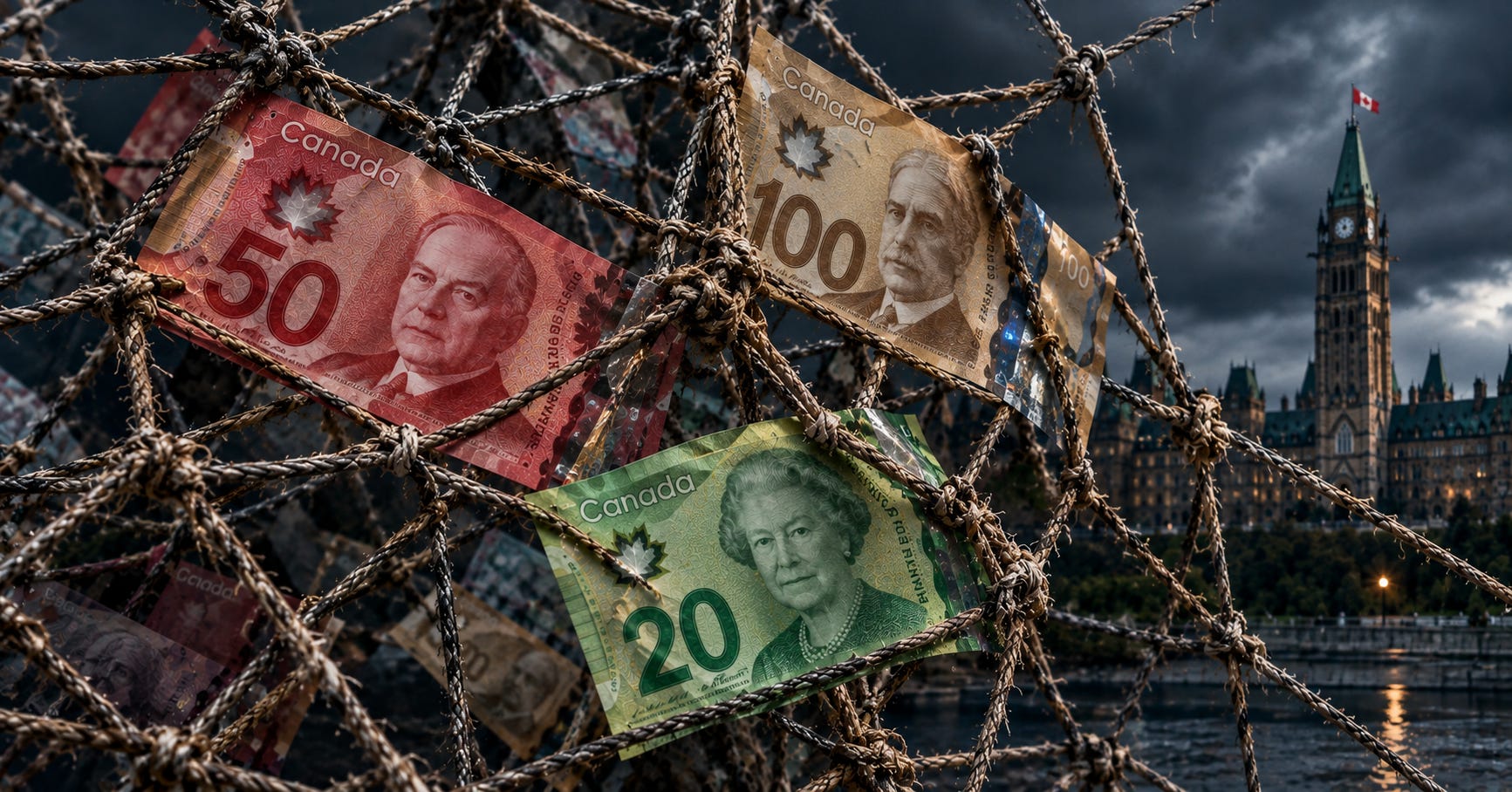
Canada is in the vulnerable position of being beset by an array of serious economic pressures all at once. The problems are largely inter-related and reinforcing one another, threatening a financial spiral from which it will be very hard to pull out.
It’s true that our nation has endured many economic burdens over its history; truly firing on all economic cylinders was more the exception than the rule. Still, rarely have so many things gone so wrong at the same time. Worse still, the current government seems unable to grapple effectively with any of it — beyond issuing a stream of announcements, plans and spending commitments.
Canadians heading to the grocery store are still finding everything getting more expensive.
A jar of jam that was $4.99 barely three years ago was $6.99 for most of this year — but is now “on sale” for that price as the “regular” price has been jacked to $7.99. A lime that could be had for 99 cents in April was $1.49 in July and, by September, $1.69. While economists would scoff at such “anecdotes,” those are still real numbers that cost people real money.
And Canadians aren’t imagining that the aggregate is getting worse. Canada is currently posting the highest annualized food inflation rate among G7 countries — 7.3 percent. According to Canada’s Food Price Report, a typical family of four now spends $17,500 per year on groceries, a year-over-year increase of $1,000.
The reasons include higher taxes that, concerning the food supply chain, amount to stacked layers of taxation that pile cost upon cost for producers, processors, shippers, wholesalers, distributors and retailers.
The reasons also include interprovincial trade barriers in a country that was founded to be a single national market but has never actually been one — not even after all of last year’s bold talk of tearing down internal trade barriers. And they include a complex and costly regulatory environment, such as endlessly shifting labelling requirements and administrative compliance burdens.
All of these policies drive up food costs for Canadians. We each pay thousands of dollars per year more than we should for the basic necessities for life itself. It is no exaggeration to call this a crisis.
Food and taxes are unfortunately just two strands of Canada’s thickening economic web of woe.
There’s an old adage that “governments spend the money, and the private sector pays for it.” A major factor in the rising cost of government is the increase of 36 percent in the number of federal public service employees from 2013 to 2023. When broader federal agencies are included, the total employee count grew to 368,000. By contrast, total private-sector employment grew by just 15 percent during this period — about the same as population growth.
If our economy was booming, such growth in government would at least be sustainable, even if it’s never optimal. But in Canada, it has been the opposite for well over a decade: the economy stagnates, government spending swells.
Combined federal, provincial and municipal government spending reached 44 percent of Canada’s entire economy in 2024 — a staggering $1.4 trillion.
And then there is the debt.
Since the Liberals gained office in 2015, Canada’s national debt has doubled to a staggering $1.6 trillion — about 50 percent of annual GDP.
Canada’s all-government debt — encompassing the federal, provincial and municipal governments as well as government-created entities — is now a hard-to-process $3.9 trillion, or 125 percent of everything the Canadian economy produces in a year.
With numbers that big, it’s no surprise the discussion has shifted from ever paying off the debt principal to merely stabilizing the annual interest costs before government finances are utterly swamped. Each Canadian taxpayer will pay between $1,825 and $3,348 per year for interest on federal and provincial government debt.
Young Canadians face another crisis: the lack of affordable housing.
The Federal Housing Advocate’s 2024-2025 Annual Report reveals a national shortfall of 4.4 million units. The Canada Mortgage and Housing Corporation estimates that Canada must build 3.5-5.8 million new homes by 2030 to restore reasonable affordability. Yet new home construction is already lagging targets.
These problems are bad enough on their own, but, as I noted above, most are entwined in a way that is steepening Canada’s decline.
Ever-higher spending and increasing debt loads demand higher taxes. Higher taxes raise the cost of food while leaving less money in people’s pockets to pay for it. More heavily-taxed businesses are less able to pay Canadian workers competitive wages, increasing the relative attractiveness of a government job. The private sector’s needs are increasingly neglected, and trade negotiations end up prioritizing political goals. And on it goes.
That is the web of woe in which Canada now finds itself.
At the top of the list right now is the Canada/U.S. trade agreement. Navigating our relationship with Donald Trump’s America is like trying to steer a canoe through rock-strewn rapids. Doing so with the current Liberal government in charge of Canada’s fate is like having a drunken old coureur des bois who forgot the paddles, yelling directions from the back of the boat.
We will need courage and creativity merely to survive.
Gwyn Morgan is a retired business leader who was a director of five global corporations.