
BREAKING: Alberta legislature endorses pipeline deal as federal motion fails
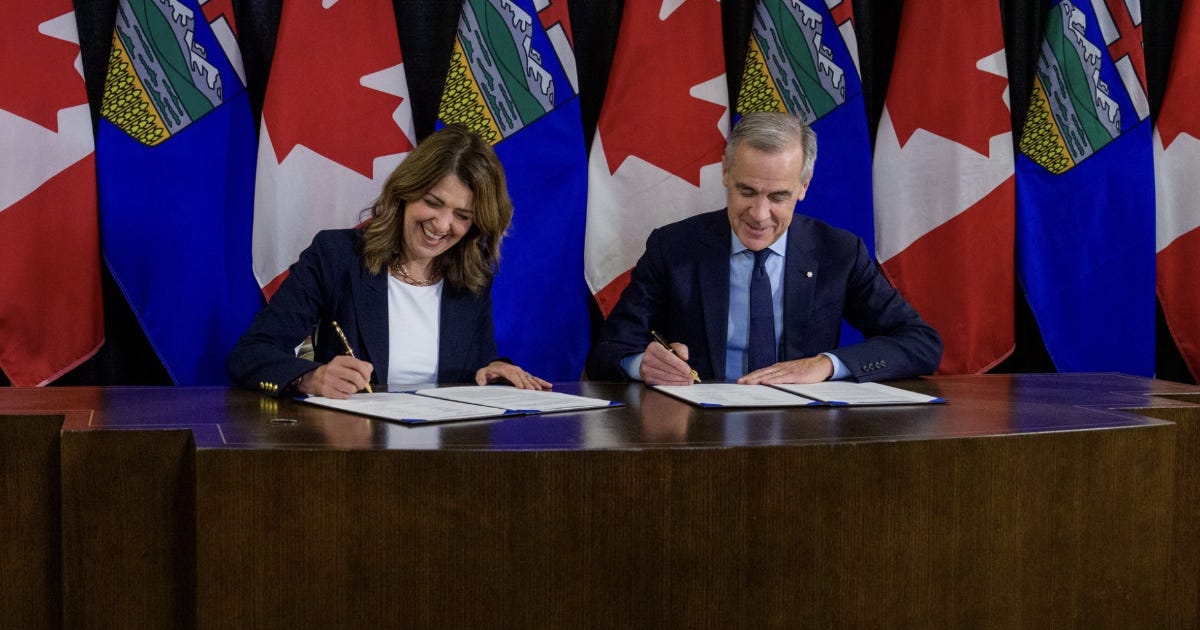
The Alberta legislature today unanimously endorsed the federal-provincial memorandum of understanding between Premier Danielle Smith and Prime Minister Mark Carney.
The Alberta legislature today unanimously endorsed the federal-provincial memorandum of understanding between Premier Danielle Smith and Prime Minister Mark Carney, while a similar federal opposition motion failed in the House of Commons.
Alberta lawmakers voted Tuesday to endorse the province’s new energy agreement with Ottawa, backing a motion that recognizes the memorandum of understanding (MOU) as a major step toward expanding Alberta’s resource sector and building a new West Coast pipeline.
Government Motion 16, introduced by Government House Leader Joseph Schow, states that the MOU signed between Alberta and the federal government is “a critical step towards building a stronger and more vibrant Alberta economy.”
The motion also urges Alberta, Ottawa, British Columbia and other involved parties to “take all necessary steps to ensure these commitments can be achieved as quickly as possible.”
Premier Danielle Smith told the Assembly the agreement marks a turning point after years of stalled projects and federal restrictions.
“After ten years of the members opposite and their constitutionally connected members in Ottawa waging an ideological war on Alberta’s economy and workers, there is a potential pathway to prosperity,” she said.
She argued the deal opens the door to expanding export capacity and constructing a new Indigenous-co-owned bitumen pipeline to the Pacific.
“This is a massive first step that will provide us with more export capacity and allow us to increase production,” she said. “Alberta’s proven oil and gas reserves represent trillions of dollars in value, which represents a generational opportunity to secure prosperity.”
Smith said the agreement ensures Indigenous communities will be central partners.
“Indigenous co-ownership of a pipeline to the northwest coast will also provide millions in revenue to communities along that route,” she said. “Indigenous communities will have opportunities to lead and benefit financially.”
She also defended the federal commitment to suspend the Clean Electricity Regulations and set aside the federal emissions cap, calling Alberta’s approach a model for balancing development and emissions reduction.
“The solution to reducing emissions is not to cap growth, it is to innovate. Full stop,” Smith said.
The premier said the agreement lays the groundwork for completing what she called the world’s largest carbon capture project.
“This agreement will see Alberta work together with our federal partners and the Pathways Group of companies to commence and complete the world’s largest carbon capture, utilization and storage infrastructure project,” she said.
Alberta NDP MLA Kathleen Ganley told the Legislature her caucus supports the MOU, calling it a promising opportunity — while warning that key details remain unresolved.
“This MOU is a hopeful sign, and Alberta’s New Democrats support it… but the devil is always in the details and some of them are lacking here,” she said.
Ganley compared the agreement to Rachel Notley’s 2016 climate and pipeline framework.
She raised concerns about long-term emissions planning and how treaty rights will be honoured.
However, despite some debate between Alberta UCP and Alberta NDP MLAs, the motion passed unanimously, with 63 voting in favour and zero against.
The motion signals formal legislative backing for the MOU and pressures British Columbia and the federal government to work with Alberta as negotiations continue on the pipeline and related regulatory reforms.
A similar vote occurred federally minutes after Alberta’s vote passed, as Conservative Leader Pierre Poilievre sponsored an Opposition motion supporting the MOU signed on Nov. 27.
The motion urges MPs to “support the construction of one or more pipelines enabling the export of at least one million barrels a day of low-emission Alberta bitumen from a strategic deep-water port on the British Columbia coast to reach Asian markets, including through an appropriate adjustment to the Oil Tanker Moratorium Act, while respecting the duty to consult Indigenous peoples.”
After the Liberals and other parties indicated their intention to vote against it, Poilievre amended the motion to include language from the MOU, making it more likely for the Liberals to support the measure.
The federal vote still failed, with Liberal, Bloc Québécois and NDP MPs voting against it.


