

Average wait times in Canada are nearly 29 weeks, tripling the average in 1993
Canadians are now waiting nearly 29 weeks for medically necessary treatment.
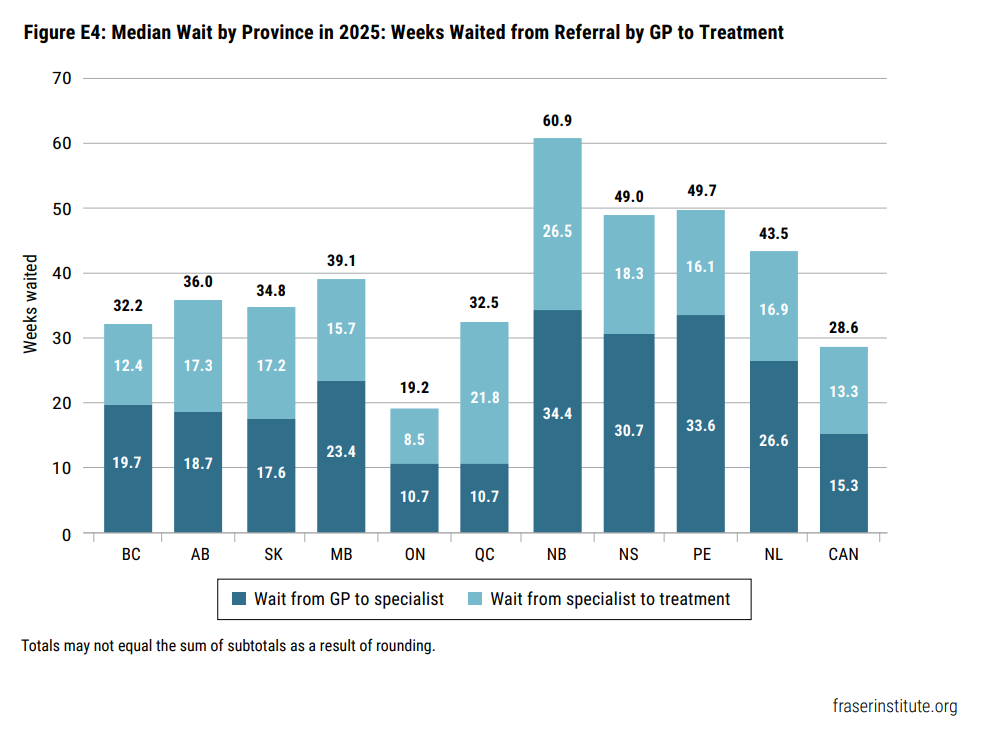
Canadians are now waiting nearly 29 weeks for medically necessary treatment. It’s a staggering wait time that far exceeds what doctors deem “clinically reasonable,” according to a new report from the Fraser Institute.
The study surveys physicians across Canada annually to determine the average time patients wait for healthcare. They found that the average wait time in 2025 was 208 per cent longer than the 9.3 week wait time Canadians waited on average in 1993. The average wait time across all provinces remained below the 30-week threshold reported last year.
“Remarkably long wait times for medically necessary care have become the defining characteristic of the Canadian health care experience,” Nadeem Esmail, the director of health policy studies at the Fraser Institute and co-author of the study, said in a press release.
When added together, physicians said an average wait time of 8.8 weeks was “clinically reasonable.”

Mackenzie Moir, a senior policy analyst with the Fraser Institute and co-author of the study said “Long wait times can result in increased suffering for patients, lost productivity at work, decreased quality of life, and in the worst cases, disability or death.”
A separate study released last month by SecondStreet found that over 23,500 patients have died on medical waitlists last year.
In the Fraser Institute study, Ontario reported the shortest wait times with 19.2 weeks, still over 10 weeks more than considered clinically reasonable by physicians. British Columbia and Quebec reported the next-shortest wait times, at 32.2 and 32.5 weeks, respectively.
Among 10 provinces, Atlantic Canada had the longest median wait time from general practitioner referral to treatment. The longest wait times were reported in New Brunswick, with Canadians waiting an average of 60.9 weeks for care. Prince Edward Island was next on the list, with Nova Scotia following, both of which reported wait times at or over 49 weeks.
Across 10 provinces, patients in Canada waited for 1.4 million procedures in 2025, according to the report.
Wait times increased in half of Canada’s provinces since last year: British Columbia, Manitoba, Quebec, Nova Scotia, and Newfoundland and Labrador. Times decreased in the other five provinces.
The report found that the median wait time in Canada from a family doctor referral to seeing a specialist rose to 15.3 weeks, up from 15 weeks last year. However, the wait time between specialist consultation and treatment decreased by 1.7 weeks, down from 15 weeks in 2024.
Compared to the 3.7-week average Canadians waited in 1993, the wait time from a family doctor referral to seeing a specialist rose by 313 per cent.
Wait times vary widely across specialities for treatment after a specialist referral. Patients waited the longest for neurosurgery and orthopedic surgery, at 49.9 and 48.6 weeks, respectively. Conversely, cancer patients waited the least time for care, with a national average wait time of 4.2 weeks for radiation oncology and 4.7 weeks for medical oncology.
The study measured only from the point of referral from a family doctor, but a recent poll found that long wait times and difficulties accessing timely care can be more profound for one in five Canadians without a general practitioner.
An Angus Reid poll last month found that lacking access to a family physician can make Canadians more than twice as likely to struggle booking appointments for early cancer screenings and non-emergency medical care.
Patients also endured delays for diagnostic technology, with a median of 18.1 weeks for MRI scans, 8.8 weeks for CT scans and 5.4 weeks for ultrasound scans.
The liberals/ndp, and kind, should take a bow, plans are working well, the destruction of good health care is part of the overall destruction of the country.
This is criminal, no matter how you want to spin it. period.