
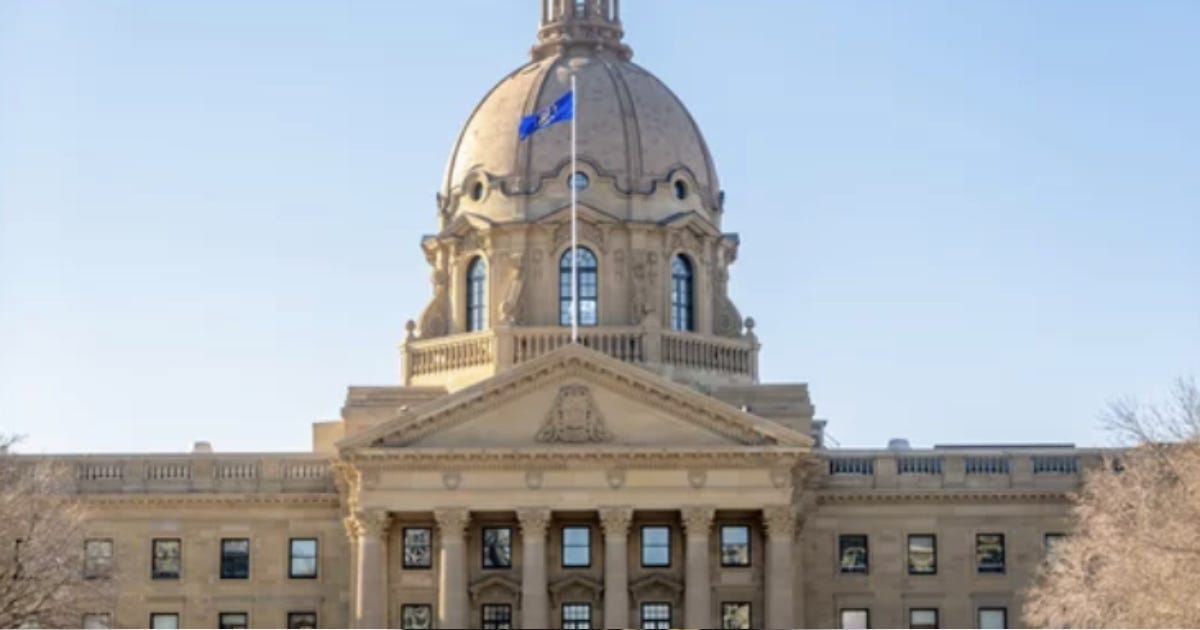
Alberta’s most significant bills of the 2025 session
The 2025 legislative session in Alberta was a watershed moment, as the provincial government pushed through major reforms to education, healthcare, how democracy works, and professional accountability
The 2025 legislative session in Alberta was a watershed moment, as the provincial government pushed through major reforms to education, healthcare, how democracy works, and professional accountability.
Several of the 14 government bills and four private members’ public bills immediately sparked political reaction, while others fulfilled long-standing UCP commitments to reform systems the party says have grown unresponsive to Albertans. Here are the most consequential bills passed this year and what they mean heading into 2026.
Bill 13: Regulated Professions Neutrality Act a.k.a. “Peterson Law”
The government introduced the “Peterson Law” to prevent regulatory bodies from disciplining professionals for lawful off-duty expression.
Alberta Premier Danielle Smith said regulators must “stay in the workplace” and stop policing personal beliefs. She referenced national cases, including Jordan Peterson’s dispute with the College of Psychologists of Ontario, as examples of political overreach.
“If there is a push or a drive from a regulator to impose upon its professionals some sort of political, cultural or social ideology, and it has nothing that relates to the professional competence or ethics of that individual professional, then it will not be permitted to happen in this province,” said Justice Minister Mickey Amery.
Bill 2: Back to School Act
The government used the notwithstanding clause to end a province-wide teachers’ strike and impose a four-year contract, including salary increases and class-size measures.
The Alberta Teachers’ Association called the move a “reckless abuse of power.” Constitutional experts, however, noted a challenge may face significant hurdles due to ongoing Supreme Court deliberations on the scope of Section 33 of the Canadian Charter of Rights and Freedoms, the notwithstanding clause.
At the same time, the government announced a Class Size and Complexity Task Force. Smith said teachers identified “classroom complexity and safety” as the most urgent issues, and the province was “taking real action to meet those needs.”
Bill 9: Protecting Alberta’s Children Statutes Amendment Act
Alberta’s government invoked the notwithstanding clause to ensure immediate enforcement of laws restricting puberty blockers, cross-sex hormones, and gender reassignment surgery for minors, while requiring parental consent for students under 16 to change their names or pronouns at school.
Bill 9, the Protecting Alberta’s Children Statutes Amendment Act, applied the notwithstanding clause of the Charter of Rights and Freedoms, the Alberta Bill of Rights, and the Alberta Human Rights Act to various pieces of legislation.
Premier Smith called the move “one of the most consequential actions our government will take during our time in office,” saying delays were unacceptable “when children are in harm’s way.”
“This government does not turn to the notwithstanding clause unless the stakes warrant it. And in this case, the stakes could not be higher,” she said.
Bill 14: Justice Statutes Amendment Act, 2025
The legislation overhauled Alberta’s rules for elections, referendums, and citizen-initiatives by removing constitutional pre-screening requirements and shifting approval authority from Elections Alberta to the Minister of Justice.
Separatist groups celebrated the bill as a breakthrough, with Alberta Prosperity Project CEO Mitch Sylvestre calling it “a massive win for Alberta’s future.”
“Bill 14 doesn’t just remove barriers; it hands us the keys to the referendum we deserve. We’re seizing this moment to build a prosperous, independent Alberta,” he said.
Amery said the goal was to create “a permissive environment” that removes barriers for Albertans who want to advance questions for a vote. He added that whether he likes the questions proposed or not is irrelevant.
The Alberta independence movement confirmed it will begin its petition drive in 2026.
Alberta Prosperity Project General Counsel Jeffrey Rath told True North the APP already has over 300,000 pledges to sign the petition, well over the 177,000 required signatures they will need to gather in 120 days.
Bill 11: Health Statutes Amendment Act, 2025
Alberta introduced dual practice, allowing surgeons to work in both the public and private systems to help reduce the province’s prolonged surgical delays.
The model restricts private surgeries to evenings, weekends, and rural or underused sites, and requires dual-practice surgeons to maintain a designated ratio of public procedures. The government says the approach mirrors successful universal systems abroad and complies with the Canada Health Act. The public health guarantee will remain, meaning no Albertan will be forced to pay out of pocket.
Alberta Premier Danielle Smith also unveiled her internal scorecard guiding the health-care overhaul in an exclusive interview with True North. She said her government will measure its health-care overhaul by whether every Albertan is attached to a family practitioner, if surgical waitlists are eliminated beyond medically recommended times, and if emergency rooms are redesigned to dramatically improve patient experience.
Together, these five bills outline the core priorities of the 2025 legislative session, reshaping Alberta’s approach to education, health care, democratic participation and professional oversight. Their full impact will continue to unfold in 2026 as new rules take effect, court challenges progress and the government moves into the next phase of its reform agenda.


